
For farmers, agricultural data is not just a collection of numbers.
A crop estimate can influence commodity prices, planting decisions, insurance, government support and how the market expects the next harvest to look. That is why the U.S. Department of Agriculture is now looking at a major upgrade to the way it collects and produces agricultural statistics.
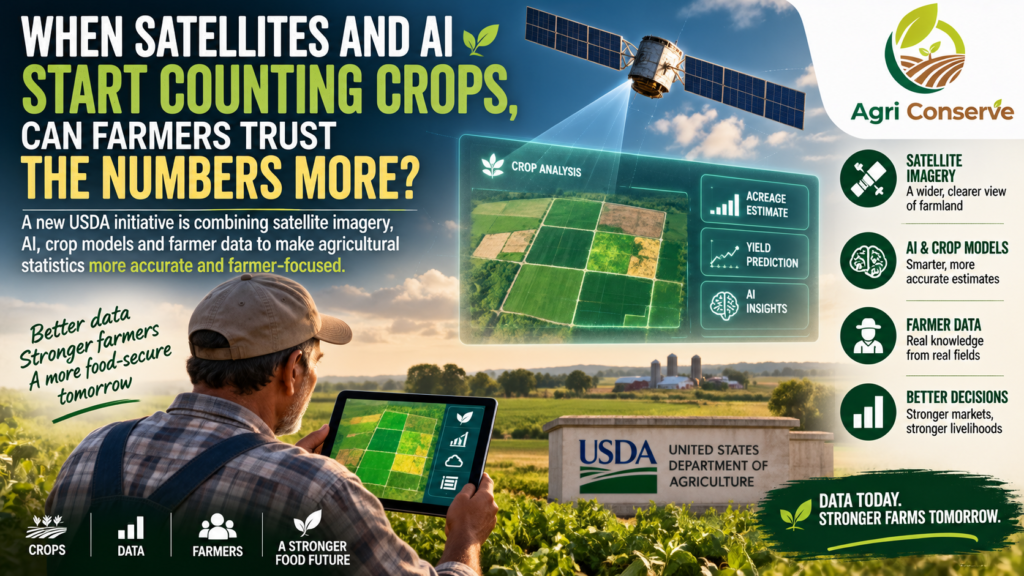
On September 1, USDA announced a new Data Modernization Plan at the Farm Progress Show in Iowa. One of its most interesting moves is a pilot that will combine satellite imagery, geospatial technology, crop models and farmer-reported information to improve estimates of crop acreage and yields.
From Farm Surveys to Satellites
USDA has relied on producer surveys and other data sources for decades. The new approach does not mean replacing farmers with technology.
Instead, USDA says it wants to combine producer knowledge with modern data tools.
The planned pilot will evaluate improved satellite imagery alongside geospatial tools and crop models. USDA is also exploring artificial intelligence and machine learning to improve how agricultural information is collected, connected and analyzed.
That could give agricultural agencies a much more detailed picture of what is happening across large farming regions without asking farmers to provide every piece of information manually.
Why Accuracy Matters on the Farm
A crop estimate may look like a simple statistic, but its impact can travel through the entire agricultural system.
If acreage or expected yields are significantly overestimated or underestimated, markets can react. Farmers, grain traders, agribusinesses, researchers and policymakers all use agricultural statistics to make decisions.
USDA has faced criticism over the reliability of some agricultural data, adding urgency to the modernization effort. Reuters reported that the new technology pilot comes after concerns from farmers and market participants about the accuracy of government estimates.
Better data therefore is not simply about better technology. It is about better decisions.
Technology Still Needs Farmers
There is an important point in USDA’s approach.
The agency is not proposing a completely automated system. Farmer-reported information will continue to play a role, while satellite and other technologies provide additional evidence.
USDA also plans to make reporting easier through better mobile access, greater use of existing administrative data and, where appropriate, prefilled information. The broader plan also calls for clearer communication about methodologies, response rates, data limitations and how producer information is used.
That last part may prove just as important as the AI itself.
The Bigger Lesson for Agriculture
Agriculture is becoming increasingly dependent on data, but data only creates value when people trust it.
Whether the information comes from a farmer, satellite, sensor, drone or AI model, its usefulness depends on accuracy, transparency and the ability to verify what is being reported.
USDA’s modernization plan is therefore an interesting signal for the wider agricultural sector. The future of farming may not simply be about collecting more data. It may be about building systems that connect different sources of information and turn them into evidence farmers can actually use.
The real test will come when these technologies move from pilot projects into everyday agricultural decision-making.
For modern agriculture, better data could become just as important as better seeds, better machinery and better farming practices.