
Good agricultural research can sit inside a university for years. The bigger challenge is getting that knowledge into a field where a farmer can actually use it.
A new partnership in the Philippines is trying to close that gap.
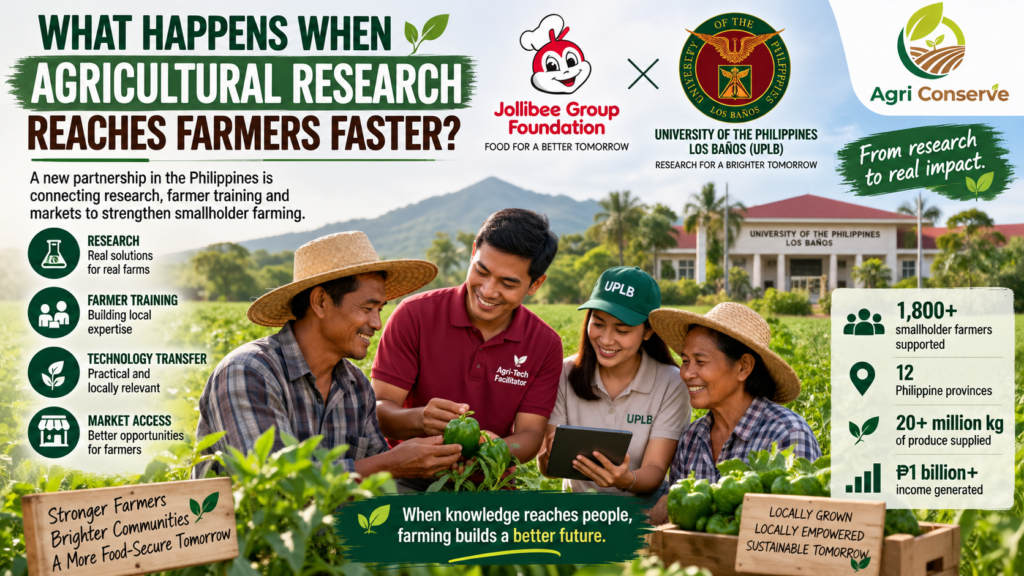
The Jollibee Group Foundation (JGF) and the University of the Philippines Los Baños (UPLB) have signed an agreement to combine agricultural research, farmer training, technology transfer and market-development experience to support smallholder farmers.
At the centre of the partnership is a group that could become particularly important: Agri-Tech Facilitators.
These are farmer leaders and community-based agricultural extension workers who help other farmers understand, test and adopt technologies and farming practices that make sense for their local conditions.
Turning Research Into Something Farmers Can Use
Agricultural research often produces valuable discoveries, but farmers don’t necessarily need another technical paper.
They need to know what works on their farm, with their crop, under their local conditions.
That’s where the facilitator model becomes interesting.
Under the partnership, UPLB will strengthen the technical training of JGF’s Agri-Tech Facilitators. These facilitators can then help translate agricultural research into practical guidance for farming communities.
The programme is also expected to explore new technologies and capacity-building initiatives for crops such as green bell pepper.
It creates a useful bridge:
Research → local experts → farmers → real-world testing
That final step matters. A technology may look promising in a laboratory or demonstration plot, but farmers ultimately need to see whether it works economically and practically in their own environment.
The Market Matters Too
The partnership isn’t focused only on production.
JGF’s Farmer Entrepreneurship Program works with farmer organisations to improve their technical, leadership and business capabilities while helping them collectively access institutional markets.
The programme has already supported more than 1,800 smallholder farmers across 12 Philippine provinces, with participating farmers collectively supplying more than 20 million kilograms of produce and generating over ₱1 billion in income, according to JGF.
That combination is important.
Better farming practices are valuable, but farmers also need a viable route to market. Otherwise, higher productivity does not necessarily translate into better livelihoods.
A Model Worth Watching
The interesting part of this partnership is not simply that a university and a large food company are working together.
It’s the structure.
Research provides knowledge. Farmers provide real-world experience. Community facilitators connect the two. Markets provide an economic reason to keep the system working.
That is a much more complete approach to agricultural innovation than simply introducing another piece of technology.
For agriculture to become more productive and sustainable, innovations have to travel the final mile—from the research institution to the people whose livelihoods depend on the land.
And sometimes, the person carrying that knowledge isn’t a scientist or a consultant.
It is another farmer.