
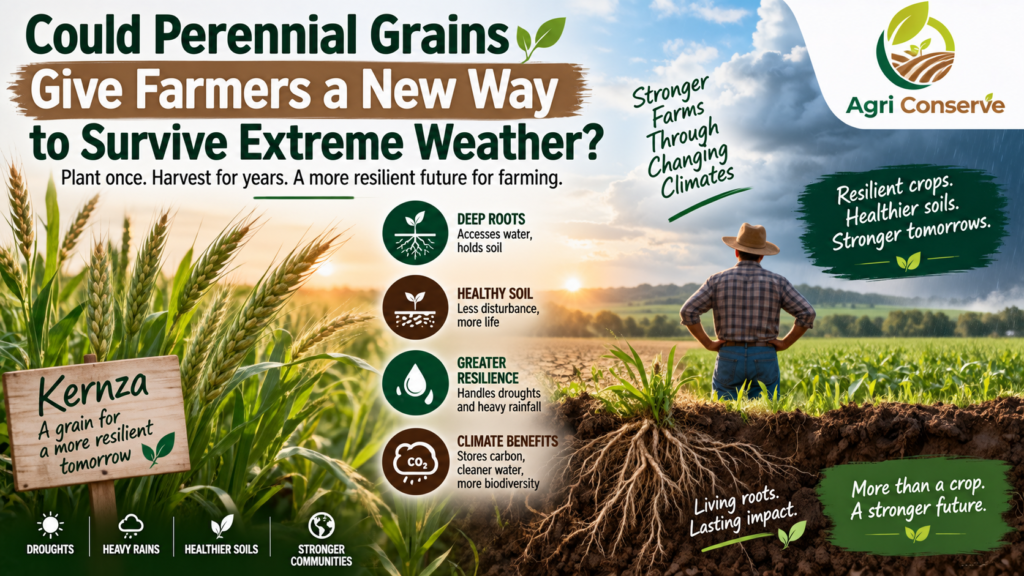

For generations, farming has followed a familiar cycle: plant, grow, harvest, clear the field and start again.
But what if some grain crops did not need to be replanted every year?
That idea is gaining attention as farmers face more frequent droughts, intense rainfall and growing pressure to protect both their soil and their incomes. A new Associated Press report published September 4 highlights farmers in Kansas experimenting with perennial grains, including Kernza, as one possible way to make farms more resilient.
A Grain That Keeps Growing
Unlike conventional wheat, which is planted again each season, perennial grains can remain established in the soil for several years.
One of the most advanced examples is Kernza, a perennial grain developed from intermediate wheatgrass. The Land Institute describes it as the world’s first commercially available perennial grain. Its deep root system remains alive year-round rather than being removed after harvest.
That changes the relationship between the crop and the soil.
Instead of disturbing the field every year, farmers can maintain living roots underground while still harvesting grain.
Why Deep Roots Matter
The roots are one of the biggest reasons researchers are interested in perennial agriculture.
Deep-rooted perennial crops can reach water farther below the surface, potentially helping them cope with periods of drought. Their permanent root systems can also help hold soil in place when heavy rainfall arrives.
The Land Institute reports that Kernza roots can reach around 10 feet deep and that the crop can provide benefits for soil health, water quality, biodiversity and carbon storage.
For farmers dealing with increasingly unpredictable weather, those characteristics could become valuable.
A Kansas farmer featured in the AP report is already looking at Kernza as a way to rebuild soil on fields affected by drainage problems while keeping those acres productive.
But This Is Not Yet a Replacement for Wheat
There is an important catch.
Perennial grains currently produce substantially less grain than conventional wheat in many situations. AP reported that Kernza yields can be around 20% to 40% of comparable wheat yields, while harvesting the smaller grain can also require different equipment and techniques.
The market is still developing too.
In the U.S., Kernza production remains tiny compared with conventional wheat. The AP reported about 3,511 acres of Kernza cultivation in 2025, compared with roughly 37.2 million acres of winter, spring and durum wheat planted or harvested during the 2025-26 period.
So this is not a story about farmers abandoning wheat tomorrow.
It is a story about researchers and early adopters asking whether agriculture can diversify its toolbox.
The Bigger Opportunity Is Below the Ground
Perhaps the most interesting part of perennial grains is not the grain itself.
It is the possibility of keeping living roots in agricultural landscapes for much longer.
The Land Institute is working with researchers around the world on perennial versions of wheat, rice, sorghum and other crops. Its research portfolio also includes recent work on the genetics, yield and root development of perennial grains.
If researchers can close the yield gap while making harvesting and markets more practical, perennial crops could eventually become one part of a broader strategy for protecting agricultural land.
The future of farming may not be about choosing between productivity and soil health. It may be about developing crops that can contribute to both.
For now, perennial grains remain an emerging technology rather than a mainstream solution. But as extreme weather keeps testing conventional farming systems, the idea of planting once and harvesting for several years is becoming increasingly difficult to ignore.