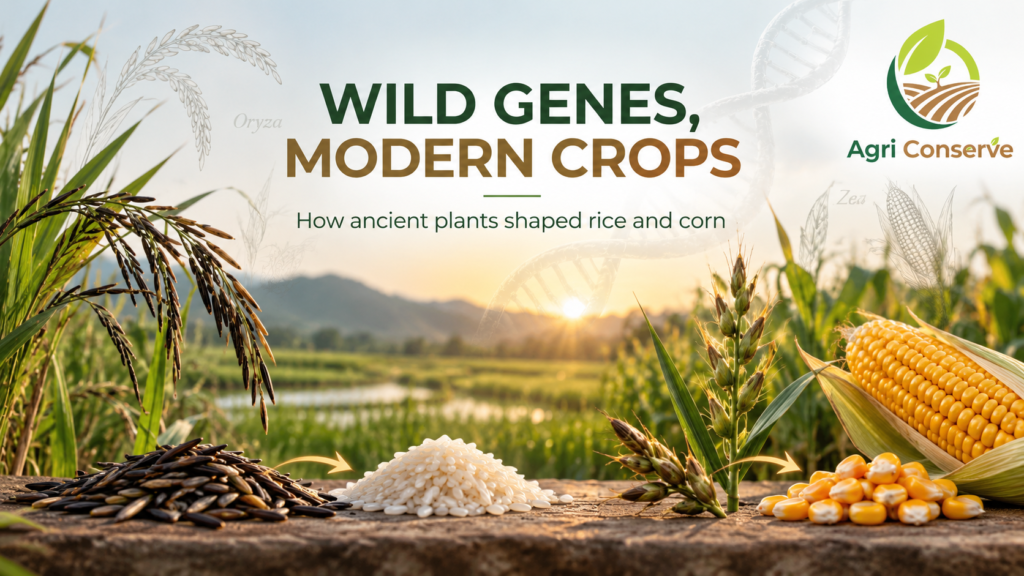

What if some of the genetic traits that make modern crops so useful existed thousands of years before humans started farming?
New research into the origins of rice, corn and other crops suggests exactly that. Scientists have found evidence that early farmers often selected useful genetic variations that were already present in wild plants, rather than waiting for entirely new mutations to appear.
The findings offer a fresh perspective on how agriculture began and why the wild relatives of today’s crops remain valuable to modern plant breeders.
The Ancient Farmers Who Changed Rice Forever
More than 8,000 years ago, communities in China’s Lower Yangtze Valley began cultivating a wild rice species called Oryza rufipogon.
Unlike the rice we grow today, wild rice naturally releases its mature grains onto the ground. This helps the plant reproduce, but makes harvesting difficult.
Some wild rice plants, however, carried genetic variations that reduced this natural seed-shedding behaviour.
Early farmers gradually selected and cultivated these plants because they were easier to harvest. Over many generations, the useful characteristics became more common, helping transform wild rice into domesticated varieties.
For years, scientists have investigated whether such traits arose only after people began cultivation or whether they had existed in wild populations much earlier.
Recent genetic research is revealing that the second explanation played an important role.
A Corn Mutation That Predates Farming
One particularly striking discovery concerns maize, commonly known as corn.
Modern corn has exposed kernels, while its wild ancestor, teosinte, produces grains enclosed in hard protective structures.
Researchers studying a gene called tga1 found that a mutation associated with exposed kernels existed more than 40,000 years ago.
That is remarkable because humans began domesticating maize only around 9,000 years ago.
In other words, the genetic variation was already present long before farmers started turning the wild plant into a crop.
Early agricultural communities did not necessarily create the variation. Through cultivation and selection, they helped make it widespread.
Rice Took Thousands of Years to Change
Genetic analysis of domesticated japonica rice tells a similar story.
Researchers examined more than 70 important genetic variations connected to domestication and adaptation.
They found evidence that a mutation in the qSH3 gene, associated with reduced seed shedding, existed in wild ancestral rice and became increasingly common over a period exceeding 2,000 years.
This supports the idea that crop domestication was not one sudden breakthrough.
It was a gradual process in which generations of farmers selected plants with useful characteristics.
The transformation of wild grasses into productive food crops took time, observation and repeated cultivation.
Why This Discovery Matters for Modern Farming
The research is more than a lesson in agricultural history.
It reminds plant breeders that wild crop relatives can contain valuable genetic diversity that commercial varieties may have lost during centuries of selection.
Some of those characteristics could help scientists develop crops better adapted to challenging environments.
Wild relatives may contain useful variations associated with temperature tolerance, disease resistance, flowering time and other important agricultural traits.
Understanding how ancient farmers selected these characteristics could help researchers identify promising genetic material for future breeding programmes.
However, finding a useful variation does not automatically produce an improved commercial variety. Scientists still need to test its performance, understand possible trade-offs and ensure that it works reliably under agricultural conditions.
The Future of Farming May Depend on Its Wild Past
Modern agriculture often looks toward advanced biotechnology and genetic engineering for the next generation of improved crops.
But this research offers an interesting reminder.
Nature has already spent thousands of years generating genetic diversity, and farmers have spent thousands more selecting from it.
Protecting wild crop relatives and preserving their genetic resources could therefore become an important part of future agricultural innovation.
The next valuable crop trait might not need to be invented in a laboratory.
It may already exist in a wild plant, waiting for scientists to discover what ancient farmers somehow recognised thousands of years ago.
SEO Title: Ancient Wild Plant Genes Reveal How Modern Rice and Corn Evolved
Meta Description: New genetic research reveals that important traits in rice and corn existed in wild plants thousands of years before domestication, offering new insights for crop breeding.
Category: Crop Science & Agricultural Research
SEO Tags: Crop genetics, rice domestication, maize breeding, wild crop relatives, agricultural biodiversity, plant breeding, genetic diversity, sustainable agriculture