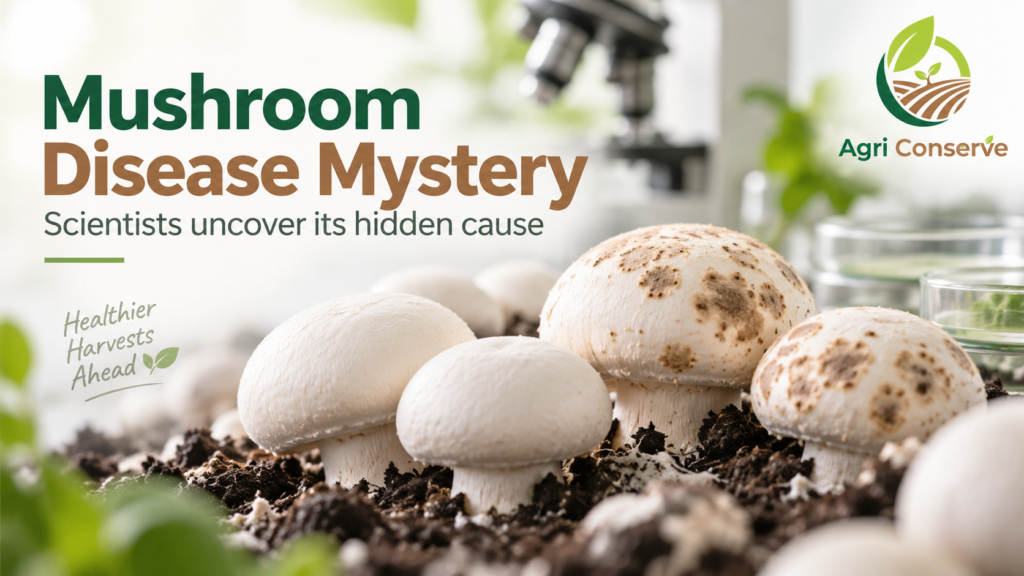

For more than a century, mushroom growers have battled a stubborn disease that damages their harvests, reduces product quality and causes financial losses.
Now, scientists at the University of Florida have discovered why controlling it has been so difficult.
The disease, known as bacterial blotch, was long associated with a small group of bacterial pathogens. However, new research has revealed that more than 17 bacterial species can contribute to the problem, making it far more complicated than previously understood.
The discovery could change how mushroom farmers detect and manage one of their industry’s most persistent diseases.
The Disease That Follows Mushrooms to Market
White button mushrooms are among the most widely cultivated mushrooms in the world. Their delicate texture and appearance also make them vulnerable to quality problems.
Bacterial blotch causes brown or yellow discoloration on mushroom surfaces, reducing their market value and sometimes making them unsuitable for sale.
What makes the disease particularly frustrating is that symptoms do not always appear immediately.
A mushroom may look healthy when it leaves the farm, only to develop visible marks during transportation, storage or retail display.
For growers, this creates uncertainty even after harvesting and packaging the crop.
Scientists Found More Than They Expected
Researchers from the University of Florida’s Institute of Food and Agricultural Sciences collected affected mushrooms from commercial growing facilities in the southern United States.
Using DNA sequencing and laboratory analysis, they investigated the bacteria associated with infected mushrooms.
The results surprised them.
Instead of identifying just the familiar disease-causing organisms, the researchers discovered a much broader community involving more than 17 potentially harmful bacterial species.
They also identified bacteria that had not previously been connected with this mushroom disease.
This could explain why some existing treatments have produced inconsistent results.
A treatment designed to control one bacterial species may not work equally well against the others.
Could Natural Treatments Offer a Solution?
The discovery is encouraging researchers to rethink mushroom disease management.
Scientists are now exploring plant-based essential oils, beneficial microorganisms and other biological products as potential ways to control bacterial blotch.
Some plant compounds have antimicrobial properties, while beneficial microbes may help suppress harmful bacteria.
These approaches could eventually give growers more sustainable options for protecting their crops.
However, researchers still need to determine whether these treatments work reliably under commercial mushroom-growing conditions.
The discovery improves scientists’ understanding of the disease, but it does not yet provide farmers with a proven new treatment.
Why This Matters for Mushroom Farmers
Mushroom cultivation depends heavily on controlled growing conditions. Temperature, moisture, hygiene and microbial activity can all affect production.
The new findings suggest that effective disease management may require a broader understanding of the microorganisms living within these environments.
Rather than focusing on one pathogen, growers may eventually benefit from diagnostic systems capable of identifying several disease-causing bacteria.
Such systems could support earlier intervention, reduce unnecessary treatments and help farmers protect the quality of their harvests.
The research also highlights the importance of understanding microbial communities in agricultural production.
A Century-Old Problem, a New Direction
The University of Florida discovery shows that some agricultural problems remain unresolved because their underlying causes are more complicated than scientists originally believed.
For mushroom farmers, the findings offer hope that more accurate diagnosis and targeted biological treatments could improve crop protection in the future.
The next challenge is turning this knowledge into affordable, practical solutions for commercial growers.
After more than 100 years of fighting bacterial blotch, scientists may finally have a clearer picture of what mushroom farmers are up against.