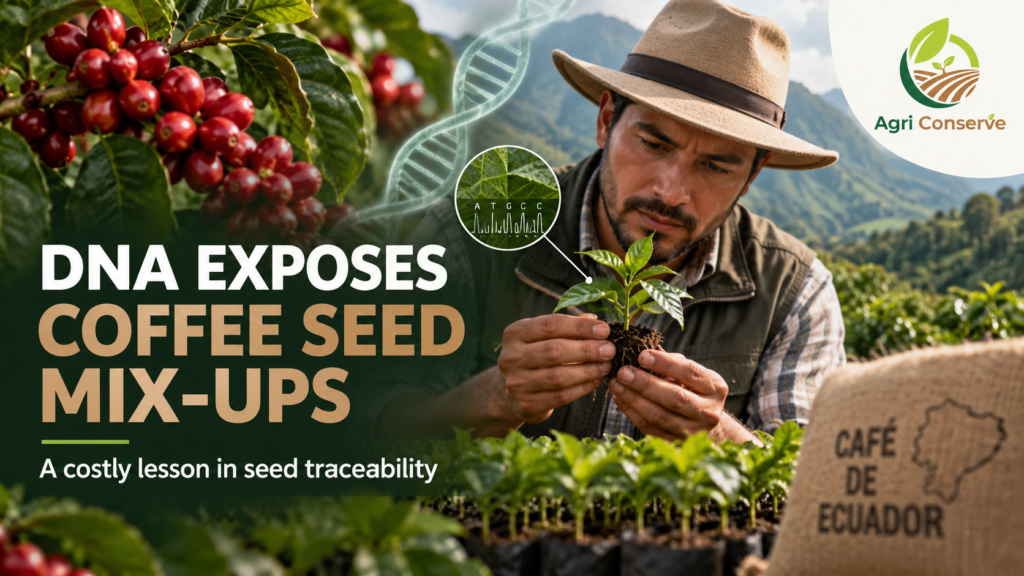

Imagine paying a premium for a particular coffee variety, spending three years growing it, and then discovering that the plants may not be what you bought.
That is exactly the problem researchers uncovered on a specialty coffee farm in southern Ecuador.
A study highlighted on October 9, 2026, by researchers at Universidad Técnica Particular de Loja found that some coffee plants grown from seeds marketed as premium Sidra and Gesha varieties did not match their declared commercial identities.
The discovery raises an important question for coffee growers everywhere: How can farmers be sure that the seeds they purchase are genuine?
Three Years Before the Mystery Was Uncovered
The story began at a coffee farm in Loja, Ecuador, where growers purchased seeds labelled as Sidra and Gesha, two names associated with high-value specialty coffee.
The seeds were expensive. According to the research, Sidra seeds cost approximately $100 per kilogram, while Gesha seeds cost around $500 per kilogram.
The planting material came without genetic or phytosanitary certification.
For approximately three years, the farmers cultivated the plants, investing time, labour and resources. Eventually, differences in the plants’ appearance raised questions about their identity.
Researchers decided to investigate using DNA analysis and physical characteristics such as leaf shape, plant architecture and branch development.
The results revealed something unexpected.
The DNA Told a Different Story
Scientists examined four distinct plant types, known as morphotypes, that emerged from the purchased seeds.
Only two matched their expected commercial identities.
One plant type sold as Sidra had a genetic profile compatible with Batian, a coffee variety developed in Kenya. Meanwhile, plants sold as Gesha belonged to an Ethiopian genetic group but did not exactly match the reference Geisha variety used for comparison.
These findings do not establish that sellers deliberately mislabelled the seeds. They do, however, expose a serious weakness in how specialty coffee planting material is identified and traded.
For farmers, that uncertainty can become expensive.
Why Coffee Variety Matters So Much
Coffee varieties differ in productivity, disease resistance, growing requirements and potential cup quality.
A farmer selecting a particular variety may be planning for a specific climate, production system or premium market.
When the planting material does not match expectations, those decisions become much harder to manage.
Unlike an annual crop that farmers can replace the following season, coffee is a perennial crop. Growers may wait several years before their investment reaches meaningful production.
Discovering a varietal mismatch after three years can therefore affect long-term farm planning and potential earnings.
The Ecuador study highlights a problem that could extend beyond coffee. Farmers growing fruit trees and other long-lived crops also depend heavily on the authenticity of the planting material they buy.
Could DNA Testing Protect Farmers?
One promising finding from the study involves combining genetic testing with ordinary plant observations.
Researchers used DNA markers to examine varietal identity and compared those results with visible plant characteristics.
They found that internode length, the distance between points where leaves or branches emerge, was particularly useful for distinguishing the coffee plants they studied.
This suggests that farmers and nurseries might eventually use simpler visual screening methods to identify suspicious planting material.
However, DNA testing remains important when precise identification is necessary, especially for expensive varieties.
The researchers believe that developing accessible identification tools and stronger seed-certification systems could help protect growers from similar problems.
A Bigger Lesson About Agricultural Trust
The findings come from one farm and a limited sample, so they cannot tell us how widespread coffee seed misidentification is across Ecuador or the global coffee industry.
Still, the case raises an issue that deserves attention.
Farmers increasingly depend on reliable information about the varieties they purchase. Yet certification and traceability systems do not always provide the same level of assurance across different agricultural markets.
Better nursery records, verified planting material and accessible genetic testing could help close that gap.
For premium coffee producers, authenticity should begin long before the first beans reach a buyer.
It should begin with the seed.
The Ecuador research reminds us that agricultural traceability is not only about knowing where food comes from. It is also about knowing exactly what farmers planted in the first place.
SEO Title: DNA Reveals Premium Coffee Seed Mix-Ups After Three Years of Farming
Meta Description: Researchers in Ecuador discovered that some premium coffee plants did not match their labelled varieties, raising concerns about seed authenticity and traceability.
Category: Crop Science & Seed Traceability
SEO Tags: Coffee farming, coffee seed authenticity, agricultural genetics, seed certification, specialty coffee, crop traceability, Ecuador agriculture, DNA testing, farmer protection