
What does military clothing have to do with growing strawberries?
Quite a lot, according to researchers at North Carolina State University.
A fabric originally developed through research into protective military clothing has found an unexpected application in agriculture. Scientists have adapted the material into a protective cover for strawberry plants, and the early results are remarkable.
In field trials, strawberry plants protected by the fabric produced 3.56 times as many harvestable fruits as uncovered plants. The technology, known as Plant Armor, could offer growers a new way to protect crops from insects while maintaining the conditions plants need to grow.
A Fabric That Protects Plants Without Blocking Nature
Farmers have used crop covers for years to protect plants from insects, frost and unfavorable weather. The challenge is finding a material that provides protection without interfering with sunlight, airflow or plant development.
Plant Armor takes a different approach.
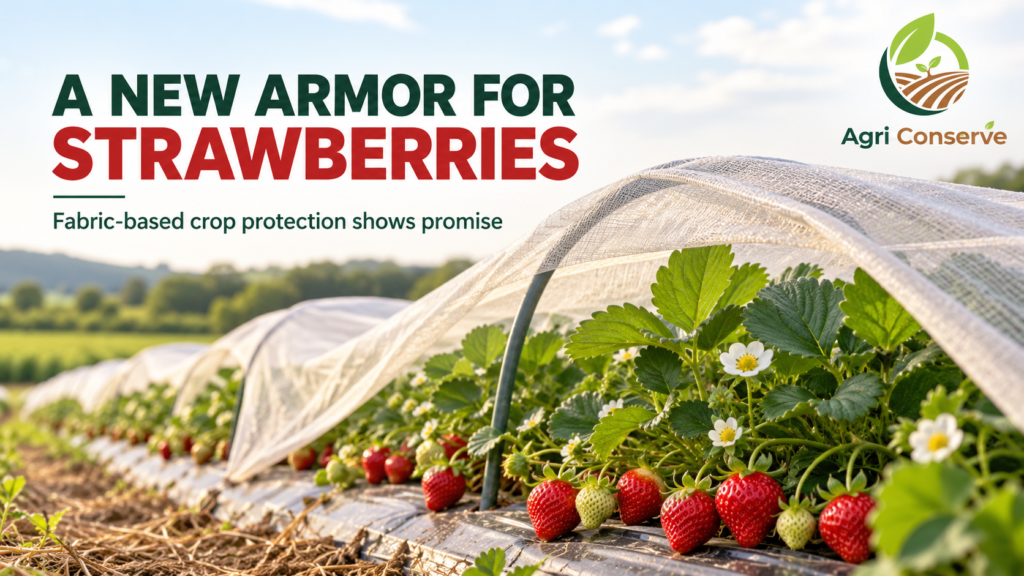
Researchers designed a three-dimensional knitted fabric that creates a physical barrier between insects and crops. Its layered structure makes it difficult for pests to reach the plants, while still allowing sunlight, rain and air to pass through.
The idea builds on textile engineering research originally intended to improve military clothing and protect people from insect bites.
By adapting the same principles to agriculture, scientists have developed a protective material that could potentially reduce the need for chemical insecticides.
The Strawberry Trials Surprised Researchers
The research team tested the second-generation Plant Armor fabric on strawberry plants grown in tunnels.
Initially, scientists were concerned that the fabric might reduce the amount of sunlight reaching the plants. That could have encouraged leafy growth at the expense of fruit production.
Instead, the results showed a substantial improvement in strawberry production.
Covered plants produced approximately 3.56 times as many harvestable fruits as uncovered plants. The total weight of harvested fruit was also higher, at around 1.84 times that of the uncovered plants.
The fabric did not significantly change relative humidity or reduce the plants’ access to sunlight. Researchers also observed warmer growing conditions beneath the protective cover, which may have contributed to improved fruit development.
These findings suggest that carefully engineered materials could help farmers create more favorable growing conditions without relying entirely on conventional chemical crop protection.
Could This Reduce Pesticide Use?
One of the most promising aspects of Plant Armor is its ability to physically prevent insects from reaching crops.
In conventional farming, growers often use insecticides to control pests that damage leaves, flowers and developing fruit. A well-designed physical barrier could reduce some of that pressure.
However, the researchers have not yet established how much pesticide or water farmers could save under commercial growing conditions.
Questions also remain about the cost of the material, its durability, practical installation and how it would perform across different climates and crops.
Those factors will determine whether Plant Armor becomes a practical option for commercial farmers.
A Different Direction for Agricultural Innovation
The research highlights something interesting about the future of farming.
Not every agricultural breakthrough needs to come from a new seed variety, a fertilizer formulation or an automated machine.
Sometimes, progress comes from applying knowledge developed in a completely different industry.
Textile engineering has already changed how people protect themselves from harsh environments. Now, researchers are investigating whether similar technologies can help plants thrive.
If further trials confirm the early results, protective fabrics like Plant Armor could become useful additions to integrated pest management and protected cultivation systems.
The technology is still developing, but its potential is worth watching.
A material once designed to protect people may eventually help farmers protect crops, improve harvests and grow food more efficiently.