
For years, farmers have been asked to change the way they grow rice to save water, protect soil and reduce emissions. Now, a new development in Punjab and Haryana is putting a financial value on those changes.
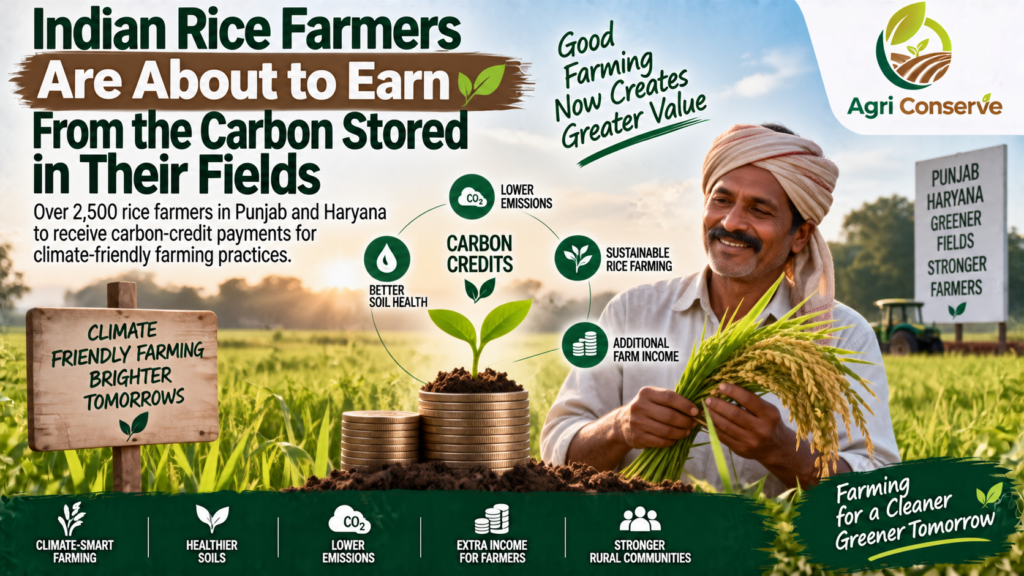
More than 2,500 smallholder rice farmers are set to receive carbon-credit payments for adopting climate-friendly farming practices. The initiative is being implemented by Grow Indigo and covers farming practices used between 2019 and 2022.
From farming practice to climate value
The farmers involved have used practices such as direct-seeded rice and reduced tillage. These approaches can reduce greenhouse-gas emissions, lower soil disturbance and improve soil-carbon storage compared with conventional practices.
The important change is that these environmental benefits are being measured and converted into verified carbon credits. The project operates under Verra’s VM0042 methodology for improved agricultural land management, which uses monitoring and verification to quantify climate outcomes.
The first issuance from the project covered about 30,000 acres in Punjab and Haryana and generated more than 50,000 carbon credits.
Farmers are becoming part of the carbon market
The model is significant because the carbon market is not being positioned only as a corporate climate tool. Farmers are being included as participants who can earn additional income by changing agricultural practices.
Grow Indigo says 75% of carbon-credit proceeds from its programme flow back to farmers. The company expects the programme to expand substantially, with a long-term target of involving more farmers and generating larger volumes of agricultural carbon credits.
That creates an interesting connection between sustainability and farm economics. A practice such as direct seeding can have value beyond the crop itself if its environmental impact can be properly measured and verified.
Verification will matter as much as the farming
Carbon farming also brings an important challenge: credibility.
A carbon credit is only useful if buyers can trust that the claimed emission reduction or carbon removal actually happened. Grow Indigo describes its programme as using soil sampling, modelling and third-party verification, while the Verra methodology sets requirements around issues such as additionality, permanence and measurement.
This is where reliable farm records, monitoring and traceability become increasingly important. As agricultural carbon markets grow, the ability to connect a specific farming practice with a measurable environmental outcome could become just as important as producing the crop itself.
A possible new revenue stream for sustainable farming
For Indian agriculture, the development points toward a larger question: can climate-friendly farming become financially attractive without placing the entire cost of transition on farmers?
If carbon markets can provide credible payments while farmers continue producing food, they could become another tool for encouraging better soil management, water efficiency and lower-emission agriculture.
The opportunity is promising, but its long-term success will depend on transparent measurement, credible verification and ensuring that farmers receive a meaningful share of the value created on their land.
The future of sustainable agriculture may not only be about growing more with less. It could also be about making the environmental value of good farming visible, measurable and worth paying for.