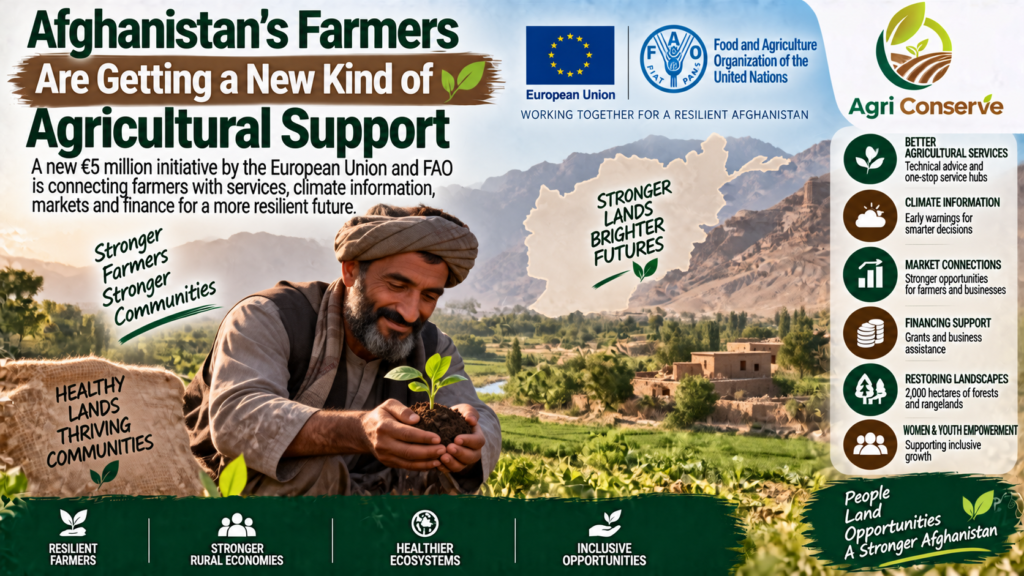

For farmers working in one of the world’s most climate-vulnerable agricultural environments, producing a crop is only half the challenge. Getting reliable advice, finding buyers, protecting natural resources and earning a stable income can be just as difficult.
A new €5 million initiative from the European Union and the Food and Agriculture Organization of the United Nations is trying to address those problems together.
Launched in Afghanistan on September 14, the programme will connect farmers and agribusinesses with agricultural services, climate information, markets and financing while also investing in degraded landscapes.
Moving beyond emergency support
The programme represents an interesting shift in how agricultural resilience is being approached in Afghanistan.
Instead of focusing only on immediate humanitarian assistance, the initiative aims to strengthen the agricultural economy itself. Farmers and rural entrepreneurs will receive access to technical advice, specialised services and market connections through four one-stop service hubs.
These hubs will also provide climate analysis and early-warning information, allowing farmers to make better decisions about planting, production and marketing as conditions change.
That connection between farm knowledge, climate information and markets could prove particularly important in a country where weather shocks can quickly affect rural incomes.
The programme is also investing in the land
The initiative goes beyond crop production.
The EU and FAO plan to restore 2,000 hectares of degraded forests and rangelands while supporting 250 women- and community-led nurseries.
That matters because agricultural resilience depends on more than what happens inside cultivated fields. Healthy rangelands, forests and surrounding ecosystems can help protect natural resources while creating additional livelihood opportunities for rural communities.
The programme will also provide matching grants and technical and business support to established agrifood and environmentally sustainable enterprises with potential to expand.
These businesses will be expected to contribute their own resources, creating a model that can help companies expand processing, purchase more products from local farmers and generate rural employment.
Women and young people are part of the strategy
The initiative specifically targets vulnerable households, including returnees, internally displaced people and host communities.
Women and young people are also a particular focus.
The support for women- and community-led nurseries is especially notable because it links environmental restoration with income generation. Instead of treating land restoration as a separate environmental activity, the programme is attempting to make it part of the rural economy.
Why this matters beyond Afghanistan
The bigger lesson is relevant to agricultural systems far beyond Afghanistan.
Climate resilience cannot come from technology alone. A farmer may have access to better seeds or climate information, but those tools have limited value if there is no extension support, financing, processing capacity or reliable market at the end of the production chain.
The new EU-FAO programme is trying to connect these pieces.
Better information can improve farm decisions. Better services can improve production. Better market connections can improve incomes. And better land management can strengthen the resource base that agriculture depends on.
For countries facing increasing climate and economic pressure, that integrated approach could become an important model for building agricultural resilience from the farm level upward.