
For millions of farmers, water is not just another farm input. It can determine whether a crop survives.
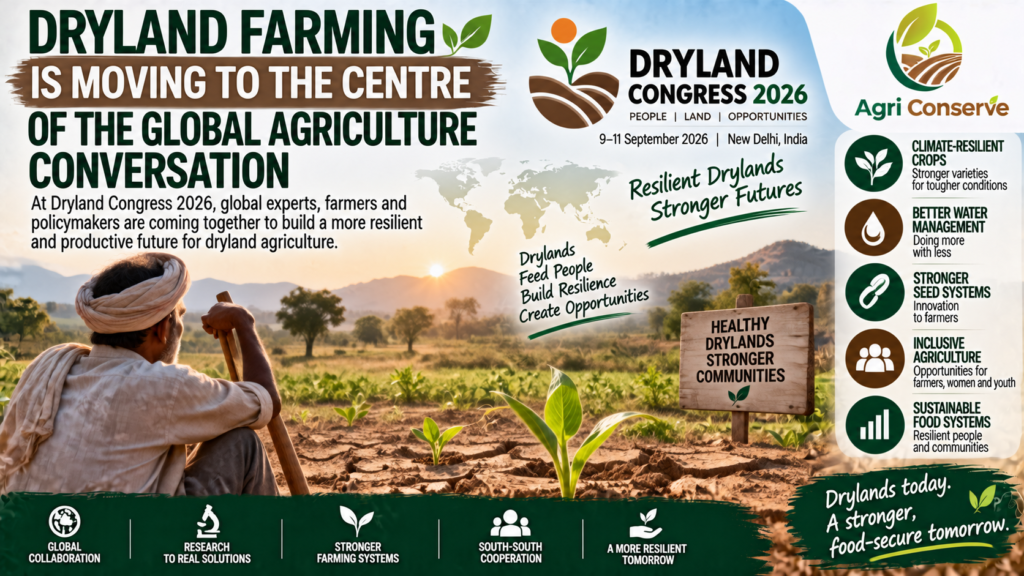
That reality is taking centre stage in New Delhi today as the Dryland Congress 2026 enters its final day. Jointly organised by the International Crops Research Institute for the Semi-Arid Tropics (ICRISAT) and the Indian Council of Agricultural Research (ICAR), the three-day gathering is bringing scientists, policymakers, farmers, development organisations and businesses together to look at how dryland agriculture can become more resilient and productive.
Why drylands matter so much
Drylands cover roughly 45–47% of the world’s land surface and support more than two billion people. Many of these communities depend heavily on agriculture while dealing with recurring drought, water scarcity, soil degradation and increasingly unpredictable climate conditions.
That makes dryland agriculture one of the biggest tests facing food systems.
The challenge is not simply producing more crops. Farmers need varieties that can handle difficult conditions, farming systems that use scarce water more efficiently and markets that make resilient production economically worthwhile.
Science has to reach the farm
The Congress is putting strong emphasis on connecting agricultural research with practical solutions.
Its discussions cover crop breeding, climate-resilient landscapes, nutrition, markets, farming systems, seed systems and the participation of women and young people. The programme also includes technologies such as genomic prediction, speed breeding, gene editing and improved seed delivery systems.
This connection between research and farmers is crucial.
A drought-tolerant crop variety has limited value if farmers cannot access affordable seed. A new water-saving technology will not transform agriculture if it is too expensive or difficult to operate. And scientific knowledge cannot create lasting impact unless extension systems and local institutions can help farmers use it.
South-South cooperation could speed things up
One of the most interesting themes of the Congress is South-South cooperation.
Instead of relying only on solutions developed in wealthier agricultural markets, countries across Africa, Asia, Latin America and other parts of the Global South can share technologies and farming approaches developed under similar conditions.
India is increasingly being positioned as a source of agricultural innovations that could be adapted elsewhere, particularly for dryland environments. ICRISAT’s Centre of Excellence for South-South Cooperation in Agriculture is designed to help countries exchange knowledge, transfer technologies and build longer-term institutional partnerships.
That could be particularly valuable for smallholder farmers facing similar challenges across different continents.
Water, seeds and markets have to work together
The Congress also highlights an important reality: there is no single solution to dryland agriculture.
Better genetics can improve crop resilience, but farmers still need efficient water management. Better farming practices can protect soil, but farmers also need reliable markets. Improved seeds can raise productivity, but strong seed delivery systems are necessary to get them into farmers’ hands.
This is why the Congress is taking a whole-system approach, bringing crop science, farming systems, markets, nutrition, policy and livelihoods into the same conversation.
The bigger opportunity
Dryland farming is often discussed as a problem that needs to be managed.
The message emerging from New Delhi is different: with the right science, policy and market support, drylands can become productive and resilient agricultural regions.
That shift in thinking matters.
As climate risks increase, the innovations developed for dryland farmers could become useful far beyond traditionally dry regions. Water-efficient crops, stronger seed systems, climate-smart farming and better resource management may increasingly become part of mainstream agriculture.
The real measure of success, however, will come after the conference ends. If research partnerships lead to technologies that farmers can afford, access and actually use, dryland agriculture could move from being one of agriculture’s biggest vulnerabilities to one of its most important innovation frontiers.