
Fertilizer has helped agriculture produce more food, but there is a problem hiding in plain sight.
A large share of the nitrogen farmers apply to fields never reaches the crop.
It can escape into the atmosphere, move into waterways or remain unavailable to plants. That means farmers can spend money on nutrients without getting the full benefit, while the environment carries part of the cost.
A new global analysis of maize farming suggests that the answer may not be simply using less fertilizer. It may be using nitrogen much more intelligently.
Researchers from Punjab Agricultural University and ICAR institutions analysed 97 research papers covering 156 field experiments conducted between 2000 and 2025. Their findings point toward a shift from maximizing fertilizer application to improving how precisely crops receive nitrogen.
The biggest gains came from putting fertilizer in the right place
One of the strongest results involved deep fertilizer placement.
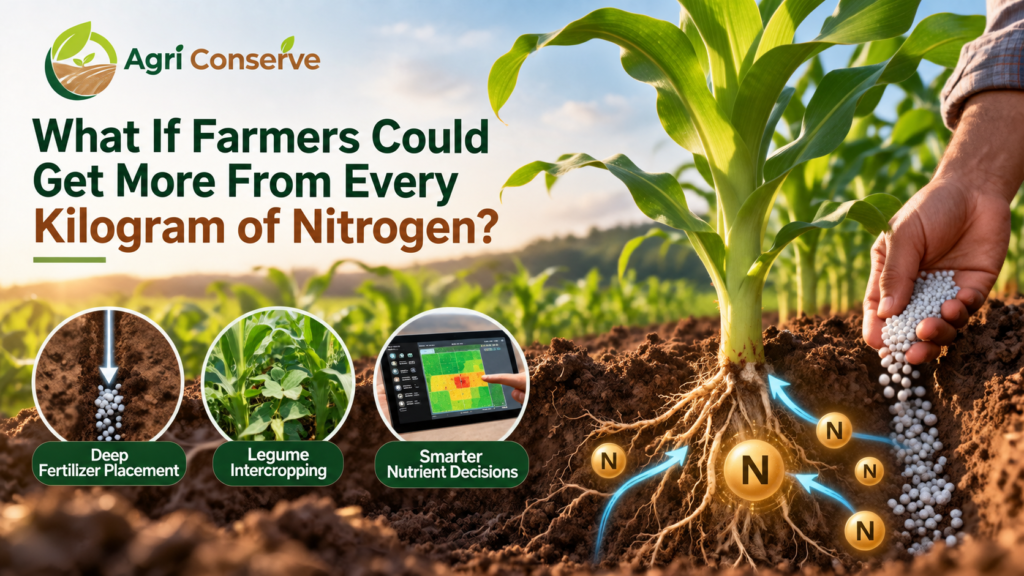
Instead of leaving fertilizer close to the soil surface, deep placement puts nitrogen closer to the crop’s active root zone. In the global analysis, this approach produced the largest improvement among the practices examined, increasing agronomic nitrogen-use efficiency by about 72% and nitrogen recovery efficiency by about 40% compared with conventional farmer practices.
The reason is fairly straightforward.
When nitrogen sits closer to where roots can access it, less can be lost from the soil surface through processes such as volatilization and runoff. The crop has a better chance of capturing the nutrient when it needs it.
That changes the question from “How much fertilizer should we apply?” to “How can we make the fertilizer we already apply work harder?”
Legumes bring another piece of the puzzle
The study also found strong results from growing maize alongside legumes.
Legume intercropping increased agronomic nitrogen-use efficiency by about 58% and produced the largest improvement in partial factor productivity among the practices studied.
Legumes can work with nitrogen-fixing microorganisms to obtain nitrogen from the atmosphere. That does not eliminate the need for fertilizer in every farming system, but it can contribute additional nitrogen to the production system and change how nutrients move through the soil.
This makes crop diversification interesting from a sustainability perspective.
A field does not necessarily have to rely on a single crop and a single external input strategy. Different plants can contribute different functions.
More fertilizer did not mean better results
Perhaps the most important finding is also the simplest.
Applying nitrogen above recommended rates actually reduced nitrogen-use efficiency.
The analysis found that excessive fertilizer rates reduced agronomic nitrogen-use efficiency by about 18% and nitrogen recovery efficiency by about 26%.
That is an important message for agriculture because farmers understandably want to protect yields.
But more nitrogen does not automatically translate into more grain.
Once crop demand is satisfied, additional nitrogen can become a liability rather than an advantage.
Farmers pay for it, while part of it can leave the field through leaching, volatilization and other pathways.
Digital advice can help farmers make better decisions
The research also looked at decision-support systems.
One example is the Nutrient Expert approach, which uses information about factors such as soil conditions, expected yields and local production conditions to provide more site-specific fertilizer recommendations.
The analysis found improvements of about 31% in agronomic nitrogen-use efficiency and 26% in nitrogen recovery efficiency for decision-support systems.
This is where digital agriculture becomes particularly interesting.
Farmers do not necessarily need complicated technology in the field.
Sometimes the most useful technology is simply better information about how much fertilizer to use, when to apply it and where it should go.
Why nitrogen efficiency matters beyond the farm
Nitrogen management is not only an issue of fertilizer cost.
When nitrogen escapes agricultural systems, it can contribute to water pollution and greenhouse-gas emissions. Nitrous oxide from agricultural soils is a particularly important concern because it is a powerful greenhouse gas.
That gives nitrogen efficiency a much bigger role in sustainable agriculture.
A farmer who gets the same or better production from a more carefully managed nitrogen programme can potentially reduce input costs while also lowering nutrient losses.
That is a much stronger proposition than sustainability measures that depend entirely on farmers accepting additional costs.
The answer will not be the same everywhere
The research also highlights an important limitation.
Soils behave differently.
The study found that soil texture influenced how strongly different nitrogen-management strategies performed. Sandy soils, for example, can lose nutrients more easily because water moves through them quickly, while heavier soils behave differently.
This is why blanket fertilizer recommendations can fall short.
A practice that works extremely well on one farm may produce a much smaller benefit somewhere else.
The future of nutrient management will therefore depend increasingly on site-specific decisions, combining soil information, crop requirements, weather conditions and farmer experience.
A quieter kind of agricultural innovation
There is a tendency to associate agricultural innovation with drones, robots and artificial intelligence.
But this research points toward something less flashy and potentially just as important.
Sometimes innovation means taking an input farmers already use and finding a much better way to manage it.
The global analysis found that agronomic interventions collectively improved maize nitrogen-use efficiency across several measures, with the strongest results coming from practices that better matched nitrogen supply with crop demand.
That could become increasingly important as farmers face pressure to produce more food while reducing costs and environmental losses.
The future of fertilizer may not be about putting more nutrients into the field. It may be about making every kilogram count.