
Farmers have spent decades learning how much phosphorus their crops need. But a new study is drawing attention to a different question that could become just as important:
How much phosphorus is already sitting in the soil, and how much of it can soil microbes make available to plants?
Researchers from Sultan Qaboos University in Oman, the James Hutton Institute in Scotland and Oman’s Environment Authority have developed a simpler laboratory method for measuring a little-known form of soil phosphorus called DNA-bound phosphorus. The work was reported on September 30 and could give scientists a better way to understand how soil microbes recycle nutrients.
The hidden phosphorus problem
Phosphorus is essential for crop growth, but farmers cannot simply look at the total amount of phosphorus in soil and assume that plants can use it.
A significant portion becomes tied up in organic material. Some of it comes from the remains of plants and microorganisms, including DNA released as biological material breaks down.
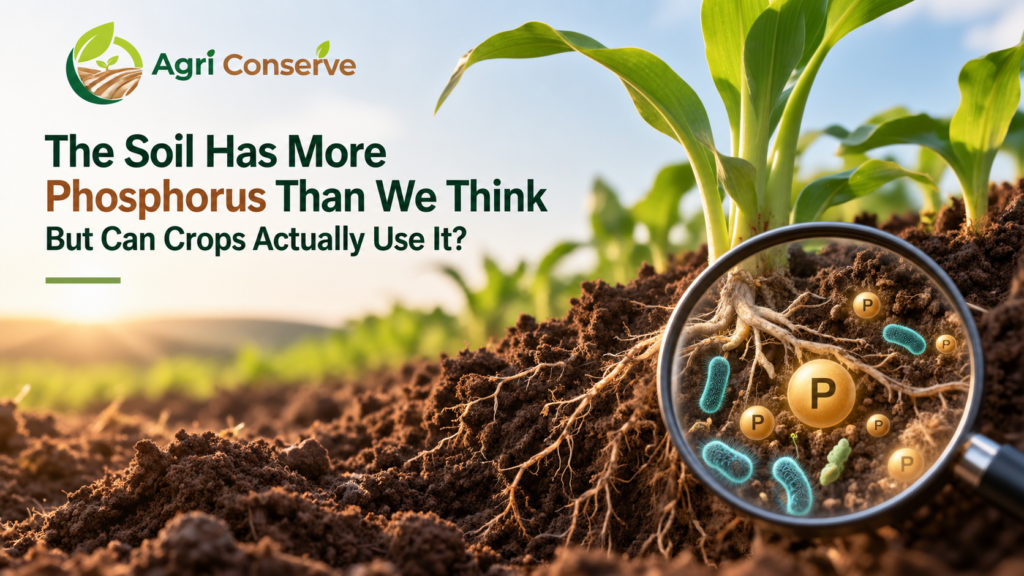
This is where soil microbes become important.
Microorganisms help break down organic phosphorus and can gradually transform it into forms that plants can absorb. Researchers have long known that this biological cycle matters, but measuring individual forms of organic phosphorus can be complicated and expensive.
The new research focuses on making one part of that measurement easier.
A complicated test just became simpler
The research team found that an enzyme-treatment stage used in an earlier method for measuring DNA-bound phosphorus was not necessary for obtaining a reliable result.
Removing that step makes the procedure less expensive and less technically demanding, while an ultrafiltration step still remains necessary to separate DNA-bound phosphorus from other material in the soil sample. Researchers tested the simplified method on 32 soil samples from different parts of the United Kingdom.
That may sound like a small laboratory improvement.
It is not necessarily small for soil research.
Cheaper and simpler testing can allow more laboratories and research programmes to study soil nutrient cycling, including in regions where expensive analytical methods are difficult to access.
Why microbes could change the fertiliser conversation
The researchers found that DNA-bound phosphorus was associated with indicators such as microbial biomass, soil organic matter, soil pH and dissolved phosphorus.
That connection could help scientists understand how actively a soil’s biological community is recycling nutrients.
The potential agricultural benefit is straightforward.
If scientists can better understand how much phosphorus a soil already contains and how efficiently its microbial community releases that phosphorus, farmers may eventually be able to make more precise fertiliser decisions.
That could reduce unnecessary applications.
Phosphorus that crops do not absorb can move from agricultural land into waterways through runoff and leaching. Excess phosphorus can contribute to eutrophication and harmful changes in freshwater ecosystems.
So improving phosphorus efficiency could benefit both the farm and the environment.
This is not yet a new fertiliser recommendation
It is important not to get ahead of the research.
The new method does not currently mean farmers should change their phosphorus fertiliser programmes or replace conventional soil tests.
The researchers developed and validated a laboratory method. Further research will need to establish how useful DNA-bound phosphorus measurements are across different agricultural soils and how reliably they can translate into practical nutrient recommendations.
That distinction matters because soil behaves differently from one location to another.
Climate, soil type, organic matter, microbial communities, crop history and previous fertiliser applications can all influence phosphorus availability. Existing agricultural guidance already emphasises the importance of choosing appropriate soil tests and interpreting results in context.
The bigger idea is more interesting than the test itself
Agriculture has traditionally focused heavily on the nutrients that farmers add to soil.
But sustainable soil management increasingly asks another question:
What can the soil already do for itself?
Microbes, organic matter, plant roots and other biological processes continuously move nutrients through the soil. Understanding those processes could eventually help farmers rely more efficiently on the nutrients already present rather than automatically adding more.
That does not mean fertiliser will disappear.
It means farmers could eventually have better information about when, where and how much fertiliser a crop actually needs.
And that could become increasingly important as farmers face higher input costs, pressure to reduce nutrient losses and growing concerns about the long-term availability of phosphate resources.
The most promising agricultural technologies are not always the ones that look futuristic.
Sometimes, innovation means finding a better way to understand something that has been beneath our feet all along.
The next step in sustainable fertiliser management may begin with looking more closely at the microscopic life already working inside the soil.