
Rice farming has a complicated relationship with climate change.
Flooded rice fields are highly productive, but the lack of oxygen in continuously flooded soil encourages the release of methane, a powerful greenhouse gas. Now, a new project in southern Brazil is attempting to tackle that problem while also removing carbon dioxide from the atmosphere.
And it is being attempted at a scale rarely seen in agriculture.
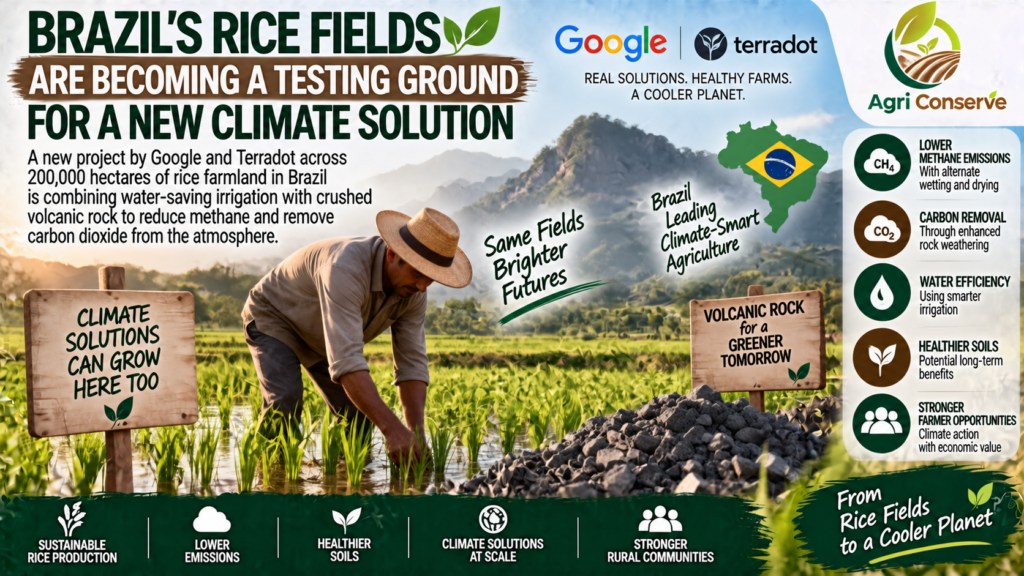
On September 16, Google and climate company Terradot announced a project covering more than 200,000 hectares of rice farmland in Rio Grande do Sul, Brazil. The project combines a water-saving rice technique with crushed volcanic rock to address both methane and carbon dioxide.
One farm, two climate problems
The first part of the approach uses Alternate Wetting and Drying (AWD).
Instead of keeping rice fields continuously flooded, farmers periodically drain them before irrigating again. This reduces the conditions that produce methane and can also lower water use.
The second part is more unusual.
Terradot plans to spread finely crushed volcanic rock across agricultural land. Through a process known as enhanced rock weathering, the minerals react with carbon dioxide and gradually convert it into more stable forms, creating a pathway for long-term carbon removal.
The idea is therefore to deal with two different climate problems at the same time.
Methane reductions can have a relatively rapid effect because methane remains in the atmosphere for far less time than carbon dioxide. Carbon removal, meanwhile, is intended to provide a longer-term climate benefit.
The numbers are what make this unusual
Google says the project will target the equivalent of 1 million tonnes of methane-related climate impact by 2030 and 1 million tonnes of permanent carbon removal by 2040.
It is also Google’s largest carbon-removal purchase so far and has been described by Terradot as the world’s largest enhanced-rock-weathering project.
The companies see Brazil as an important starting point because the country has more than 1.5 million hectares of rice cultivation, while southern Brazil offers suitable conditions and nearby basalt sources for the project.
Farmers are part of the climate solution
What makes this particularly interesting for agriculture is that the project is not designed as a climate programme sitting outside the farm.
Farmers will adopt the irrigation changes, while the rock application takes place directly on agricultural land.
AWD can potentially reduce water and input costs, while the rock weathering approach is also being studied for its effects on soil health. That means the project is trying to create an economic connection between farming and climate action rather than treating farmers simply as participants in a carbon programme.
But scaling it will require proof
The concept is promising, but large-scale carbon removal still faces questions around measurement, verification, cost and actual climate performance.
Google and Terradot are supporting research with Stanford’s Soil Biogeochemistry and Environmental Laboratory to strengthen the scientific evidence around AWD and methane reduction. The companies also intend to use measurement and verification systems as the programme expands.
That scientific work matters.
If this model can demonstrate reliable results at farm scale, it could potentially be adapted to other rice-growing regions, including India and Vietnam.
A different way to think about sustainable rice
Rice farmers are often asked to reduce water use, cut emissions and adapt to climate change.
This project attempts to connect those goals into one agricultural system.
Instead of asking farmers to sacrifice productivity for sustainability, the approach is exploring whether better water management, soil practices and carbon removal can work together on the same land.
It is still an emerging model, and its long-term success will depend on credible measurement and whether the economics work for farmers.
But the experiment in Brazil is worth watching.
The future of climate-smart agriculture may not be about finding one perfect solution. It may be about combining several practical solutions on the same farm and making each one reinforce the other.