
The next major agricultural shock may already be developing over the Pacific Ocean.
A very strong El Niño is taking shape, and climate agencies are warning that its effects could be felt across farms and food systems well into 2027. For agriculture, the important question is no longer simply whether El Niño will arrive. It is whether farmers and governments can act before the weather damage begins.
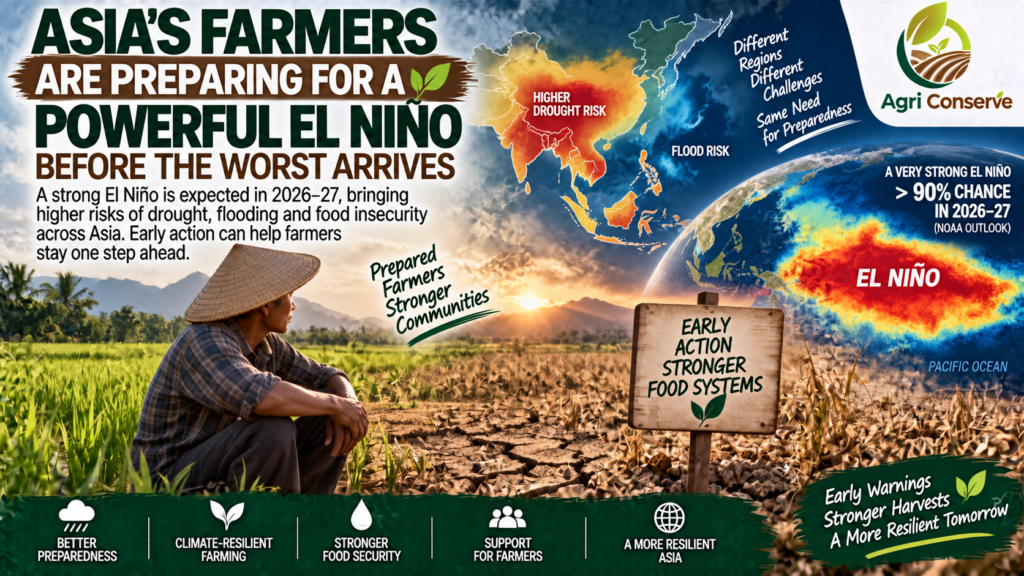
The latest NOAA outlook gives more than a 90% chance of a very strong El Niño during the Northern Hemisphere autumn and winter of 2026–27.
That makes this more than a climate story. It is becoming an agricultural planning issue.
The same El Niño can create very different problems
El Niño does not simply make the world hotter or drier everywhere.
Its effects vary by region. Parts of South and Southeast Asia can experience below-normal rainfall, while other regions may face excessive rainfall, flooding or landslides.
FAO’s agricultural risk analysis identifies South and Southeast Asia, Southern Africa, the Sahel, Central America and the Caribbean among the regions where drought risks could become particularly serious. In some agricultural areas, the probability of drought exceeds 50%.
For farmers, that can mean difficult decisions about planting dates, crop varieties, irrigation and livestock feed.
The interesting part is what is happening before the crisis
This time, organisations are trying to respond earlier.
FAO and the World Food Programme have launched a $202 million anticipatory-action appeal aimed at protecting 8.8 million people across 22 high-risk countries.
The idea is simple but powerful: provide support before crops fail, livestock die or food prices rise sharply.
That can include drought-tolerant seeds, livestock support, water assistance, cash transfers, insurance and early-warning information.
This represents a significant change in agricultural disaster management.
Instead of waiting for a failed harvest and then providing relief, governments and humanitarian organisations are increasingly using forecasts to prepare farmers in advance.
Better forecasts can become a farm input
FAO has used 41 years of satellite observations through its Agricultural Stress Index System to identify where strong El Niño events have historically produced severe agricultural drought.
The resulting maps can identify vulnerable crop and pasture areas at a resolution of roughly one square kilometre. That gives agricultural agencies a much better basis for deciding where to prioritise water, seed, fodder and other support.
In other words, climate information is becoming something farmers can potentially act on before the crisis arrives.
India and Asia have particular reasons to pay attention
For South Asia, rainfall timing is critical.
FAO notes that El Niño can bring below-normal rainfall across parts of the region, particularly during the monsoon period. That can affect water availability, crop establishment and ultimately food production.
This makes adaptation more than a long-term sustainability goal.
Farmers may need to make decisions months earlier based on information about rainfall probability, reservoir conditions and expected heat.
That could mean changing planting windows, selecting shorter-duration or drought-tolerant varieties, improving water storage and reducing dependence on crops that require large amounts of water.
The biggest lesson is timing
Agriculture has traditionally responded to weather after it happens.
The emerging approach is different.
What if farmers could receive useful information early enough to change what they do?
That is the promise behind anticipatory action.
It will not prevent El Niño. It cannot guarantee a successful harvest. But acting early can reduce the damage and give farmers more options.
And as climate variability increases, having those extra options could become one of the most valuable forms of resilience available to agriculture.
The most important agricultural technology during the next El Niño may not be a machine in the field. It may be a warning that reaches the farmer early enough to make a different decision.