
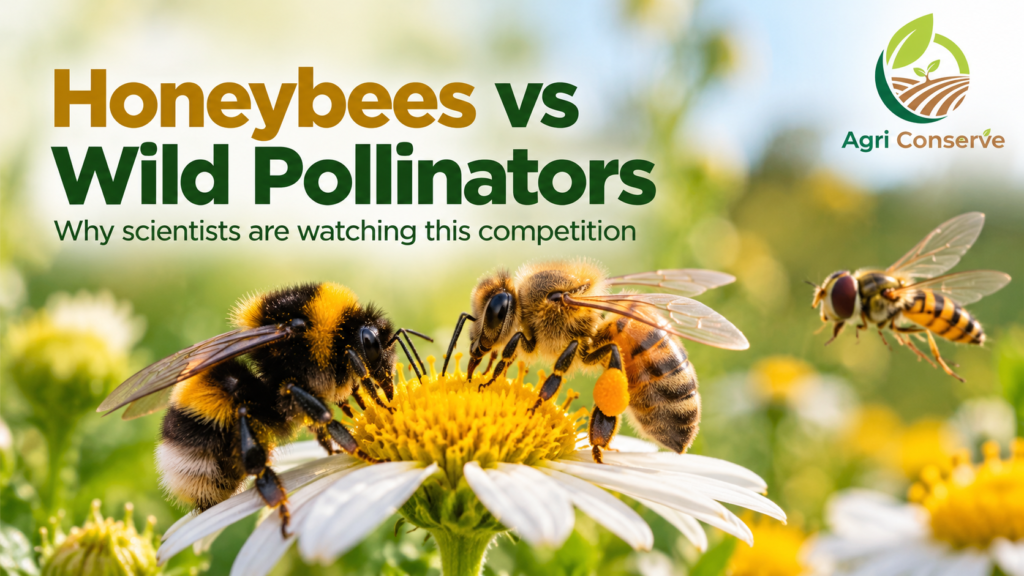

Honeybees have become symbols of environmental conservation. We plant flowers for them, protect their colonies and celebrate their role in producing the food we eat.
But scientists in England have discovered something surprising.
Honeybees are not always the friendly neighbours we imagine. When competing for nectar and pollen, they can physically push other insects away from flowers, leaving wild pollinators with fewer opportunities to feed.
Researchers at Anglia Ruskin University have documented this behaviour in a new study published in Ecological Entomology. Their findings raise an interesting question for sustainable agriculture: Could having too many managed honeybees in one area create problems for the wild insects that also pollinate our crops?
What Happens When Bees Compete for Flowers?
The researchers spent two years observing pollinators at five locations around Cambridge, England.
They studied insects visiting bramble and ivy flowers, which provide important sources of nectar and pollen.
Over 93 hours of observation, the team recorded encounters between honeybees, bumblebees, solitary bees, hoverflies and other flower-visiting insects.
The results revealed a clear pattern.
Honeybees frequently interrupted other insects while they were feeding. In some cases, they chased competitors away or physically displaced them from flowers.
The researchers found that wild pollinators avoided honeybees in 28% of observed interactions on bramble flowers and 36% on ivy.
Honeybees also won a greater proportion of encounters than other pollinator groups.
More Honeybees Didn’t Mean More Pollinators
One of the most interesting findings involved bumblebees.
On bramble flowers, a doubling of honeybee density was associated with a 14% reduction in bumblebee abundance.
The researchers also observed fewer solitary bees and hoverflies in areas with higher honeybee activity on ivy.
This suggests that increasing honeybee numbers does not necessarily improve conditions for every pollinating insect.
Managed honeybees are valuable, but they are only one part of a much larger pollinator community.
Wild bees, hoverflies, butterflies and other insects contribute to pollination across agricultural and natural landscapes.
When food sources become crowded, competition can affect how these insects use the available flowers.
Warmer Weather Could Make Competition Worse
The scientists also noticed that competitive encounters became more frequent during warmer conditions.
Temperature can influence how actively different insects forage. Honeybees often become more active as temperatures rise, while some wild pollinators are more sensitive to heat.
High temperatures can also affect the amount of nectar flowers produce.
If plants offer less nectar while more insects compete for it, feeding opportunities may become increasingly limited.
The researchers believe rising temperatures could intensify competition between managed honeybees and wild pollinators, although the long-term consequences still need further investigation.
Does This Mean Farmers Should Stop Keeping Bees?
Not at all.
Honeybees play an important role in agricultural pollination, and beekeeping supports livelihoods around the world.
The research does not suggest abandoning managed beekeeping.
Instead, it highlights the importance of considering where colonies are placed and whether the surrounding landscape provides enough flowers for different pollinator species.
Researchers suggest that areas with high concentrations of beehives may need particular attention.
For farmers, maintaining flowering field margins, hedgerows and other suitable habitats could help provide more diverse food sources for pollinating insects.
The goal should be to support a healthy pollinator community rather than focusing exclusively on one species.
Agriculture Needs More Than Honeybees
The study challenges a simple but popular idea: that increasing the number of honeybees automatically helps biodiversity.
Healthy agricultural ecosystems depend on many different insects, each interacting with crops and wild plants in different ways.
A landscape that supports honeybees but loses its wild pollinators may become less ecologically diverse.
The findings from Cambridge do not prove that honeybees are causing widespread pollinator declines or reducing crop yields. They do show that direct competition for flowers is real and deserves greater attention.
For agriculture, that is an important distinction.
Protecting pollinators means protecting the diversity of insects that contribute to healthy ecosystems, not simply increasing the number of managed hives.
Sometimes, helping nature requires looking beyond the species we know best and making space for the ones we rarely notice.