
Most bananas we eat have something unusual in common. They don’t contain the hard, developed seeds needed for conventional plant breeding.
That might seem convenient for consumers, but it has created a serious problem for banana farmers.
The Cavendish banana, which dominates international banana trade, is highly vulnerable to certain fungal diseases. And because commercial Cavendish plants are largely sterile, developing improved varieties through traditional crossbreeding has been extremely difficult.
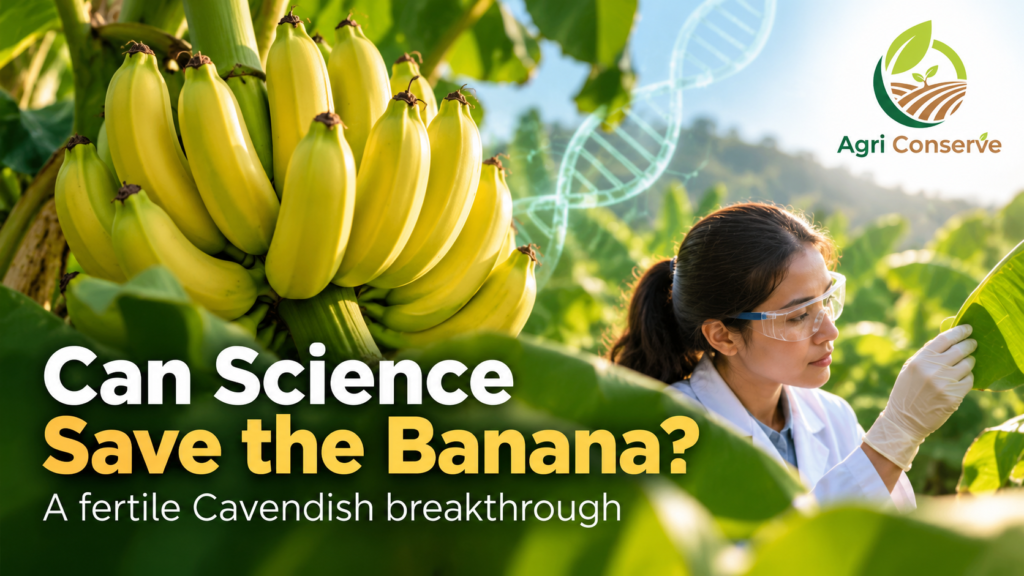
Now, scientists working with Yelloway, a partnership between Chiquita and plant-breeding company KeyGene, have announced a breakthrough.
They have developed a fertile Cavendish breeding line called Yellowdish, allowing researchers to cross the variety with other bananas and produce viable offspring.
The discovery could change the future of banana cultivation.
Why the World’s Favourite Banana Is in Trouble
Cavendish bananas became popular because of their consistent quality, high productivity and ability to withstand transportation over long distances.
But the global banana industry depends heavily on genetically similar plants.
That creates a weakness.
When a disease can infect one susceptible Cavendish plant, many other plantations growing the same variety may face similar risks.
One of the biggest threats is Fusarium wilt Tropical Race 4, commonly called TR4.
This soil-borne fungal disease attacks a banana plant’s vascular system, interfering with its ability to transport water and nutrients.
Once the fungus establishes itself in the soil, controlling it becomes extremely difficult. Infected plantations can remain unsuitable for susceptible varieties for years.
For farmers who depend on bananas for their livelihoods, that presents a serious economic threat.
The Breakthrough Scientists Have Been Waiting For
For decades, banana breeders have struggled to work with Cavendish genetics because the variety rarely produces viable seeds.
Without seeds, conventional breeding becomes extremely challenging.
Yelloway’s researchers have now developed a fertile Cavendish line that retains Cavendish genetics while allowing successful reproduction.
The team has already crossed these plants with disease-resistant banana varieties and produced offspring that are growing at its breeding facility.
This gives researchers something they previously lacked: a more practical way to combine the commercial qualities of Cavendish with useful disease-resistance characteristics from other bananas.
Instead of relying almost entirely on the existing Cavendish variety, breeders can now investigate new combinations of desirable traits.
Could This Lead to Disease-Resistant Bananas?
That is the ultimate goal.
Yelloway is working to develop banana varieties that can resist serious diseases such as TR4 and Black Sigatoka, another fungal disease that affects banana leaves and productivity.
The researchers also want future varieties to tolerate environmental stresses such as drought and heat.
However, the new fertile banana is a breeding breakthrough, not a finished solution.
Scientists must still determine whether its offspring can consistently resist diseases while maintaining the flavour, appearance, productivity and transport characteristics that make Cavendish commercially successful.
Yelloway hopes to make at least one improved commercial variety available to selected partners by 2030.
For now, the new plants remain part of an ongoing breeding programme.
Why This Matters for Farmers
Banana farming supports agricultural livelihoods across Asia, Latin America and Africa.
For many growers, disease management involves considerable investment in monitoring, planting material, sanitation and farm management.
Developing more resistant varieties could eventually reduce some of those pressures.
Stronger genetic diversity may also help the industry avoid depending too heavily on a single vulnerable variety.
But access will matter.
An improved banana variety will only benefit farmers if reliable planting material becomes available at a reasonable cost and performs well under local growing conditions.
The Future of Bananas May Depend on Their Seeds
The Yellowdish breakthrough reveals an interesting paradox.
The seedless quality that helped make Cavendish bananas commercially successful also made improving them through conventional breeding remarkably difficult.
By overcoming that reproductive barrier, scientists have created new possibilities for crop development.
There is still considerable research ahead, and the global banana industry remains vulnerable to disease.
But for the first time, breeders have a more practical route to developing Cavendish-like bananas with improved resistance.
The future of one of the world’s most popular fruits may depend on something consumers rarely see: a banana that can finally produce seeds.