
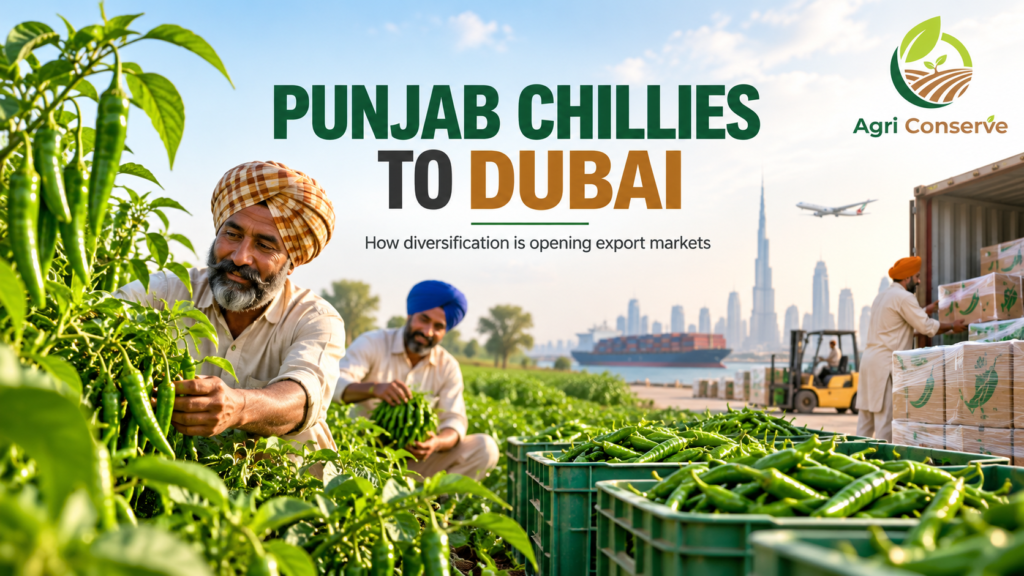

For decades, wheat and paddy have shaped the agricultural landscape of Punjab. These crops provide familiar markets and established farming systems, but some farmers are now discovering that growing something different can open doors far beyond India.
In Ferozepur, a group of farmers is preparing to export around 700 tonnes of green chillies to Dubai, building on a smaller international shipment earlier this year.
Their story offers an interesting example of how crop diversification, collective farming and direct market connections can create new income opportunities.
From 15 Tonnes to a Much Bigger Ambition
The journey began in April 2026, when farmers associated with Saragarhi Farmer Producer Company Limited sent their first 15-tonne consignment of green chillies to Dubai.
For farmers accustomed to selling their produce in domestic markets, it was an important milestone.
Now, the group is working toward a substantially larger operation.
According to reporting published on October 21, farmers have expanded their chilli cultivation from approximately 20 acres to 60 acres, with the ambition of producing around 700 tonnes for export.
They are growing the Gauri variety, which has attracted interest from buyers in the Middle East.
The expansion reflects a growing confidence that Punjab’s agricultural opportunities need not remain limited to conventional crops.
Why Farmers Are Looking Beyond Wheat
The economics of chilli cultivation are a major attraction.
According to estimates reported by The Indian Express, farmers involved in the initiative expect potential earnings of approximately ₹2.68 lakh per acre from chillies, compared with around ₹40,000 per acre from wheat.
These are projected returns, not guaranteed profits. Actual earnings depend on yield, input costs, crop quality, labour requirements and market conditions.
Still, the difference helps explain why farmers are willing to explore alternatives.
The group has also secured a contract price of approximately ₹29 per kilogram for its chillies, offering greater clarity about potential revenue before the crop reaches the market.
For growers, knowing who will purchase their harvest can make a significant difference when deciding whether to invest in a new crop.
The Strength of Farming Together
One of the most important parts of this story is the role of the Farmer Producer Company.
Individual smallholders often struggle to supply international buyers because export markets require consistent quality, sufficient quantities, proper packaging and dependable logistics.
By working together, farmers can combine their production and negotiate with buyers more effectively.
Saragarhi Farmer Producer Company has brought together a core group of growers and dozens of associated farmers.
Support linked to the Agriculture Infrastructure Fund has also helped strengthen the initiative’s market connections and postharvest arrangements.
This collective approach allows farmers to participate in opportunities that might otherwise remain beyond the reach of individual farms.
Growing for Export Requires More Than a Good Harvest
Selling fresh chillies internationally brings its own challenges.
Exporters must maintain product quality from harvesting through packing, transportation and delivery. Delays can reduce freshness and affect profitability.
The group’s earlier experience illustrates this risk. Export logistics were disrupted, and much of the produce ultimately went to domestic markets.
Even so, the arrangement reportedly protected participating growers through payments linked to their agreed export terms.
The experience highlights why reliable contracts, quality standards and backup markets are essential for agricultural exports.
Farmers cannot depend on higher prices alone. They also need dependable supply chains.
A Different Future for Punjab’s Farmers
The Ferozepur initiative does not mean that chillies will replace wheat or paddy across Punjab.
Chilli cultivation requires different skills, labour arrangements and market planning. It may not suit every farm.
But the project demonstrates how farmers can create new opportunities when they combine suitable crops with assured buyers and organised production.
For Punjab, where agricultural diversification has remained an important policy discussion for years, examples like this provide practical lessons.
The real achievement is not simply that green chillies are travelling from Ferozepur to Dubai.
It is that farmers are beginning to see themselves as participants in international agricultural markets rather than producers restricted to traditional local selling arrangements.
Sometimes, improving farmers’ incomes starts not with growing more of the same crop, but with finding a better market for something different.