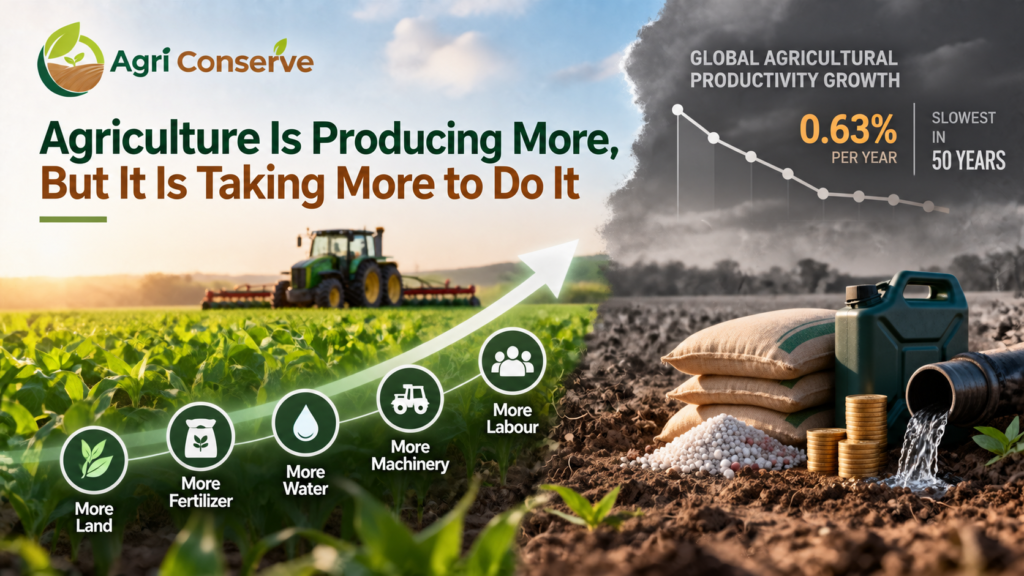

Farmers around the world are producing more food, feed and raw materials. But a new global assessment from Virginia Tech points to a troubling question: how much more are we using to get that extra output?
New data from the 2026 Global Agricultural Productivity Report show that global agricultural productivity growth averaged only 0.63% a year between 2015 and 2024, the slowest pace in about five decades. Newswise
That matters because productivity is not simply about producing more. It is about producing more without proportionally increasing the land, labour, fertilizer, machinery and other resources required to do it.
The hidden cost behind higher production
Modern agriculture has become remarkably productive, but the latest numbers suggest that simply adding more inputs is becoming a weaker strategy.
When farmers need additional land, fertilizer, machinery or other resources to increase production, costs can rise and pressure on soil, water and ecosystems can grow. Virginia Tech researchers warn that continuing along this path could make it harder for agriculture to meet future demand sustainably. Where The Food Comes From
The issue becomes even more important as climate change adds another layer of uncertainty. Heat, drought, changing rainfall and other stresses can make existing production systems less reliable, while farmers still need to maintain output.
The productivity gap is becoming harder to ignore
The latest assessment does not suggest that agriculture has stopped improving. Instead, the concern is that the rate of improvement is no longer fast enough.
Virginia Tech’s researchers estimate that agriculture needs substantially faster productivity growth to meet projected demand toward 2050 without relying heavily on additional resources. Their analysis points to declining public investment in agricultural research, difficulties adopting proven technologies, diminishing gains from conventional inputs and increasing climate pressures as some of the factors behind the slowdown. Where The Food Comes From
This changes the conversation around agricultural innovation.
A new seed, sensor, irrigation system or digital platform has limited value if farmers cannot afford it, access it, understand it or integrate it into their existing production system.
Innovation needs to reach the farm
One of the most important messages from the report is that agricultural innovation cannot stop at the research laboratory.
Farmers need access to technologies that work in their specific environments, along with financing, infrastructure, training and reliable information. A highly advanced technology that remains out of reach for smallholders does little to improve productivity on the ground.
To help address this information gap, Virginia Tech has also launched GAP IQ, an open-access platform that brings together decades of agricultural data. The platform is designed to help governments, researchers and other decision-makers examine productivity trends and explore where investments in areas such as research, irrigation, farmer training and soil health could have the greatest impact. research.vt.edu
The next agricultural race may be about efficiency
For decades, agricultural progress was often associated with producing more. The next phase may be defined by how efficiently that production happens.
That means better seeds, healthier soils, smarter water use and more precise farm management, but also stronger extension systems and faster movement of proven research from institutions to farmers.
The productivity slowdown is therefore more than an economic statistic. It is a warning that feeding a growing population cannot depend indefinitely on using more resources.
The future of farming may depend less on how much more agriculture can consume, and more on how intelligently it can produce.