
A pest attacking stored beans does not care whether the crop was grown sustainably.
Once the harvest reaches storage, farmers can still lose part of what they worked months to produce.
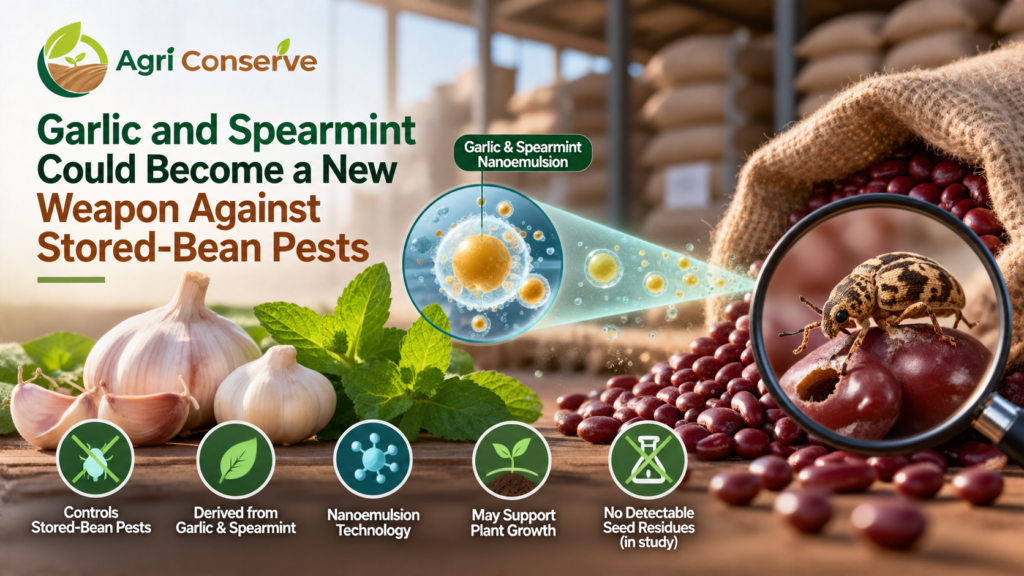
Researchers in Japan are now testing an unusual solution. Instead of developing another conventional synthetic insecticide, a team at Kyushu University has turned compounds from garlic and spearmint into nanoscale formulations that can kill a major stored-bean pest while having relatively limited effects on one of its natural enemies. The research has received renewed attention this week as the technology moves into discussions around more environmentally friendly postharvest pest control.
The target is the adzuki bean beetle, Callosobruchus chinensis, a widespread pest that attacks stored legumes.
And the interesting part is not simply what the researchers used.
It is how they delivered it.
Turning garlic chemistry into a precision treatment
The researchers worked with diallyl disulfide, a sulfur-containing compound found in garlic oil, and (R)-carvone, a compound associated with spearmint.
They converted these compounds into oil-in-water nanoemulsions, creating extremely small droplets that can improve the stability and delivery of the active ingredients. The droplets in the study were roughly 54 to 62 nanometres in size. Kyushu University Faculty of Agriculture
When researchers tested the formulations against the adzuki bean beetle, the garlic-derived nanoemulsion produced the strongest fumigant effect.
More importantly, turning the garlic compound into a nanoemulsion increased its insecticidal effectiveness by about 30.5%. The spearmint-derived compound also showed an improvement of about 8.2% after nanoemulsification. Kyushu University Faculty of Agriculture
That is where nanotechnology starts to become genuinely interesting for agriculture.
The goal is not necessarily to invent a completely new chemical.
It can also involve finding a better way to deliver something that already exists in nature.
The researchers were also watching the insects farmers want to keep
An insecticide that kills the target pest but also wipes out beneficial insects can create another problem.
The Kyushu team therefore tested the formulations against Anisopteromalus calandrae, a parasitoid wasp that naturally attacks stored-product pests.
At concentrations estimated to kill half of the target beetle population within 24 hours, the mortality of the parasitoid remained relatively low for the garlic formulation and the 2:1 garlic-to-spearmint mixture, staying at 22% or less in the reported experiments. Kyushu University Faculty of Agriculture
That does not mean the formulation is automatically safe for every beneficial insect or every agricultural environment.
It does, however, give researchers something important to investigate further.
There was another unexpected result
The research also produced an interesting result involving the crop itself.
The 2:1 mixture of the garlic and spearmint compounds actually promoted root growth in adzuki bean seedlings under the study conditions.
Researchers also reported that they could not detect residues of the tested compounds on the surface of the treated bean seeds. Kyushu University Faculty of Agriculture
Those findings make the technology more intriguing, but they should not be confused with proof that the treatment is ready for commercial farm use.
The researchers still need to test how well it performs under real storage conditions and at larger grain and legume facilities. Kyushu University says the team also wants to investigate whether the approach can control other pests and eventually support commercialization. Kyushu University
Why stored crops deserve more attention
Postharvest losses are often overshadowed by what happens in the field.
Farmers can protect a crop from diseases, weeds and insects throughout the growing season and still lose valuable produce after harvest if storage conditions allow pests to multiply.
That makes stored-grain protection an important part of sustainable agriculture.
Reducing losses means producing more usable food from the harvest that farmers already have.
It can also reduce the pressure to produce additional crops simply to compensate for food lost during storage.
That is why technologies such as botanical fumigants, improved storage systems, monitoring tools and biological control can become important pieces of a wider food-security strategy.
Nature is becoming a source of agricultural chemistry
There is a broader lesson here.
Agriculture does not always need to choose between traditional synthetic chemistry and going completely chemical-free.
Researchers are increasingly exploring whether natural compounds can be made more effective through modern formulation and delivery technologies.
In this case, garlic and spearmint provide the biological compounds while nanoemulsion technology helps deliver them.
That combination is still experimental, but it represents an interesting direction for crop protection.
The real test will come outside the laboratory.
Can the formulation work reliably inside commercial storage facilities? Can farmers afford it? Will it remain effective against different pest populations? How will it perform over longer storage periods? And can researchers maintain its advantage over beneficial organisms?
Those questions remain unanswered.
But the idea itself is hard to ignore.
Sometimes the next generation of agricultural pest control may not come from a completely new chemical. It may come from taking something nature already made and learning how to use it much more precisely.