
For decades, plant breeders have focused on a familiar question: Can we make this crop produce more?
Researchers at the University of Queensland are asking a more unusual question:
What if we also bred crops for what they leave behind for the next crop?
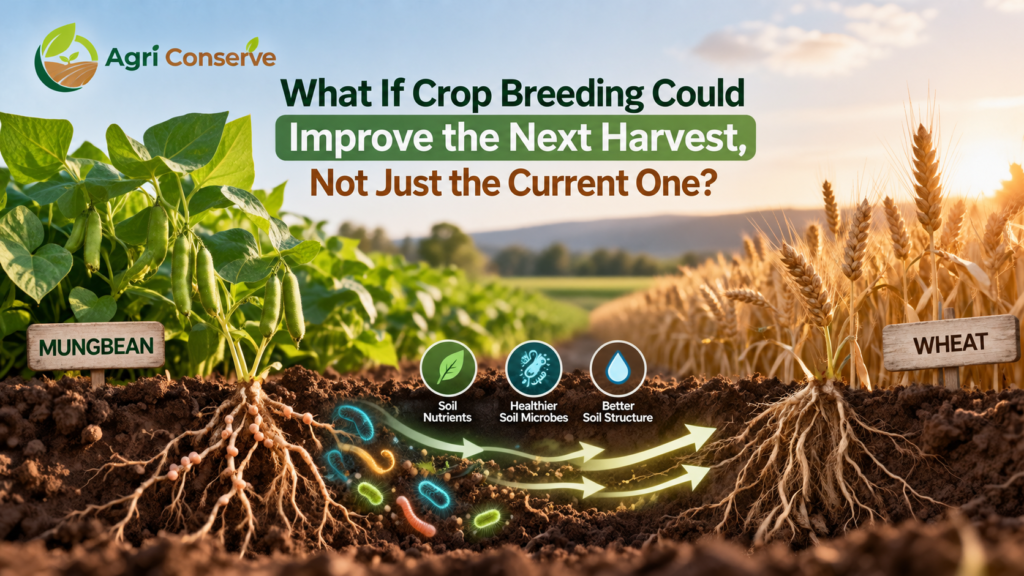
Their recent research suggests that the genetic identity of one crop can influence how well the following crop performs. In a striking mungbean-wheat experiment, different mungbean varieties produced very different outcomes for the wheat planted afterward, even though the researchers used the same wheat variety across the trial.
The idea could open a new direction for sustainable crop breeding.
Every crop leaves something behind
Farmers already understand the value of crop rotation.
A legume can improve nitrogen availability. Different crops can disrupt pest cycles. Roots can change soil structure, water use and microbial communities. Crop residues also influence what happens after harvest.
But breeders have traditionally evaluated a variety mainly on how it performs during its own growing season.
The Queensland researchers argue that this misses an important part of the story.
A crop does not simply finish when it is harvested. It leaves behind a biological legacy that can influence the crop that comes next. That legacy can involve soil nutrients, water conditions, soil structure and microbial communities.
Now scientists are asking whether genetics can influence that legacy.
The mungbean experiment produced a surprising result
Researchers grew more than 300 genetically diverse mungbean varieties in southern Queensland.
Afterward, they planted the same wheat variety across the plots.
That created a useful test. Since the wheat was genetically identical, differences in its performance could be linked largely to what the different mungbean varieties had left behind.
The results were remarkable.
The researchers found that wheat yields could vary by up to about 1 tonne per hectare, depending on which mungbean variety had previously occupied the soil.
That means two farmers could plant the same wheat variety under otherwise similar conditions, yet see significantly different results because of the genetics of the crop grown before it.
It changes the way we think about a crop rotation.
The variety may matter as much as the rotation
Farmers often talk about rotations in broad terms: wheat after mungbean, wheat after chickpea, maize after soybean and so on.
This research suggests that the conversation could eventually become more specific.
Instead of simply asking which crop should come next, farmers might one day ask:
Which variety of the previous crop creates the best conditions for my next crop?
That would turn crop rotation from a general management practice into something much more precise.
The researchers have also identified genetic regions associated with the performance of the following wheat crop. Some of those regions appear to create trade-offs, with genetic characteristics that help one crop perform well potentially leaving fewer resources for the next crop.
That finding could force breeders to rethink what they mean by a high-performing variety.
More yield from the whole farm, not just one season
The biggest opportunity lies in changing the target of breeding.
Imagine a mungbean variety that produces a good harvest but also leaves behind conditions that consistently help the following wheat crop perform better.
Now compare it with another mungbean variety that produces a similar harvest but leaves the next crop in a weaker position.
If breeders select only for mungbean yield, both varieties may look competitive.
If they evaluate the entire rotation, the first variety could become much more valuable.
The Queensland researchers used modelling to test this idea. When they applied selection pressure to both mungbean performance and the yield of the wheat that followed, the simulations showed potential gains in both crops.
That points toward a different philosophy of crop improvement.
The goal would no longer be simply to produce the best individual crop.
It would be to produce the best-performing farming system.
This could reduce pressure on fertilizer
The potential sustainability benefit is particularly interesting.
If certain crop varieties naturally leave more nitrogen or create better conditions for the following crop, farmers may eventually need fewer external inputs to maintain productivity.
The research does not yet prove that farmers can immediately reduce fertilizer applications. Scientists still need to understand exactly what creates these legacy effects and test them across more environments.
But the possibility is significant.
Instead of trying to solve every production problem by adding another input, breeders could help crops work better together.
That fits with a wider shift toward improving resource efficiency rather than simply increasing input levels.
Technology could make this much more practical
This idea would have been extremely difficult to pursue at a large scale a few decades ago.
Today, researchers have access to genomic tools, drones, high-throughput field measurements, crop models and increasingly powerful computing systems. These technologies can help scientists examine thousands of plants and connect genetic differences with what happens in the soil and in subsequent crops.
That opens the possibility of eventually developing varieties specifically suited to particular rotations and environments.
The concept could extend beyond mungbean and wheat.
Researchers point to combinations such as canola and wheat or chickpea and barley as other systems where the idea could be explored.
The research still has a long way to go
This is not yet a new seed recommendation for farmers.
The scientists themselves say they need to understand what actually drives the legacy effect. Nitrogen fixation, root characteristics, residues, soil microbes, water use and other processes could all contribute.
They also need to test whether the effects remain consistent across different soils, climates and farming systems.
That caution is important.
A promising research result becomes useful agriculture only when farmers can rely on it under real conditions.
Still, the underlying idea is powerful.
The future of breeding may be bigger than the plant
Agricultural breeding has achieved enormous gains by making individual crops more productive.
The next opportunity may be to make crops better neighbours.
A variety could be judged not only by the grain it produces, but also by the soil environment it leaves behind and the opportunity it creates for the crop that follows.
That would make crop breeding more closely connected with soil health, nutrient efficiency and whole-farm sustainability.
The next generation of agricultural varieties may not simply be bred to win their own season. They may be bred to leave the farm in a better position for the next one.