

Sometimes agricultural innovation does not begin with a high-tech machine or an AI system.
Sometimes it begins with a better crop variety.
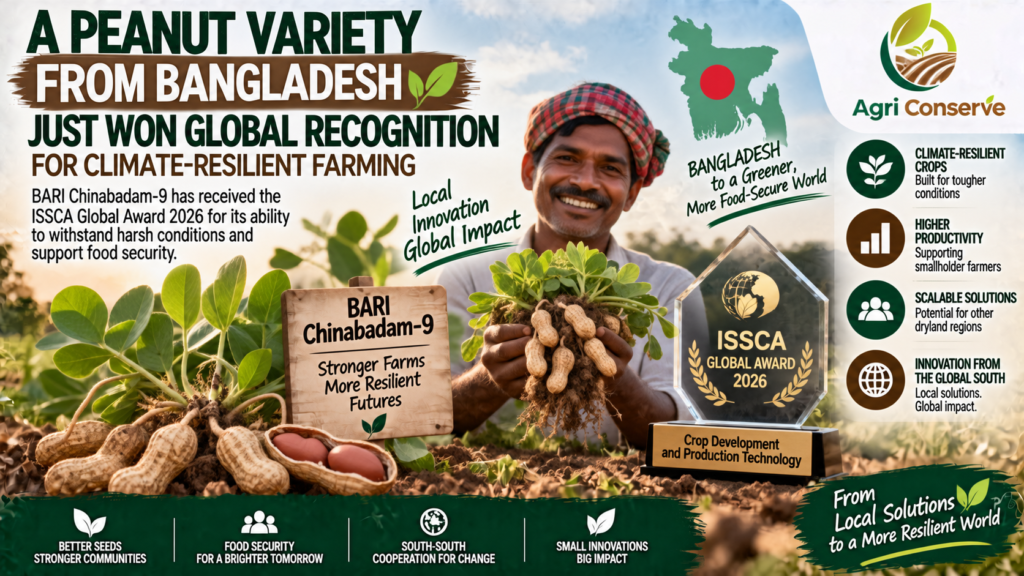
That is what has happened with BARI Chinabadam-9, a groundnut variety developed by the Bangladesh Agricultural Research Institute. The variety has just received the ISSCA Global Award 2026 in the Crop Development and Production Technology category at the Dryland Congress in New Delhi.
The recognition is particularly interesting because the award is focused on agricultural solutions from the Global South that have potential to be adapted and scaled in other regions.
A Peanut Designed for Difficult Conditions
Groundnut farmers in dry and environmentally challenging areas face a familiar problem.
They need crops that can continue producing when growing conditions are far from ideal.
BARI Chinabadam-9 was recognised for its ability to withstand adverse environmental conditions while supporting productivity and food security. The variety has been highlighted for its potential to strengthen the resilience of smallholder farmers in dryland regions.
That makes the story bigger than one peanut variety.
It shows how crop breeding adapted to local conditions can become a climate-resilience tool.
Why This Award Matters
The ISSCA awards are not simply looking for interesting research.
Their evaluation criteria include real-world adoption, demonstrated impact, evidence, scalability and whether a solution can be adapted to other regions with similar agricultural conditions.
That is an important shift in the way agricultural innovation is viewed.
A variety can be scientifically impressive, but its real value comes when farmers can access it, grow it successfully and benefit from the results.
Innovation From the Global South Can Travel
BARI’s recognition also highlights something that often gets overlooked in global agricultural discussions.
Important agricultural solutions do not always come from the world’s largest research institutions or wealthiest farming economies.
Bangladesh has developed crop technologies specifically around the realities faced by its farmers. Some of those solutions may now have relevance for other countries dealing with similar heat, water and soil challenges.
That is exactly the idea behind the International Crops Research Institute for the Semi-Arid Tropics’ (ICRISAT) Centre of Excellence for South-South Cooperation in Agriculture, which works to identify proven agricultural innovations and help connect them with countries that could benefit from them.
The Bigger Lesson for Farmers
Climate resilience does not always require completely new farming systems.
Sometimes, a more resilient seed can make a significant difference.
The challenge is making sure those varieties reach farmers through reliable seed systems, extension services and markets. The ISSCA model specifically emphasises technology transfer and partnerships that can help proven solutions move across borders.
For countries facing similar agricultural pressures, BARI Chinabadam-9 offers an interesting example of what locally developed crop science can achieve.
The next generation of climate-resilient agriculture may not come from one universal solution. It may come from hundreds of locally developed innovations that can be shared, adapted and grown in new places.

great