
Artificial intelligence in agriculture is often associated with drones, robots and expensive smart machinery. But some of the most useful AI tools emerging in India are much simpler.
They fit inside a smartphone.
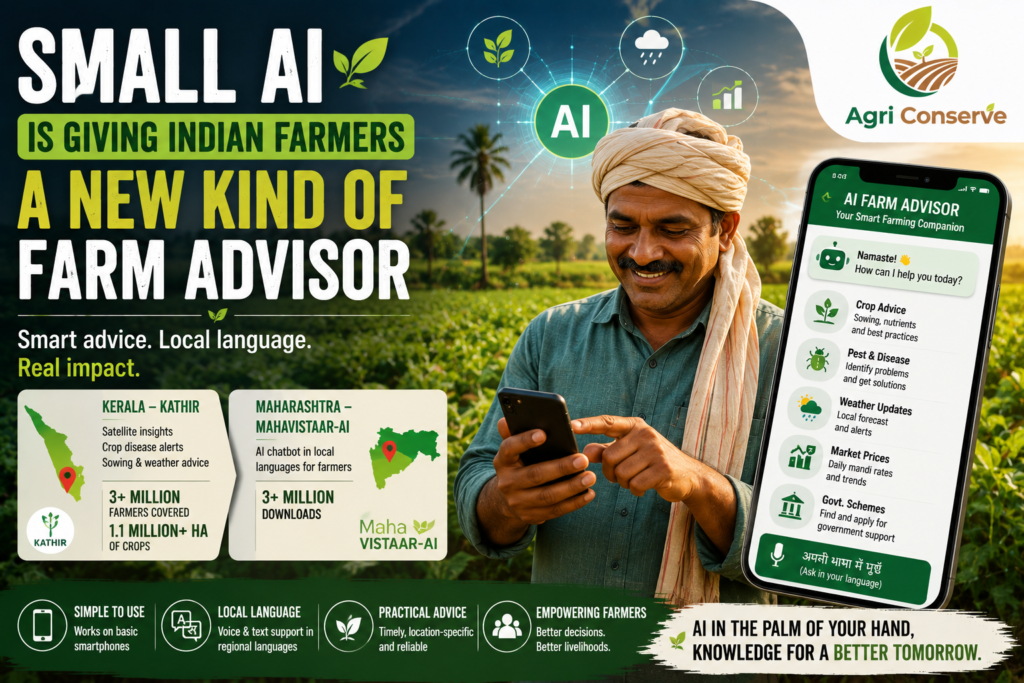
A new World Bank feature highlights how “small AI” is being used to give Indian farmers practical advice on crops, pests, weather, markets and government support—often in local languages and through basic smartphones.
The idea is not to build an enormous system that tries to solve every agricultural problem. Instead, these tools focus on small, specific decisions that matter to farmers every day.
Advice When the Crop Needs It
In Kerala, the KATHIR digital agriculture platform combines satellite imagery, remote sensing and AI to provide localized weather alerts, sowing advice and crop-disease information.
Farmers can even upload photographs of damaged crops and receive AI-supported guidance about possible diseases and treatments.
The platform is already working with data covering more than 3 million farmers and over 1.1 million hectares of crops, according to the World Bank.
In Maharashtra, another tool called MahaVISTAAR-AI works as a generative-AI chatbot. Farmers can ask questions through voice or text in their own languages, while the system draws information from trusted agricultural sources and provides answers tailored to their location. The chatbot has already been downloaded more than 3 million times.
That local connection may be one of the most important parts.
A farmer doesn’t necessarily need to understand how AI works. They need to be able to ask, “What is happening to my crop?” and receive an answer they can understand and act upon.
The Bigger Opportunity
These systems are also beginning to move beyond advice.
KATHIR’s verified farm information can help banks, cooperatives and agribusinesses design financial products and improve access to loans. Maharashtra’s system is being developed to assist farmers with tasks such as government-benefit applications.
This suggests that AI could eventually become more than a digital encyclopedia for farmers.
It could become a bridge between farmers and the wider agricultural ecosystem—connecting them with research, markets, financial services and government programmes.
Of course, AI advice still needs reliable data, local validation and human oversight. A wrong recommendation at the wrong time can cost a farmer much more than a wrong answer on a phone.
But the direction is encouraging.
The most important agricultural technology may not always be the most complicated one. Sometimes, the real breakthrough is simply putting useful knowledge into a farmer’s hands at the moment it is needed.
And in India, that future is already beginning to take shape.