
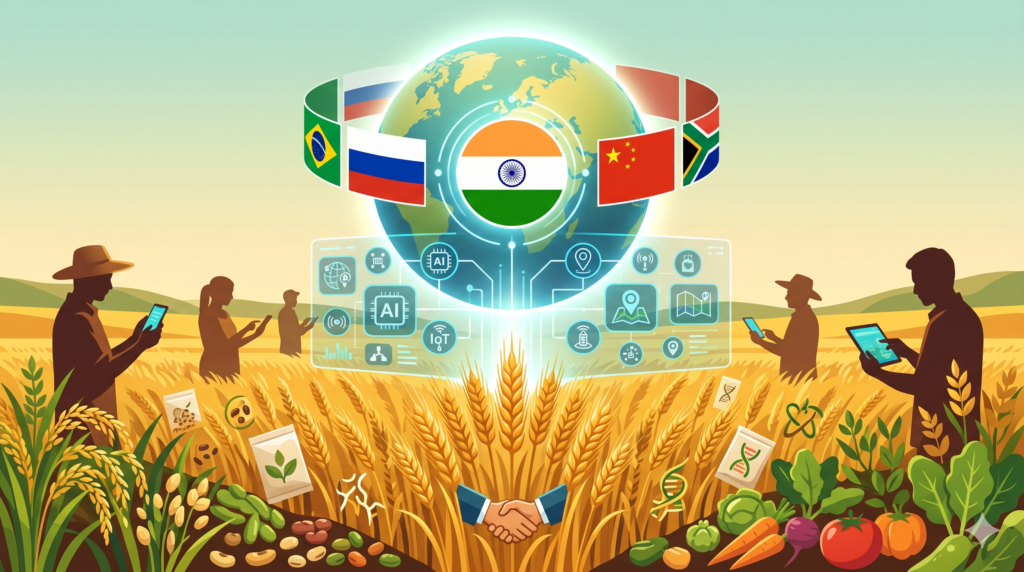
Global agriculture is entering a new phase of collaboration as BRICS nations officially adopted the Indore Declaration, creating a stronger framework for cooperation in food security, agricultural innovation, and sustainable farming.
Led under India’s presidency, this development places India at the center of several major agricultural initiatives that aim to improve farming systems through technology, knowledge exchange, and long-term sustainability.
The declaration signals more than policy alignment. It reflects a shared commitment among BRICS countries to build agricultural systems that support farmers, strengthen food supply resilience, and prepare agriculture for future challenges.
Understanding the Indore Declaration
The Indore Declaration was introduced after a five-day gathering of agriculture ministers and officials representing BRICS member countries including Brazil, Russia, India, China, and South Africa.
The agreement focuses on strengthening cooperation in agriculture while addressing some of the world’s most pressing food and farming challenges.
Key priorities include:
- Improving global food and nutrition security
- Supporting small and marginal farmers
- Expanding opportunities for women and youth in agriculture
- Encouraging climate-resilient and sustainable farming practices
- Strengthening agricultural trade and investment partnerships
Together, these priorities create a roadmap for a more connected and future-ready agricultural ecosystem.
Five Key Agricultural Initiatives Announced
1. Global Forum on Farmers’ Rights in Seed Systems
One of the most significant outcomes of the declaration is the decision to establish a Global Forum on Farmers’ Rights in Seed Systems, with India serving as the coordinating country.
This initiative aims to:
- Strengthen protection of farmers’ seed rights
- Preserve indigenous seed varieties
- Support traditional agricultural knowledge connected to seed conservation
The initiative recognizes that local seed systems continue to play an important role in agricultural resilience and biodiversity.
2. Launch of the BRICS AGRIN Network
BRICS countries also agreed to develop the AGRIN Network, focused on Agro-Inputs, Genetic Resources, and Information exchange.
India will coordinate this platform to encourage:
- Exchange of agricultural resources
- Technical collaboration among member countries
- Sharing of successful farming practices and innovations
This network is expected to improve access to agricultural knowledge across participating nations.
3. Progress Toward a BRICS Grain Exchange
Member nations agreed to continue work on operationalizing the proposed BRICS Grain Exchange.
The objective is to create stronger connections between agricultural markets and improve foodgrain movement across regions.
Expected benefits include:
- Better foodgrain trade efficiency
- Stronger market integration
- Improved agricultural supply-chain coordination
This initiative could support more stable food systems during periods of global uncertainty.
4. Centres of Excellence Network for Agroecology
To address climate-related agricultural challenges, BRICS introduced a Centres of Excellence Network dedicated to agroecology and regenerative agriculture.
Initial coordination responsibilities will be managed by the Indian Institute of Farming Systems Research, Modipuram under ICAR.
The network aims to encourage:
- Sustainable land management
- Climate-smart farming practices
- Collaborative agricultural research
5. Building a Digital Agriculture Network
Technology will also play a central role through the launch of a Digital Agriculture Network.
This initiative promotes adoption of:
- Artificial Intelligence in farming
- Internet of Things applications
- Geospatial technologies
- Digital agricultural solutions
Initial coordination will be led by IIT Delhi, helping accelerate technology integration across agricultural systems.
Why This Development Matters for Global Food Security
The influence of BRICS in global agriculture is substantial.
Collectively, BRICS nations represent nearly half of the world’s population and contribute a significant share of global agricultural land and foodgrain production.
Greater cooperation among these economies has the potential to:
- Improve food system resilience
- Increase agricultural productivity
- Encourage sustainable farming adoption
- Strengthen long-term food security worldwide
These outcomes could become increasingly important as countries adapt to climate pressures and changing food demands.
India’s Expanding Role in Agricultural Leadership
The meeting brought together close to 100 delegates, including international representatives, reflecting the growing importance of agricultural diplomacy.
India’s leadership across multiple initiatives highlights its increasing influence in shaping conversations around sustainable agriculture, innovation, and farmer-focused development.
By combining modern agricultural technologies with traditional knowledge systems, India is positioning itself as an important contributor to the future of global farming.
Final Thoughts
The adoption of the Indore Declaration marks an important step toward a more collaborative and technology-enabled agricultural future.
From seed rights and agroecology to digital farming and food trade cooperation, these initiatives could shape how nations respond to food security challenges in the years ahead.
As agriculture continues to evolve, partnerships like these may become essential in building a farming ecosystem that is productive, sustainable, and inclusive.
What are your thoughts on India’s growing leadership in digital agriculture and sustainable farming? Share your perspective in the comments.
