
India is taking a more practical and region-focused step toward improving agriculture. Shivraj Singh Chouhan recently shared a plan where the central government and state governments will work together to design customized farming strategies. The goal is simple yet impactful. Increase farm productivity, improve farmer income, and promote long-term sustainability across different regions of the country.
A Shift Toward Region-Specific Farming Strategies
Instead of applying a single policy across the country, this new initiative recognizes that every region in India has different agricultural conditions. Soil quality, water availability, weather patterns, and local resources vary widely.
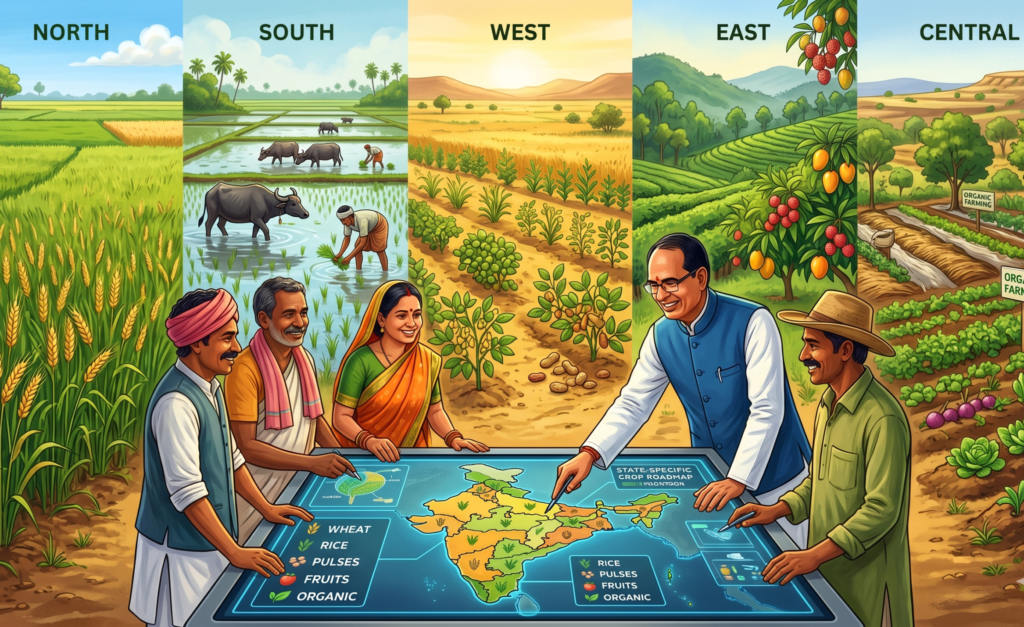
To address this, the country will be divided into five agro-climatic zones. Each zone will have a dedicated roadmap that suggests:
- Suitable crops for that region
- Recommended crop varieties
- Best farming practices based on local conditions
This approach ensures that farmers are not forced to follow generalized methods that may not work for their land. Instead, they will receive guidance that aligns with their specific environment.
Data-Driven Farming for Better Results
A major highlight of this initiative is the use of scientific data. Information related to soil health, water resources, and weather conditions will be used to create these roadmaps.
This means farmers will benefit from more informed decisions, helping them achieve better yields while reducing unnecessary risks. It also ensures that modern agricultural practices reach even the grassroots level.
At the same time, states will have more control over how they use funds. They can now allocate budgets across 18 agricultural schemes without strict limits. This flexibility encourages cooperation between the central and state governments rather than a top-down approach.
Key Focus Areas of the Initiative
Promoting Natural Farming
The government plans to encourage natural farming methods. This will help protect soil health and reduce the excessive use of chemical fertilizers and pesticides. Over time, this can improve land productivity and environmental balance.
Boosting Pulses and Oilseeds Production
India aims to increase the production of pulses and oilseeds. This step will reduce dependency on imports while maintaining stable production of staple crops like wheat and rice.
Encouraging High-Value Crops
Farmers will be guided to grow high-value crops, especially on limited land. This can significantly improve their income without requiring large-scale expansion.
Supporting Market Access
If farmers choose to sell their produce in markets outside their state through government-supported channels, transportation costs will be covered. This helps farmers access better prices and wider markets.
A Broader Vision for Indian Agriculture
Beyond productivity, this initiative focuses on long-term goals such as food security, better nutrition, and higher farmer income. Digital tools like Farmer IDs will also play a role in streamlining benefits and improving access to schemes.
Overall, this move reflects a more thoughtful and practical direction for Indian agriculture. By focusing on regional needs and scientific methods, the government aims to build a system that supports both farmers and the environment.
