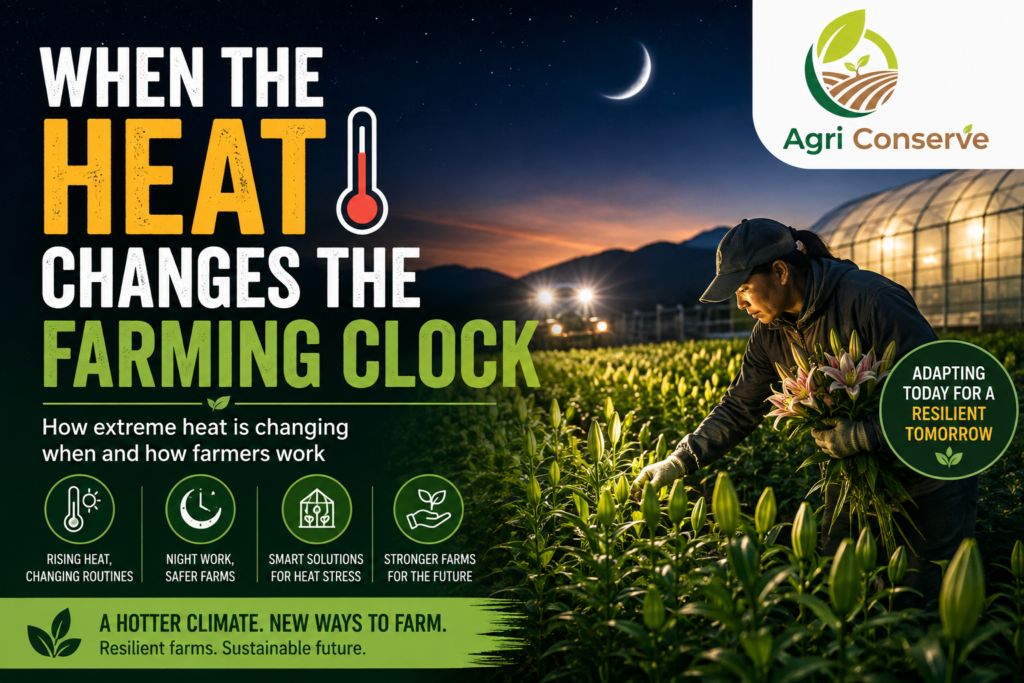

In Japan, some farmers are starting work before sunrise—or even in the middle of the night.
It sounds unusual, but for farmers facing increasingly intense summer heat, changing the clock has become a practical way to protect crops, livestock and workers.
A Reuters report this week describes farmers harvesting flowers at night and adjusting poultry routines so animals can feed before temperatures rise. In some greenhouses, temperatures can climb beyond 40°C, making ordinary daytime work increasingly difficult.
The problem is not limited to Japan. Across Europe, Asia and other agricultural regions, extreme heat is changing when farmers can safely work and how crops and livestock are managed.
Farming Is Adapting to a Hotter Day
Heat affects agriculture in several ways. Crops can mature too quickly, fruit may struggle to develop properly, and livestock can suffer from heat stress. At the same time, farmers themselves face greater health risks while working outdoors.
Japan’s Ministry of Agriculture, Forestry and Fisheries reported 59 deaths from heatstroke during agricultural work in 2024, compared with 37 the previous year. The ministry has responded by introducing a nationwide summer heat-safety campaign running from July through September.
That response shows how climate adaptation is moving beyond crop varieties and irrigation. The way farming work is organised is changing too.
Technology Can Help, But It Isn’t the Whole Answer
Japan is also investing in measures to reduce heat-related agricultural losses. Its agriculture ministry highlights heat-tolerant crop varieties, improved farm management and technologies designed to reduce heat stress.
For example, Japan’s latest climate-impact assessment found that high temperatures were affecting rice quality and other crops, while the use of heat-tolerant rice varieties and better water and fertilizer management showed benefits.
But technology cannot replace practical decisions made on the farm. Sometimes the simplest adaptation is changing when the work happens.
A Preview of Farming’s Future?
The image of farmers harvesting under artificial lights may seem unusual today. It could become less unusual as extreme heat becomes a more frequent challenge.
For agriculture, resilience will increasingly mean adapting not only what farmers grow, but also how, when and under what conditions they farm.
The future farm may still look familiar from a distance. But its working day could look very different.