
Introduction
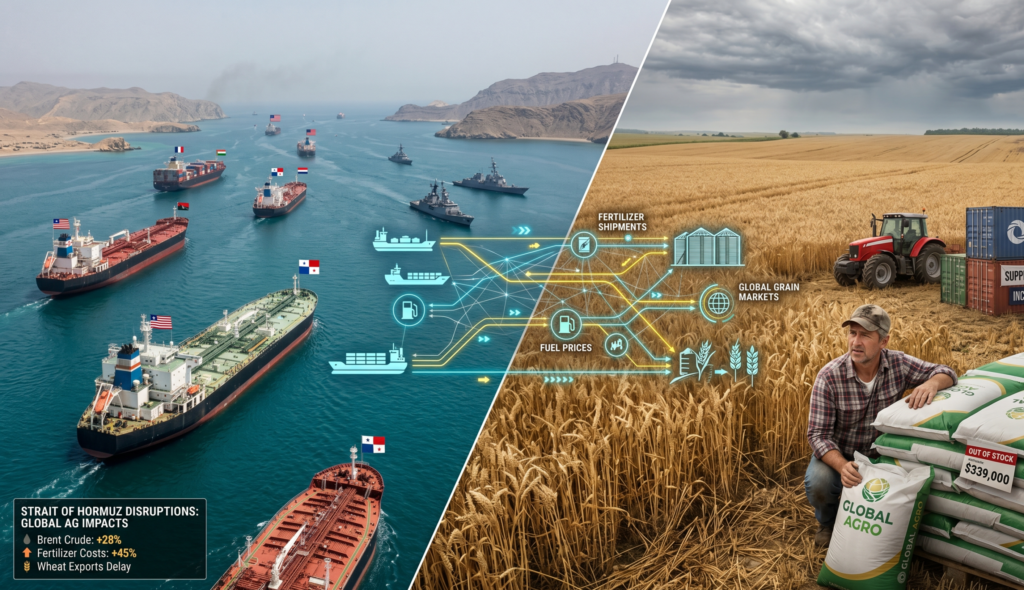
Rising instability around the Strait of Hormuz is no longer just an energy market issue. It is now raising serious concerns about global agriculture and the fragility of modern food supply chains. As trade routes face pressure, experts are warning that farming systems across the world could feel the impact much sooner than expected.
Strait of Hormuz and Its Hidden Role in Agriculture
The Strait of Hormuz is widely recognized as one of the most important global trade corridors, especially for oil shipments. However, its importance goes far beyond energy.
A large share of agricultural inputs, including fertilizers and raw materials used in food production, also move through this critical route. When disruptions occur, even temporary delays can affect supply chains that farmers depend on every day.
This dependency reveals a less visible but serious risk in the global food system.
Structural Weakness in Modern Farming Systems
Experts in agriculture and food systems point out that the current disruption is exposing deeper structural weaknesses.
Modern agriculture is heavily reliant on three key factors:
- Imported synthetic inputs such as fertilizers
- Stable fuel prices for production and transport
- Predictable international logistics networks
When even one of these elements becomes unstable, the impact spreads quickly. Farmers face rising costs, delayed supplies, and uncertainty in production planning.
Timing Makes the Situation More Serious
The timing of supply disruptions adds further pressure. When such challenges occur during active planting or cultivation periods, the consequences become more severe.
Farmers may struggle with fertilizer shortages, shifting crop plans, or reduced yields. Over time, this can influence food availability and price stability in different regions.
International observers have also warned that prolonged disruptions could increase pressure on global food affordability, especially in import-dependent economies.
Growing Interest in Sustainable and Resilient Farming
As uncertainty increases, there is growing attention on farming methods that reduce dependence on external inputs.
These approaches include:
- Improving soil health through natural processes
- Increasing biodiversity on farmland
- Enhancing water retention in soil systems
- Reducing chemical fertilizer use over time
Such practices are gaining traction because they aim to build long-term resilience rather than short-term output alone.
Challenges in Transitioning to New Methods
Despite rising interest, the shift toward more resilient farming systems is not simple.
Farmers and producers face several challenges:
- High initial transition costs
- Limited access to financing
- Risk of lower short-term yields
- Lack of infrastructure and training in some regions
Because of these barriers, adoption remains uneven across countries and farming communities.
Policy and Investment at a Crossroads
Industry experts believe the current disruption could influence future agricultural policy. Instead of treating supply shocks as isolated events, governments and institutions may begin focusing on long-term system resilience.
This includes investments in sustainable farming practices, improved supply chain security, and diversification of input sources.
Conclusion
The situation around the Strait of Hormuz highlights how closely connected global trade and food production have become. While the long-term outcome remains uncertain, one thing is clear: conversations around food security, supply chain resilience, and sustainable farming are becoming more urgent worldwide.
