
A farmer checking market prices on a phone, receiving climate information digitally or using an online service to connect with buyers may soon become a much more normal part of agriculture in Fiji.
The Fijian government has just endorsed a National E-Agriculture Strategy for 2026–2031, marking a significant push to bring digital technology deeper into the country’s farming system. The strategy was endorsed by Cabinet on September 22 and announced publicly this week.
What makes the development interesting is that Fiji is not focusing on just one agricultural app or platform. It is trying to build a wider digital system around farmers.
From farmer records to artificial intelligence
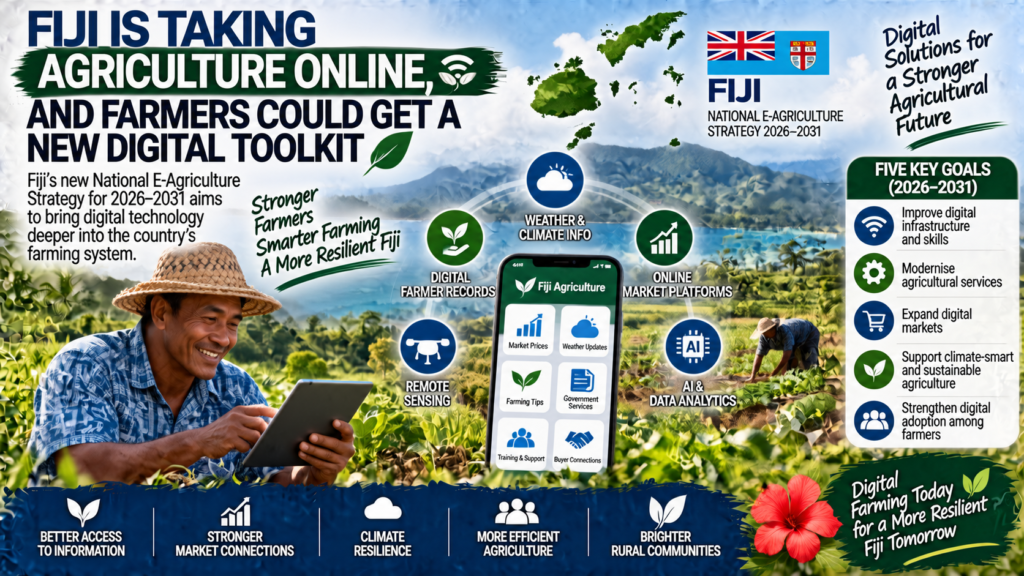
The strategy includes technologies ranging from relatively simple mobile applications to more advanced systems such as geospatial mapping, remote sensing, artificial intelligence and data analytics.
It also proposes digital farmer registries and online market platforms that could improve the way farmers access government services, agricultural information and potential buyers.
For a country made up of many islands and rural communities, digital access could be particularly valuable.
Instead of every agricultural service requiring a physical visit to a government office, some information and support could increasingly reach farmers remotely.
The goal is not technology for technology’s sake
The strategy has five broad goals, including improving digital infrastructure and skills, modernising agricultural services, expanding digital markets and supporting climate-smart and sustainable agriculture.
That last part is particularly important.
Digital agriculture becomes much more useful when it helps farmers make better decisions.
Weather and climate information can support planting decisions. Geospatial data can help identify land and production patterns. Digital market platforms can improve access to buyers. Farm records can help governments understand where support is needed.
The technology is essentially becoming a new layer of agricultural infrastructure.
Fiji has already started building the foundation
This is not Fiji’s first attempt at agricultural digitalisation.
The country has already developed the VitiAgri Data Hub, which brings together information such as farmer demographics, production records, government assistance, farm visits, input use and market information. Fiji’s Parliament was also told earlier this year that the government was working to expand its agricultural database and strengthen digital systems.
The new strategy gives those efforts a broader direction.
Implementation will happen in two phases. The first will establish digital foundations and infrastructure, while the second will focus on wider adoption and integrating digital services into regular agricultural operations. An E-Agriculture National Steering Committee will oversee the rollout.
The biggest challenge may be outside the technology
Building digital agriculture is relatively easy to describe.
Making it work for farmers is much harder.
Farmers need reliable connectivity, affordable devices, useful information and training. Digital services also need to be simple enough for people who may not regularly use online platforms.
Fiji’s strategy recognises this by including digital capacity and adoption as one of its central goals rather than treating technology access as the entire solution.
That could determine whether the strategy succeeds.
A sophisticated agricultural platform has little value if farmers do not trust it, cannot access it or cannot see a practical benefit from using it.
Why Fiji’s experiment matters
Fiji is a relatively small agricultural economy, but the challenge it is trying to solve is global.
Governments everywhere are collecting more agricultural data while farmers increasingly face climate uncertainty, changing markets and pressure to produce more efficiently.
The difficult part is connecting those two worlds.
If Fiji can turn digital records, climate information, market data and agricultural services into tools that farmers genuinely use, its experience could offer useful lessons for other small island states and developing agricultural economies.
The future of digital agriculture may not be about putting a computer in every field. It may be about making the right information reach the right farmer at the right moment.