
Agriculture has no shortage of research.
Scientists are developing better crops, smarter farming systems, new biological inputs, robotics and digital tools. The bigger problem is often what happens after the research is finished.
A promising technology can remain inside a laboratory for years. A useful farming practice may never reach the farmers who need it. A startup can have a strong idea but struggle to move from a pilot project to commercial scale.
The European Union is now trying to tackle that gap directly.
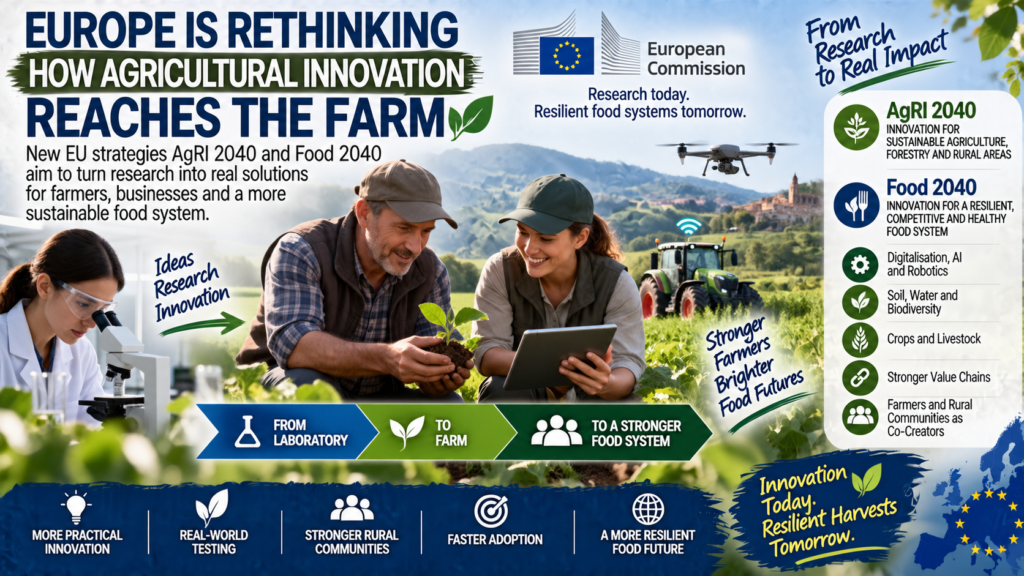
The European Commission has introduced a new long-term research and innovation strategy for agriculture and food, built around two frameworks called AgRI 2040 and Food 2040. The strategy is designed to connect research more closely with farmers, businesses, startups and rural communities and move useful innovations from research into real-world use.
The real problem may not be invention
The EU’s approach recognises something that is easy to overlook.
Agricultural innovation does not create much value if farmers cannot actually use it.
AgRI 2040 therefore puts greater emphasis on testing technologies in real-world conditions, involving farmers and other users in developing solutions, and helping promising ideas move towards market deployment. The framework specifically identifies digitalisation, artificial intelligence and robotics alongside soil, water, crops, livestock, rural development and stronger value chains.
That could change how agricultural research is prioritised.
Instead of asking only “Can we develop this technology?”, researchers and policymakers increasingly have to ask “Will a farmer actually use it, and what would make that possible?”
Two strategies, one food system
AgRI 2040 focuses on agriculture, forestry and rural areas.
Its companion framework, Food 2040, looks at the wider food system, including processing, packaging, distribution, retail, food services, consumption, food waste and recycling.
Together, they recognise that food-system problems rarely stay within one part of the chain.
A new crop variety, for example, has little impact if farmers cannot access quality seed. A successful harvest does not automatically create better farmer incomes if processing and market connections are weak.
The EU is therefore trying to connect innovation across the entire journey from research to farmer, business and consumer.
Farmers are being treated as co-creators
One of the more interesting elements is the emphasis on farmers and rural communities as participants in innovation rather than simply end users.
The European Commission says their experience and knowledge are important for identifying practical problems, testing solutions and ensuring that innovations work outside research environments.
That approach could be particularly important for technologies such as AI and robotics.
A tool may work perfectly in a controlled demonstration but still fail commercially if it is too expensive, difficult to maintain, poorly adapted to local conditions or incompatible with the way farmers actually work.
What comes next
The timing is significant.
The EU will hold its AgRI 2040 Conference in Brussels on September 24 and 25, bringing together policymakers, researchers, farmers, businesses, startups, SMEs and other agricultural stakeholders to help shape future research and innovation priorities.
The strategy is also intended to influence the next EU research and innovation programme for 2028–2034.
So this is not simply another agricultural conference.
It is part of a much larger attempt to decide which agricultural innovations Europe should invest in, how they should be tested and how quickly successful ideas can reach the people who actually produce food.
The lesson extends far beyond Europe
Every agricultural system faces the same basic challenge.
There is a growing amount of scientific knowledge, but the distance between discovery and adoption can still be enormous.
If Europe succeeds in shortening that distance, the most important result may not be a single new technology.
It could be a better system for turning research into practical farming solutions.
The next agricultural revolution may depend less on how many new ideas the world can invent and more on how quickly good ideas can move from the research field to the farmer’s field.