
Europe does not have a shortage of agricultural research.
The bigger problem is what happens after the research is completed.
A promising crop variety can remain in a laboratory. A new disease-detection technology can struggle to reach farmers. A startup can develop a useful agricultural tool but find it difficult to move from a successful trial to commercial deployment.
The European Commission is now trying to tackle that gap.
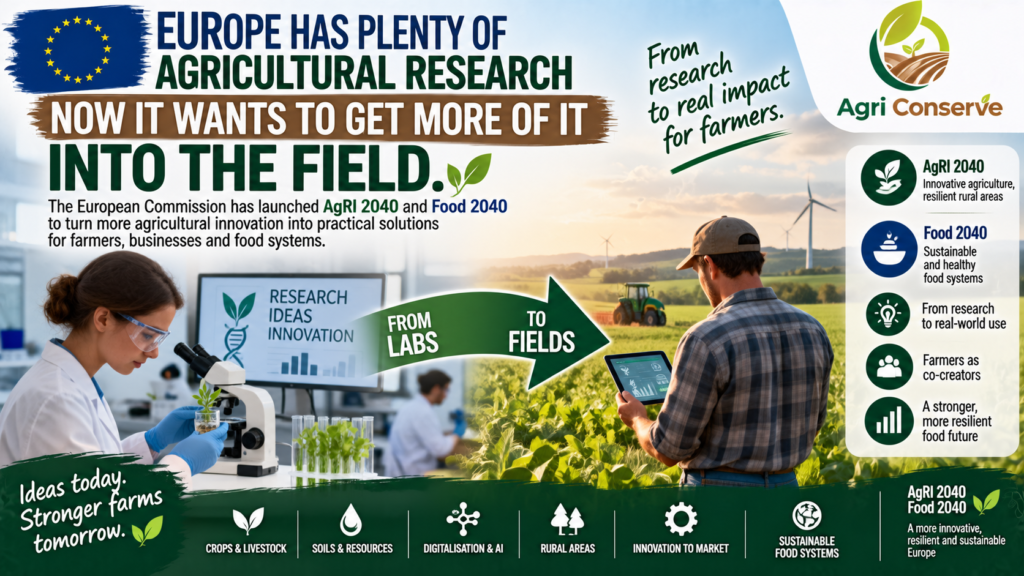
On September 8, the Commission launched a new strategic approach to agricultural and food research and innovation, built around two frameworks called AgRI 2040 and Food 2040. The goal is straightforward: move more agricultural innovation from research and testing into practical use.
From Research to the Real Farm
The new strategy puts greater emphasis on what happens between scientific discovery and adoption.
Researchers, farmers, businesses and other users are expected to work together to co-create, test and demonstrate solutions in real-world conditions rather than developing technologies in isolation.
That could matter for technologies ranging from drought-resistant crops and faster disease detection to digital farming tools, robotics and more efficient use of water.
The European Commission specifically identifies these areas as examples of innovation that should reach practical agricultural use rather than remain at the research stage.
What Are AgRI 2040 and Food 2040?
The two frameworks divide the challenge into connected parts.
AgRI 2040 focuses on agriculture, forestry and rural areas. Its areas of action include soils and agricultural ecosystems, crops and livestock, the bioeconomy, rural areas, agricultural value chains, digitalisation, artificial intelligence and robotics.
Food 2040 takes a wider food-system view, covering areas such as food production and processing, sustainable diets, resource efficiency, food waste, consumer behaviour and aquatic food systems.
Together, they are designed to guide future EU-funded research and innovation under Horizon Europe 2028–2034 and relevant parts of the European Competitiveness Fund.
Farmers Are Not Just End Users
One of the most important changes is the way farmers are positioned in the innovation process.
The EU strategy describes farmers, foresters and rural actors as key users and co-creators of research and innovation. Their practical experience can help identify real problems, test solutions and determine whether a technology actually works under farm conditions.
This sounds simple, but it addresses a longstanding challenge in agricultural innovation.
A technology can perform extremely well in a controlled trial and still fail to deliver value on a working farm because of cost, labour requirements, local climate, infrastructure or the way farmers actually operate.
Bringing users into the process earlier can help close that gap.
The Bigger Challenge Is Adoption
The strategy also recognises that innovation does not end when a research paper is published.
Europe wants stronger connections between research, entrepreneurship, investment, regulation and market adoption. The Commission says the approach should help startups, scale-ups and SMEs move promising technologies closer to the market.
That could become particularly important as agriculture faces several pressures at once: climate change, resource constraints, geopolitical uncertainty, labour shortages and increasing competition.
The EU is essentially asking a different question now.
Not just “Can we develop this technology?”
But “Can we make it useful, affordable and scalable for the people who actually farm?”
Why This Matters Beyond Europe
Agricultural innovation often spreads beyond the region where it begins.
If Europe succeeds in creating stronger pathways from research to farms, the lessons could be useful elsewhere, particularly for countries trying to balance agricultural productivity with climate resilience, resource efficiency and farmer livelihoods.
The approach also reinforces an important principle for the future of agriculture: innovation has little value if it cannot reach the field.
The next major milestone will be the EU AgRI 2040 Conference in Brussels on September 24–25, where researchers, policymakers and agricultural stakeholders will help shape the future research and innovation priorities.
The next agricultural revolution may not come from inventing more technologies. It may come from becoming much better at turning the technologies we already develop into tools farmers can actually use.


