
Agriculture is entering a new era where science and technology are helping farmers produce healthier crops while overcoming challenges such as climate change, pests, diseases, and water scarcity. Advances in biotechnology and crop science are enabling the development of resilient farming systems that improve productivity while reducing environmental impact.
1. CRISPR Gene Editing: Building Stronger and More Resilient Crops
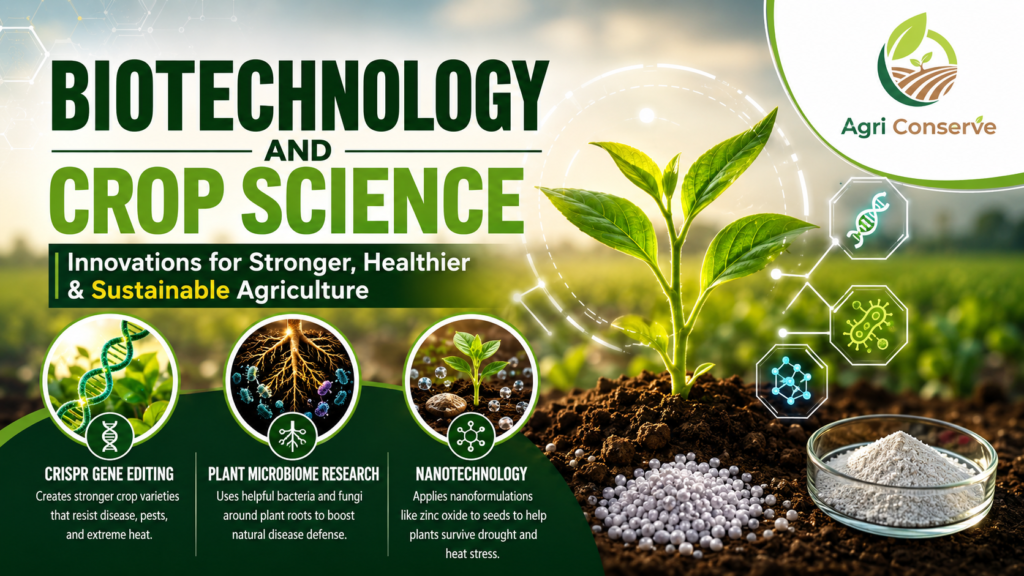
CRISPR gene-editing technology has transformed modern crop breeding by allowing scientists to make precise improvements to plant genetics. Unlike traditional breeding methods, CRISPR can quickly develop crop varieties that are naturally more resistant to diseases, insect pests, and extreme weather conditions such as heat and drought.
These improvements help farmers reduce crop losses, minimize dependence on chemical pesticides, and maintain stable yields even under challenging environmental conditions.
2. Plant Microbiome Research: Harnessing Nature’s Beneficial Microorganisms
Plants naturally interact with billions of beneficial bacteria and fungi that live around their roots, collectively known as the plant microbiome. Researchers are discovering how these microorganisms strengthen plant immunity, improve nutrient uptake, and enhance resistance against harmful pathogens.
By encouraging healthy microbial communities, farmers can naturally improve crop health while reducing the need for synthetic fertilizers and chemical disease-control products. This biological approach supports sustainable agriculture and healthier soils.
3. Nanotechnology: Enhancing Seed Performance Under Climate Stress
Nanotechnology is emerging as a promising innovation in crop science. Scientists are developing nanoformulations containing essential nutrients such as zinc oxide that can be applied directly to seeds.
These tiny particles improve seed germination, strengthen early plant growth, and help crops tolerate drought, heat stress, and other environmental challenges. By delivering nutrients more efficiently, nanotechnology contributes to healthier crops while reducing resource wastage.
Shaping the Future of Agriculture
The combination of CRISPR gene editing, plant microbiome research, and nanotechnology is revolutionizing modern agriculture. Together, these innovations are helping farmers produce stronger, healthier, and more climate-resilient crops while promoting sustainable farming practices.
As global food demand continues to rise and climate conditions become increasingly unpredictable, biotechnology and crop science will play a vital role in ensuring food security, protecting natural resources, and building a more sustainable agricultural future.