
A large, shiny apple might look like the perfect harvest. But for some apple growers, the fastest-growing fruit can become their biggest problem.
Researchers at Michigan State University have discovered that rapid growth can interfere with the movement of calcium inside apples, increasing their risk of developing a damaging condition called bitter pit.
The findings, published on October 23, 2026, offer a new explanation for a problem that costs apple producers millions of dollars and can turn seemingly healthy fruit into an unsellable product.
The Problem Hidden Beneath the Apple Skin
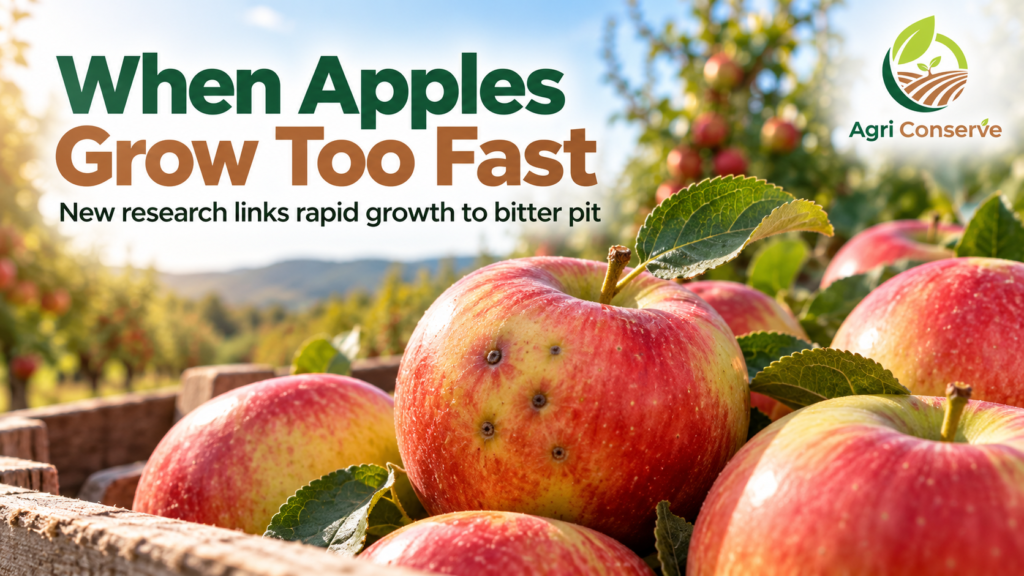
Bitter pit is a physiological disorder that produces small, dark, sunken patches on an apple’s surface or inside its flesh.
The affected tissue becomes damaged, and the fruit can develop an unpleasant taste.
For farmers, one of the most frustrating aspects is that bitter pit can become more noticeable after harvest, particularly during storage.
An apple that looks perfectly marketable when picked may later develop symptoms that reduce its commercial value.
The problem is especially serious in Honeycrisp apples, a popular variety known for its crisp texture and sweet flavour.
Researchers estimate that bitter pit causes tens of millions of dollars in annual revenue losses for the American Honeycrisp industry.
Scientists Found Something Unexpected
For years, growers and researchers have associated bitter pit with calcium deficiency and larger fruit size.
But the Michigan State University team wanted to investigate whether fruit size was actually responsible or whether something else was happening as apples developed.
They studied Honeycrisp apples under different growing conditions, changing the number of fruits on trees to influence how quickly individual apples grew.
The results revealed a clear relationship.
Apples that grew faster experienced earlier disruption to the tissues responsible for transporting calcium.
These tissues, called xylem, carry water and minerals through the plant.
When calcium transport declined, the apples became more vulnerable to bitter pit.
In the fastest-growing treatment, xylem transport fell to half its maximum level approximately 1.7 weeks earlier than in the slower-growing treatment.
The researchers also observed corresponding reductions in calcium concentrations in the apple peel.
Why Growth Speed Matters
Calcium plays an important role in maintaining the structure and stability of plant cells.
Apple fruits receive calcium primarily through their xylem during development.
The new research suggests that rapid fruit growth can compromise this transport system, effectively restricting calcium delivery before the fruit finishes developing.
That helps explain why bitter pit can occur even when growers take steps to manage calcium nutrition.
The problem may not simply involve how much calcium is available.
It may also involve whether the fruit can continue transporting enough calcium as it grows.
To investigate this further, scientists temporarily shaded some apple branches to slow fruit growth.
When they removed the shade, growth accelerated. These growth surges were associated with reduced xylem transport, strengthening the connection between growth rate and the disorder.
What Could This Mean for Apple Farmers?
The findings could eventually change how growers manage Honeycrisp orchards.
Instead of focusing only on calcium applications or final fruit size, farmers may need to pay closer attention to growth patterns during the season.
The researchers suggest that carefully managing irrigation, crop load and other factors influencing fruit growth could offer opportunities to reduce bitter pit.
However, these approaches require further testing before growers can use them as established recommendations.
Slowing fruit growth too much could create other problems, including smaller fruit and lower market returns.
The challenge is finding a balance between productivity, fruit size and quality.
The Bigger Lesson for Fruit Farming
Apple growers invest significant resources in pruning, thinning, irrigation, nutrition and storage to produce fruit that meets market expectations.
But the new study highlights why higher production does not always translate into greater profitability.
A large harvest has limited value if a substantial portion of the fruit cannot be sold.
For researchers, understanding how growth affects internal nutrient movement could lead to more targeted orchard-management strategies.
The findings may also encourage scientists to investigate similar relationships in other fruit crops, although those applications remain unproven.
For now, the clearest lesson comes from Honeycrisp apples.
A successful harvest is not simply about growing bigger fruit. It is about growing fruit that maintains its quality from the orchard to the consumer.