
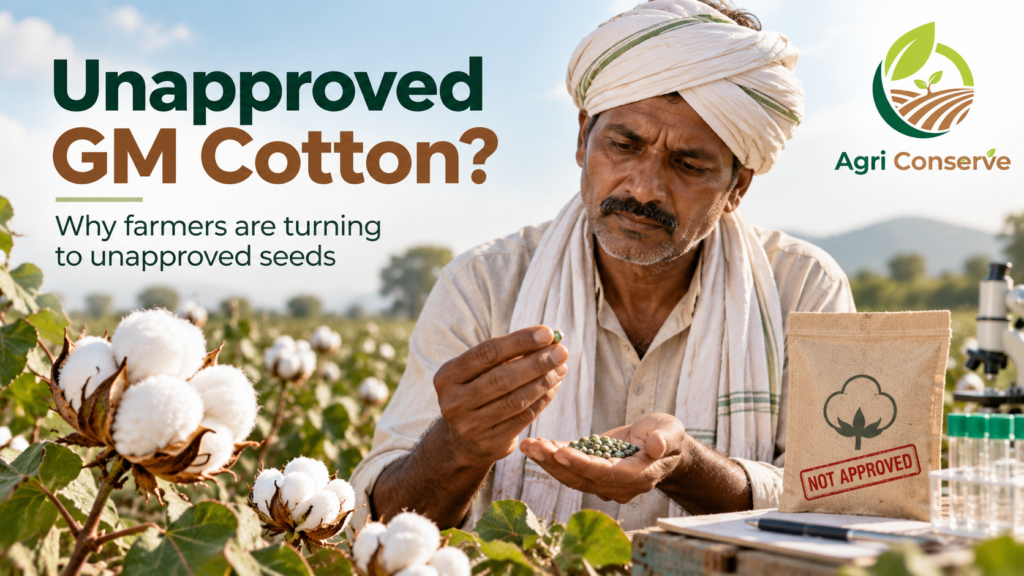

A farmer buying cotton seeds usually wants three things: a healthy crop, fewer pests and a harvest that makes the season worthwhile.
But a new study suggests that thousands of Indian cotton farmers are turning to seeds that haven’t received government approval, largely because they are struggling with the cost of controlling weeds and insects.
The study estimates that 24% to 30% of India’s cotton-growing area during the 2025–26 season may have been planted with unauthorised genetically modified (GM) cotton hybrids.
That is a striking figure for one of the world’s major cotton-producing countries. It also raises an uncomfortable question: Why are farmers choosing unapproved technology when regulated alternatives are available?
What the Researchers Found
The South Asia Biotechnology Centre conducted the study with support from the Federation of Seed Industry of India and the National Seed Association of India.
Researchers collected 227 seed and leaf samples from cotton-growing areas across Maharashtra, Telangana, Andhra Pradesh and Rajasthan. Their investigation covered farmers in 16 districts, focusing on locations where unauthorised cotton cultivation was suspected.
Laboratory testing revealed genetically modified traits that India has not approved for commercial cultivation.
One was cp4-epsps, a gene that enables cotton plants to tolerate glyphosate, an herbicide used to control weeds.
Another was Vip3A, an insect-resistance gene associated with protection against certain caterpillar pests.
The researchers detected the herbicide-tolerance trait in approximately 73% of the samples and Vip3A in about 54%.
However, these samples came from selected hotspots, not a random national survey. The researchers developed their broader acreage estimate using additional field and market information.
The Economics Behind the Decision
The attraction of these cotton hybrids becomes clearer when looking at the cost of farming.
Weeding is labour-intensive, and finding enough agricultural workers can be difficult during the growing season.
According to the study, manual weed control can cost farmers approximately ₹12,000 to ₹15,000 per acre.
By comparison, the researchers estimated that glyphosate-based weed control could cost around ₹750 to ₹850 per acre for multiple applications.
For a farmer managing several acres, that difference can be significant.
Herbicide-tolerant cotton allows growers to apply certain herbicides without killing the crop itself. This can reduce manual weeding requirements, which helps explain why farmers may seek out seeds carrying the trait despite their unapproved status.
Pest management is another concern. Farmers have faced growing difficulties with pink bollworm, including resistance to some existing Bt cotton technologies.
The study suggests that these practical pressures are contributing to demand for newer genetic traits.
The Problem With an Unregulated Seed Market
India already permits commercial cultivation of approved Bt cotton hybrids containing specific insect-resistance genes.
But herbicide-tolerant Bt cotton and hybrids carrying additional unapproved traits have not completed the required regulatory approval process.
That distinction matters.
A technology being used in farmers’ fields does not automatically mean regulators have assessed and approved its safety, performance and associated management requirements.
An informal seed market also creates problems with accountability.
Farmers may struggle to confirm a seed’s genetic identity, assess its quality or identify who is responsible if the crop fails to perform as promised.
For an industry that increasingly values traceability and responsible production, that uncertainty deserves attention.
A Bigger Question for Agricultural Biotechnology
The findings reveal a difficult gap between what farmers need and what India’s regulatory system currently permits.
Farmers want technologies that reduce labour costs and protect yields. Regulators must evaluate new traits for biosafety, environmental impacts and appropriate agricultural use.
Both concerns matter.
The challenge is finding a system that supports timely scientific evaluation while preventing unverified planting material from spreading through informal markets.
There is also a need for better farmer education, reliable seed certification and practical alternatives for weed and pest management.
The study’s national estimate still requires careful interpretation because researchers concentrated their field sampling in suspected hotspots. Nevertheless, the findings indicate a problem that agricultural authorities and seed companies cannot easily ignore.
The Future of Cotton Depends on More Than Better Seeds
The debate surrounding unauthorised GM cotton is not simply about whether biotechnology is good or bad for agriculture.
It is about whether farmers can access effective technologies through systems that provide proper testing, transparency and accountability.
If regulated seeds become less attractive than those available through informal channels, policymakers need to understand why.
For India’s cotton sector, the next step should involve stronger monitoring, credible research and practical engagement with farmers.
The real challenge is ensuring that agricultural innovation reaches farmers without leaving seed quality, safety and trust behind.