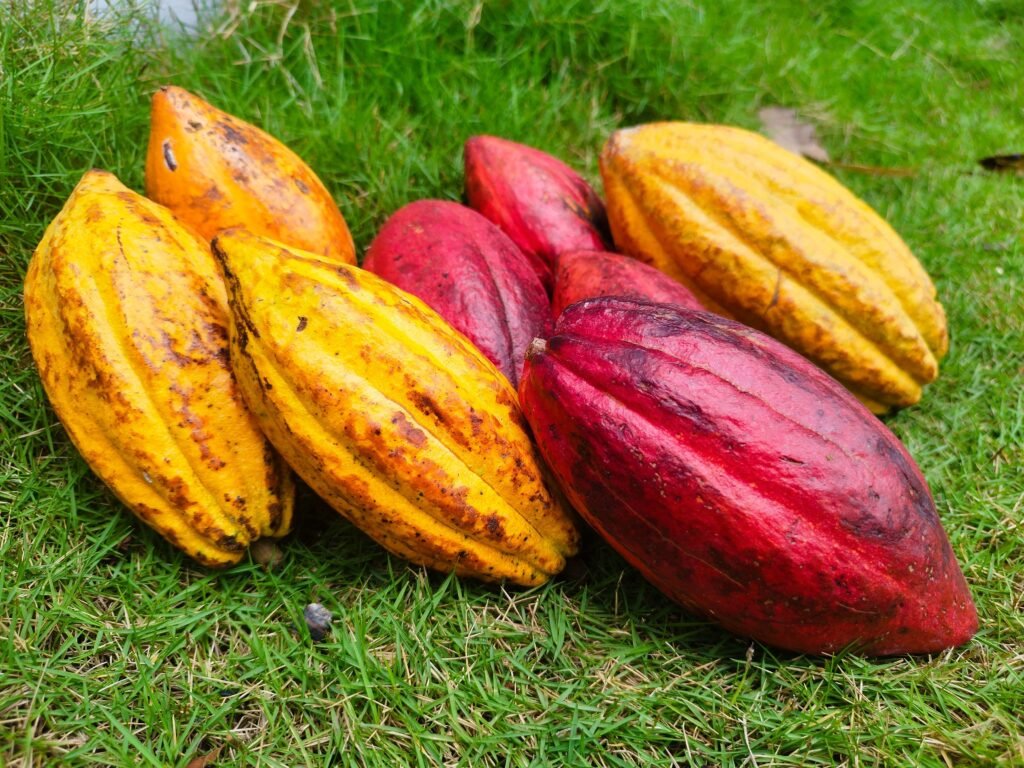

The Amazon is usually discussed in terms of what needs to be protected.
But Brazil is increasingly asking a different question:
Can agricultural production itself become part of the restoration strategy?
That question is behind a growing push to expand cocoa agroforestry in the Amazon, where cocoa trees are grown alongside native and other useful trees instead of replacing forests with conventional monocultures.
The issue has gained fresh attention this week as Brazil promotes cocoa as a potential tool for restoring degraded pasture while creating a new source of income for farmers.
From cattle pasture to cocoa agroforestry
Brazil’s Inova Cacau 2030 plan aims to strengthen the country’s cocoa sector while improving productivity, farmer incomes and environmental performance.
The plan was formally established by Brazil’s Ministry of Agriculture and Livestock in May 2026 and will run through 2030. Its objectives include increasing productivity, improving cocoa quality, raising producer incomes and strengthening Brazil’s position as a sustainable cocoa origin.
One particularly interesting part is its focus on agroforestry systems.
Instead of clearing new forest for cocoa, the strategy aims to expand production in areas that have already been degraded or converted from other land uses.
Brazil’s own Inova Cacau documentation says that a large share of cocoa production in Pará already occurs on previously degraded land, often involving family farmers and agroforestry systems.
That creates a potentially powerful combination.
Food production + farmer income + landscape restoration.
Why cocoa works differently from a typical monoculture
Cocoa naturally fits into shaded production systems.
Farmers can grow cocoa alongside trees such as açaí and babaçu, creating a more complex agricultural landscape than a single-crop field. Reuters reports that Brazil’s current push includes converting some cattle areas toward these kinds of agroforestry systems.
The objective is not simply to plant more cocoa.
It is to create productive landscapes where trees remain part of the farming system.
That can help maintain habitat, protect soil and create additional products for farmers, depending on the agroforestry model.
There is already a bigger climate project behind it
Brazil is also supporting the Cacau Brasil Agrofloresta project in Pará and Bahia.
The four-year initiative has approximately US$31 million in funding and aims to establish more than 12,000 hectares of agroforestry systems, with an expected carbon sequestration potential of around 5 million tonnes of carbon.
The project is being implemented through cooperation involving Brazil’s Ministry of Agriculture, CEPLAC, IICA and other partners.
That makes cocoa more than a commodity story.
It is becoming part of a broader experiment in productive conservation, where land restoration and agricultural production are designed to work together.
But there is a serious warning
Cocoa is not automatically sustainable simply because it grows in the Amazon.
This is where the story becomes more complicated.
Rising cocoa prices are attracting investment, and Reuters reports concerns that large-scale producers could turn toward monoculture or clear land if expansion is not properly controlled. There have also been reports of environmental and labour problems in some production areas.
That means the distinction between forest-friendly cocoa and simply more cocoa is extremely important.
If cocoa expansion leads to new deforestation, the environmental argument quickly weakens.
If it instead replaces degraded pasture, maintains tree cover and provides viable incomes for smallholders, the outcome can look very different.
The farmer has to remain at the centre
Brazil’s strategy recognises that environmental goals will only last if cocoa production also makes economic sense.
The Inova Cacau 2030 framework includes economic, social, environmental and governance pillars. It also focuses on improving producer incomes, supporting rural families, strengthening cooperatives and encouraging sustainable production systems.
That is an important lesson for sustainable agriculture.
Farmers cannot be expected to become landscape restoration managers without a viable business model.
The strongest agroforestry systems are therefore likely to be those where environmental benefits and farm economics reinforce each other.
A possible model for other tropical regions
Brazil’s cocoa experiment is worth watching far beyond the Amazon.
Across tropical regions, governments are searching for ways to restore degraded land without removing agricultural livelihoods from the equation.
Cocoa is not a universal answer.
But the broader model is interesting:
Take degraded land. Add productive trees. Protect existing vegetation. Diversify farm income. Build market access. And make restoration economically worthwhile.
If Brazil can demonstrate that this model works at scale, cocoa could become an example of how agricultural production can contribute to landscape recovery rather than simply competing with it.
The biggest test, however, will be whether Brazil can expand cocoa without repeating the environmental mistakes associated with other booming agricultural commodities.
The future of sustainable farming may not always be about choosing between agriculture and conservation. In the right system, the farm itself can become part of the restoration strategy.