
For years, sustainable agriculture has faced a difficult question: will farmers adopt greener practices if those practices do not improve their livelihoods?
Vietnam is offering an increasingly interesting answer.
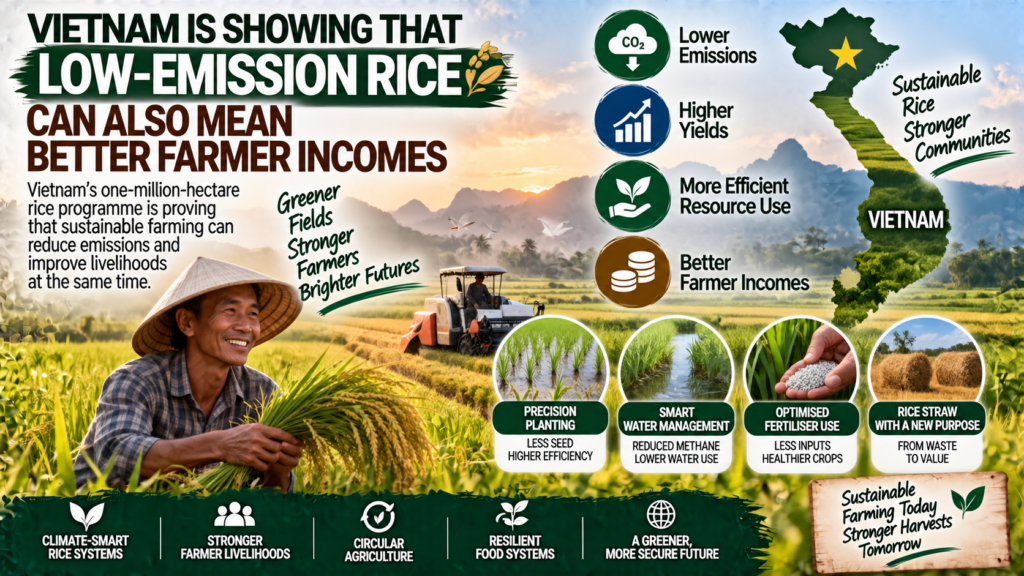
The country’s ambitious programme to develop 1 million hectares of high-quality, low-emission rice in the Mekong Delta by 2030 is moving beyond pilot projects and into large-scale implementation. New results from the programme suggest that reducing emissions does not necessarily mean asking farmers to accept lower productivity or higher costs.
The change is happening in the field
One of the most promising developments is the wider use of precision nutrient management and mechanised rice planting.
In Can Tho, results from eight 50-hectare demonstration models conducted between 2024 and 2026 showed that precision fertiliser placement combined with row seeding could reduce seed use to around 50–60 kg per hectare and nitrogen use by about 30% compared with the programme’s earlier benchmark.
The same trials reported pesticide reductions of at least 20%, around 5% higher yields and lower greenhouse-gas emissions.
That combination is what makes the programme particularly interesting.
It is not simply asking farmers to produce “greener rice.” It is trying to make the production system more efficient at the same time.
Water is becoming part of the solution
The programme also promotes alternate wetting and drying, where rice fields are periodically allowed to dry instead of remaining continuously flooded.
This matters because flooded rice fields create conditions that produce methane.
Managing water differently can therefore reduce emissions while potentially lowering irrigation requirements. The programme also encourages farmers not to burn rice straw after harvest, instead collecting, reusing or incorporating it into the production system.
That begins to turn the rice field into something closer to a circular system.
Water, fertiliser, straw, machinery and crop residues are being considered together rather than as separate parts of production.
The economics may be the real breakthrough
The International Rice Research Institute has argued that Vietnam’s experience is particularly important because regenerative and low-emission agriculture must create economic value for farmers if it is going to spread at scale.
That is a crucial point.
Farmers cannot be expected to carry the cost of climate action indefinitely.
If a new practice saves fertiliser, reduces water use, improves yields, lowers post-harvest losses or creates access to higher-value markets, sustainability becomes much easier to adopt.
Vietnam is increasingly trying to build those connections into the programme.
The rice straw story is just as interesting
The initiative is also encouraging new uses for rice straw.
Instead of burning it, the material can enter other parts of the rural economy, including livestock feed, mushroom production, organic inputs and other agricultural applications. IRRI’s work in the Mekong Delta has been developing these kinds of circular-economy models alongside the one-million-hectare programme.
That means the objective is gradually moving beyond simply reducing emissions from rice cultivation.
The larger ambition is to create a higher-value rice system in which fewer resources are wasted.
Why other rice-growing countries should watch Vietnam
The Mekong Delta is one of the world’s most important rice-producing regions, and the lessons emerging there could matter far beyond Vietnam.
India, Thailand, Indonesia, Bangladesh and other major rice producers are all looking for ways to reduce agricultural emissions without threatening food production or farmer incomes.
Vietnam’s experience suggests that the strongest climate-smart farming models may not be the ones that focus on carbon alone.
They may be the ones that make farmers more efficient, more resilient and more profitable while reducing environmental pressure at the same time.
That is a much more compelling proposition for agriculture.
Sustainable farming becomes far more powerful when farmers do not have to choose between protecting the environment and making a living.