
Agricultural innovation often looks impressive in a laboratory. The harder question is whether it can survive the realities of a farm.
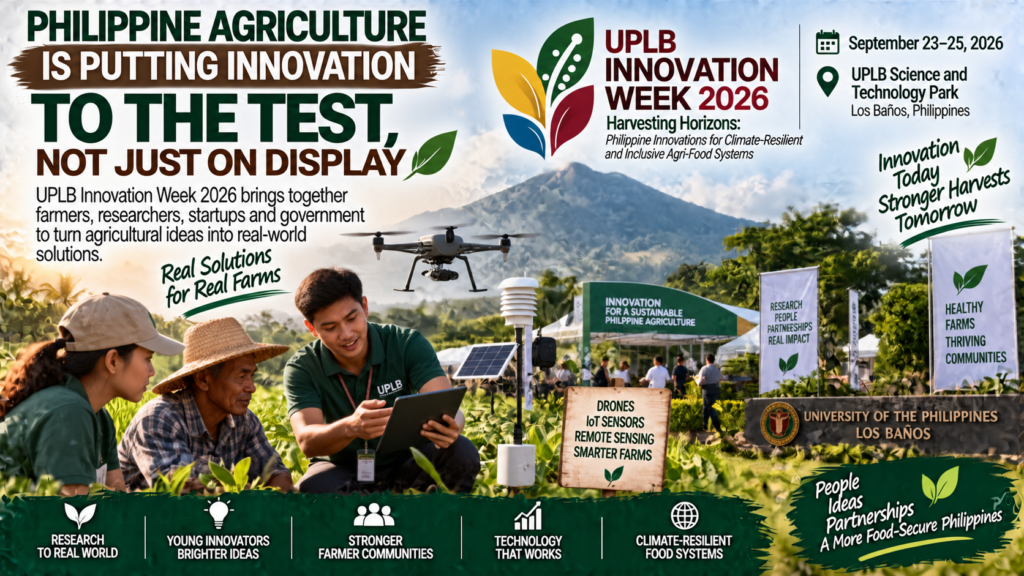
That question is taking centre stage in the Philippines today as Innovation Week 2026 opens at the University of the Philippines Los Baños (UPLB) Science and Technology Park. Running from September 23 to 25, the event brings researchers, farmers, startups, government agencies, businesses and young innovators together around one goal: moving agricultural ideas closer to actual use.
From research to something farmers can actually use
The event is built around the theme “Harvesting Horizons: Philippine Innovations for Climate-Resilient and Inclusive Agri-Food Systems.”
But what makes it interesting is the emphasis on adoption.
Today’s programme includes discussions on technology transfer, regulatory support and market access, alongside a forum connecting young farmers, student innovators, startups and industry leaders. The event also features an agricultural innovation marketplace showcasing technologies developed by universities, government-supported projects and private companies.
That reflects a problem agriculture has faced for years: good research does not automatically become good farming.
Tomorrow, the technologies leave the exhibition
One of the most practical parts of the three-day event begins on September 24.
Farmers, cooperatives and local governments will be able to see drones, IoT sensors and remote-sensing tools demonstrated for actual agricultural applications. The programme is specifically designed to help participants understand how these technologies can support decisions about soil, weather and farm management.
This is important because farmers do not necessarily need more technology.
They need technology that solves a problem they already have.
A soil sensor is useful if it helps a farmer manage irrigation. A drone matters if it can provide information that changes a crop-management decision. Remote sensing becomes valuable when its data reaches someone who can act on it.
Young innovators are being brought into the system
The event is also giving agriculture’s next generation a much bigger role.
Students and young entrepreneurs will participate in the NextGen Agri Forum, while the Agrinnovation QuizCon and later the Agri Hackathon are designed to encourage new ideas around agricultural science, biotechnology, climate resilience and food systems. Selected innovations will also have opportunities to connect with investors and industry partners.
That combination of science, entrepreneurship and farming could become increasingly important as agriculture faces challenges that cannot be solved by one sector alone.
The real opportunity is adoption
Perhaps the most important message from Innovation Week is that agricultural innovation should not end with invention.
UPLB describes the event as a platform connecting research and technology development with enterprise creation, policy support, investment and community adoption.
That connection matters.
A new agricultural technology can remain unused because of cost, regulations, lack of financing, limited farmer awareness or simply because it does not fit the way farms operate.
Solving those barriers can be just as important as developing the technology itself.
The Philippines is therefore trying something more ambitious than an agricultural exhibition.
It is creating a meeting point where researchers can meet farmers, innovators can meet investors and technologies can meet the people expected to use them.
If that connection works, the most valuable outcome of Innovation Week may not be the technology showcased this week.
It may be the innovations that actually make their way into Philippine fields.