
What happens when a disease in animals, unhealthy soil, unsafe food and environmental damage are treated as separate problems?
Often, the response comes too late.
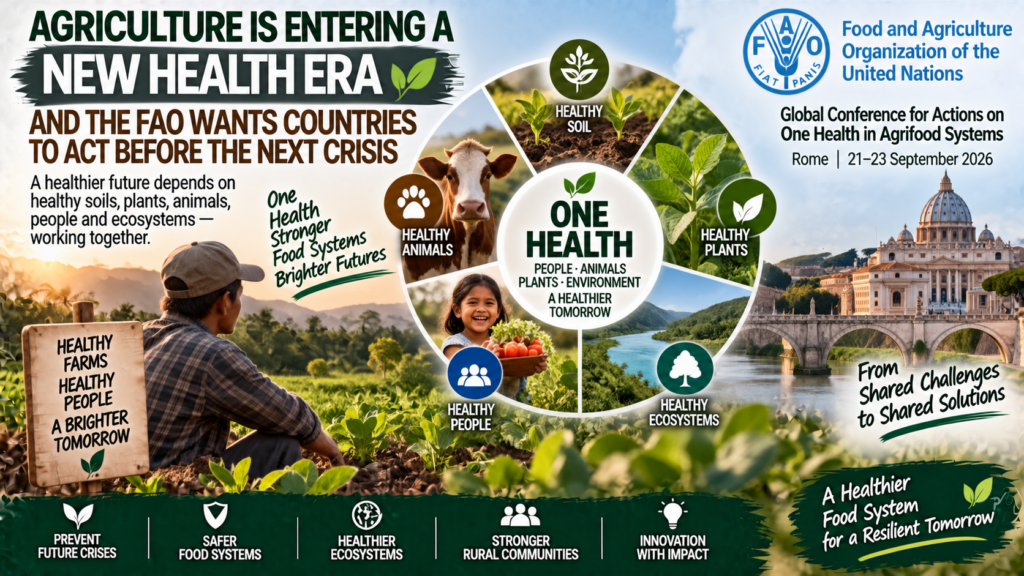
The FAO is trying to change that approach this week as global leaders, scientists, farmers, policymakers and other stakeholders gather in Rome for the Global Conference for Actions on One Health in Agrifood Systems, running from September 21 to 23. The central idea is simple: the health of people, animals, plants, soil, water and ecosystems is deeply connected.
Agriculture is more connected than it looks
A farm is not just a place where crops or animals are produced.
Soil affects plants. Plants affect animals. Animals interact with people. Water moves between farms and ecosystems. Microorganisms influence soil fertility, plant health and disease. What happens in one part of this system can eventually affect another.
The FAO says these connections are becoming increasingly important as climate change, biodiversity loss, emerging diseases, antimicrobial resistance, food-safety risks and environmental degradation put pressure on food systems.
That is where the One Health approach comes in.
Rather than creating separate policies for agriculture, animal health, environmental protection and public health, it encourages countries to look at these issues together.
The focus is moving from reaction to prevention
One of the most interesting aspects of the conference is its emphasis on preventing problems before they become major crises.
Today’s programme includes discussions on healthy production systems, safe and nutritious food, soil health, rangelands and pastoralism, and the role of women farmers. A Global Youth Forum is also running alongside the main conference.
This matters because prevention can be considerably less disruptive than responding after a disease outbreak, food-safety incident or environmental crisis has already spread.
For agriculture, that could mean better disease surveillance, healthier soils, safer production systems and stronger early-warning mechanisms working together rather than independently.
Soil is becoming part of the health conversation
One particularly interesting session today focuses specifically on soil health as a foundation of One Health.
That may sound like an agricultural issue, but healthy soil influences much more than crop yields.
Soil affects water retention, nutrient cycling, biodiversity and the resilience of agricultural ecosystems. Poor soil can increase dependence on external inputs and make farms more vulnerable to drought and other stresses.
Putting soil health alongside animal health, food safety and human health reflects a broader change in how food systems are being understood.
Technology alone will not solve the problem
The conference is also looking at innovation, science and local knowledge.
But the FAO is not presenting technology as a standalone answer. Its agenda calls for stronger collaboration between agriculture, environment, health, finance and other sectors, along with investment that can turn promising ideas into measurable action.
That is important because many agricultural problems cross institutional boundaries.
A farmer dealing with contaminated water, for example, may simultaneously face a crop-health issue, a livestock-health concern and a food-safety risk. Treating each problem separately can miss the connection between them.
What could come out of the conference?
The FAO expects the three-day meeting to help establish a shared global vision and priority actions for implementing One Health in agrifood systems.
It also plans to identify investment opportunities and launch a One Health knowledge and intelligence hub.
The real test, however, will come after the conference.
A global framework only becomes valuable when countries translate it into better surveillance, stronger agricultural practices, healthier ecosystems and practical support for farmers.
That is why this week’s discussions are worth watching.
The future of sustainable agriculture may depend on recognising that a healthy food system cannot be built by protecting crops alone. It requires healthy soil, healthy animals, healthy ecosystems and healthy people working as parts of the same system.