
Across Europe, the farming calendar is quietly changing.
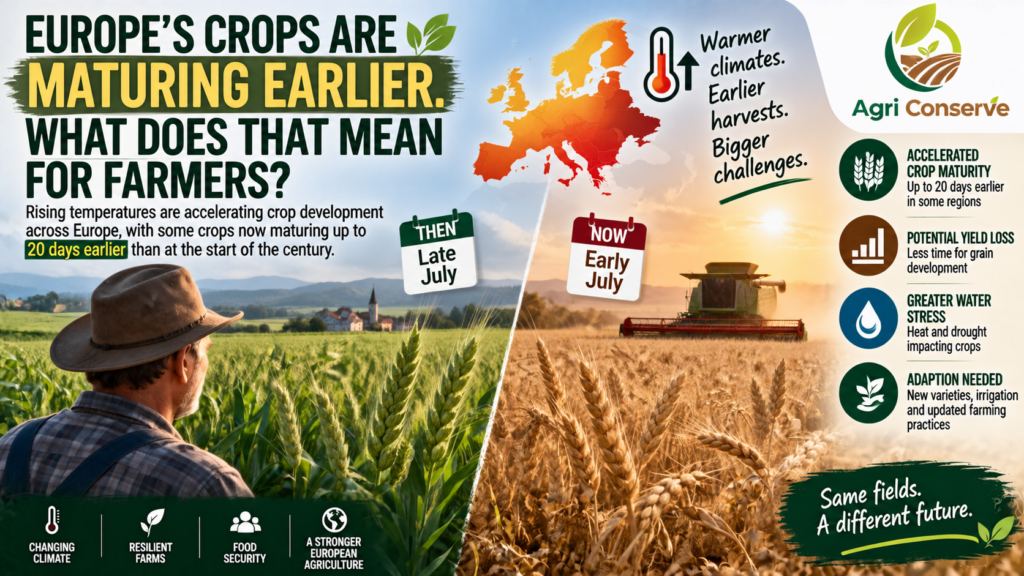
Crops that once followed relatively predictable growth patterns are now reaching maturity earlier as rising temperatures accelerate their development. In some parts of Europe, winter wheat can now mature up to 20 days earlier than it did around the start of the century.
At first glance, an earlier harvest might sound like good news.
But the reality is more complicated.
When Heat Speeds Up the Crop
Plants need enough time to develop properly. When temperatures rise too quickly, crops can accumulate the heat they need to mature before they have had enough time to build grain, biomass or yield.
The European Commission’s Joint Research Centre has already documented this effect during the 2026 growing season. Repeated heatwaves shortened the grain-filling period of winter crops and brought harvests forward. In parts of central Europe, crops matured prematurely, raising concerns about grain size and quality.
This is particularly important for crops such as wheat, maize and rapeseed, where the timing of flowering, grain filling and maturity can strongly influence the final harvest.
Earlier Does Not Necessarily Mean Better
The problem is that accelerated development can come with a productivity cost.
The latest European data shows how heat and water stress are occurring together. Persistent high temperatures and exceptional rainfall deficits have reduced biomass accumulation, affected flowering and accelerated crop senescence across western and central Europe. The JRC sharply reduced its 2026 yield forecasts for several summer crops, with grain maize among the crops facing some of the largest reductions.
France provides a particularly stark example.
Reuters reported that only 27% of France’s grain maize crop was rated good or excellent by August 31, the lowest level recorded since monitoring began in 2011. France’s agriculture ministry has projected a substantial year-on-year decline in maize production.
So the issue is not simply that farmers are harvesting earlier.
It is that the crop may be reaching the finish line before it has reached its full potential.
The Farming Calendar May Need to Adapt
For farmers, changing crop development creates a difficult planning problem.
Planting dates, irrigation schedules, crop varieties and harvesting operations are all connected to the crop’s development cycle. If temperatures continue to push those cycles forward, traditional calendars may become less reliable.
That makes crop monitoring increasingly important.
The JRC’s MARS system already combines weather information, satellite observations and crop modelling to monitor agricultural conditions and produce yield forecasts across Europe.
This kind of technology can help farmers and policymakers understand where crops are developing unusually fast and where heat or water stress is beginning to affect yields.
Adaptation Will Need More Than One Solution
There is no single farming practice that can solve the problem.
Farmers may need to consider varieties better suited to warmer conditions, more efficient irrigation, improved soil moisture management and changes in planting or harvesting schedules. The European Commission’s own adaptation research highlights water management, changing cultivation practices and adjusting crop choices as important responses to climate pressure.
The bigger lesson is that climate change is not only changing how much farmers can grow.
It is changing when crops grow, when they mature and when farmers need to act.
And that shift could have consequences far beyond individual farms, influencing grain quality, food prices, supply chains and agricultural planning across Europe.
The farming calendar was once largely written by the seasons. Increasingly, farmers may have to write it with temperature, water and real-time crop data as well.


