
A farmer may know exactly how much land they own, how many animals they have and what they planted this season.
But when a farm uses digital tools, another question becomes increasingly difficult to answer:
Who owns all the data those technologies generate?
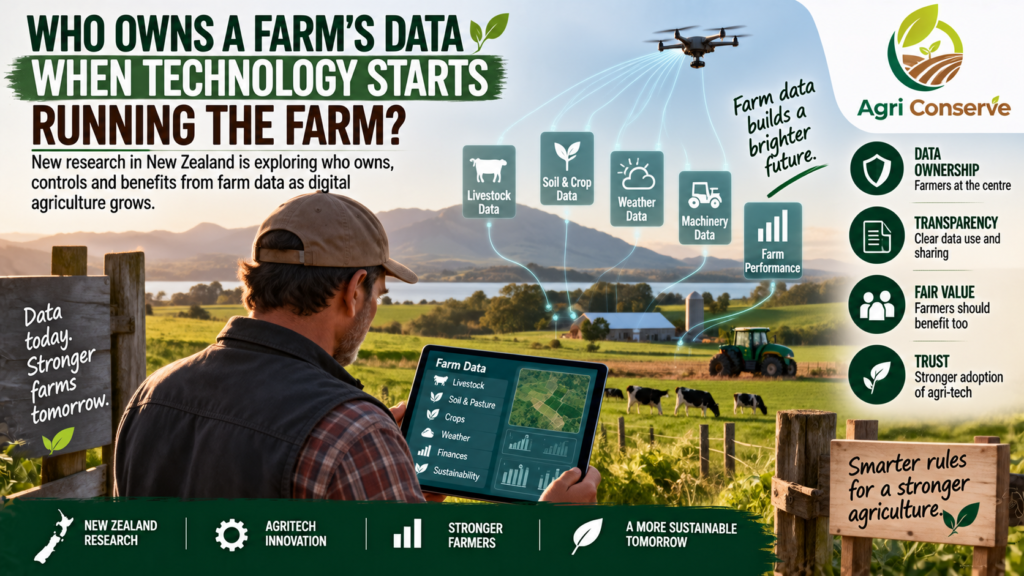
That question is now at the centre of new research in New Zealand, where agricultural technology is becoming deeply embedded in everyday farm management. A study led by researchers at Massey University is examining how farmers understand the collection, sharing, storage and use of their farm data.
The Farm Is Becoming a Data Generator
Modern farms can generate enormous amounts of information.
Livestock management systems record animal performance. Sensors monitor soil and pasture conditions. Digital platforms track environmental compliance, finances and production. Crop technologies can record field conditions and management decisions.
Each tool may provide useful information on its own. But when these systems are connected, a farm can effectively become a continuous source of digital data.
New Zealand currently has more than 500 agritech firms, according to the researchers behind the new study. As adoption increases, questions about who controls this information become more important.
The Problem Is Not Just Privacy
Farm data is different from ordinary personal information.
It can reveal how a farm operates, what it produces, how productive its land is, what inputs it uses and how its livestock or crops are performing.
That information can have commercial value.
Massey University researcher Dr Albert Boaitey argues that farm data should be treated as a valuable asset rather than simply as an input for digital agricultural systems. The research team is particularly interested in whether farmers understand what happens to their information after they provide it to technology companies or service providers.
That creates an important question for the future of digital agriculture:
If farmers create the data, should they also share in the value created from it?
Trust Could Become Agriculture’s Digital Currency
Technology adoption depends heavily on trust.
Farmers are unlikely to embrace digital systems fully if they do not understand what information is being collected, who can access it or how it might eventually be used.
This issue becomes even more important when several companies, platforms and service providers are connected to the same farm.
The Massey research is examining these concerns with the aim of providing evidence that can help shape agricultural data governance in New Zealand. The researchers hope stronger governance can keep farmers at the centre of the country’s digital agricultural transition.
Data Governance Is Becoming Part of Farming
This debate is not limited to New Zealand.
As precision agriculture, artificial intelligence, satellite monitoring and connected farm equipment expand around the world, agricultural data is becoming part of the infrastructure of modern farming.
The question is no longer simply whether farmers should use technology.
It is also whether farmers have enough control over the information generated by that technology.
That could eventually influence how digital agriculture contracts are written, how data-sharing permissions work and whether farmers can benefit financially from the information their farms generate.
The next stage of smart farming may not only be about smarter machines. It may be about creating smarter rules for the data those machines collect.
For agriculture to become truly digital, farmers will need more than access to technology. They will need confidence that their information is being handled transparently, responsibly and in a way that creates value for them too.


