
A farmer in a remote village may be far away from an agricultural office, but there is one service that already reaches many rural communities: the postal network.
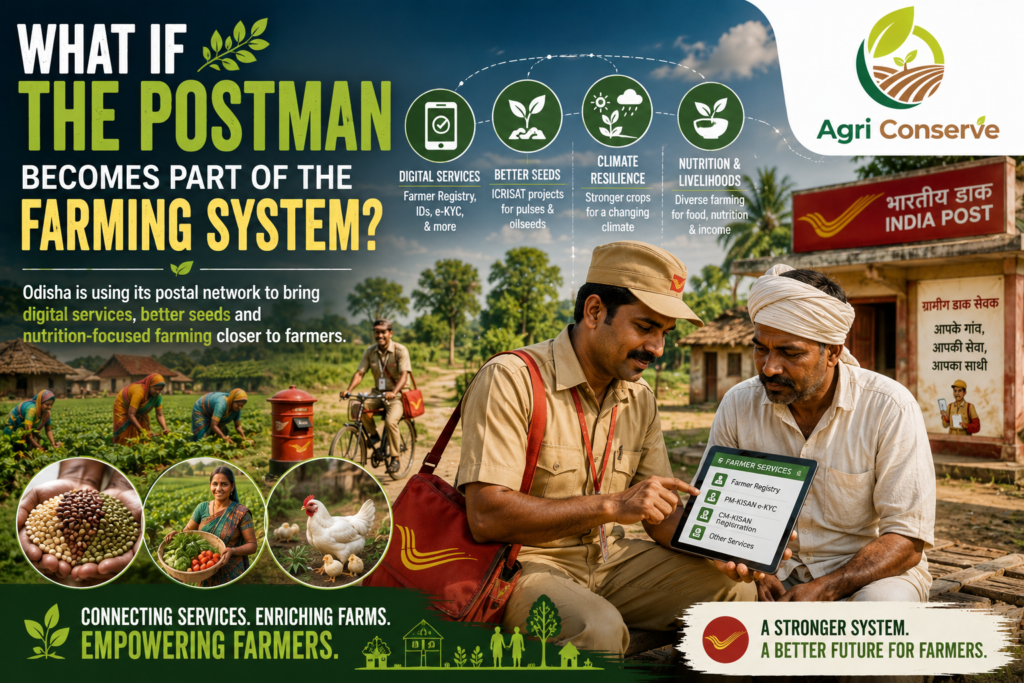
Odisha is now trying to use that network to bring agricultural digital services closer to farmers.
The state’s Agriculture and Farmers’ Empowerment Department has signed an agreement with the Department of Posts, along with partnerships with ICRISAT and the M.S. Swaminathan Research Foundation, to strengthen digital agriculture, seed systems, climate resilience and farmer livelihoods.
The interesting part is the role planned for Gramin Dak Sevaks. They are expected to help farmers with Farmer Registry enrolment, Farmer ID generation, CM-KISAN registration, PM-KISAN e-KYC and other digital services.
For farmers in remote areas, that could make digital agricultural services much more accessible.
From Digital Agriculture to Better Seeds
The partnerships go beyond registration and digital services.
ICRISAT is working with Odisha on projects focused on improving seed systems for pulses and oilseeds, including chickpea seed production and speed breeding for improved and climate-resilient varieties. The goal is to make quality seed more available while encouraging crop diversification.
That matters because better technology is useful only when farmers can actually access the inputs needed to benefit from it.
A farmer may receive better weather information or agricultural advice, for example, but still struggle if quality seed is unavailable locally.
Odisha’s approach attempts to connect these pieces—digital services, research, seed systems and farmer support.
Farming for Food and Nutrition, Not Just Yield
Another partnership takes an even broader approach.
The three-year project with MSSRF is expected to work with around 3,000 small and marginal farmers in Nayagarh district. It will combine biofortified crops, pulses, vegetables, backyard poultry, aquaculture, seed banks, nutrition gardens and community processing units.
This is important because a successful farm is not measured only by how much it produces.
What farmers grow can also influence household nutrition, dietary diversity and income.
A diversified farming system can potentially give families more than one source of food and income instead of depending heavily on a single crop.
The Bigger Lesson
Agricultural innovation does not always have to mean a robot in a field or an advanced AI system.
Sometimes innovation is about using infrastructure that already exists in a smarter way.
A postal worker helping a farmer complete a digital registration, a research institute improving local seed systems and a community growing nutrient-rich crops may seem like completely separate activities.
Together, however, they form something much more valuable: an agricultural system designed to bring knowledge, services, seeds and opportunities closer to the farmer.
The future of farming may not be built by one technology.
It may be built by connecting many small pieces that already exist.