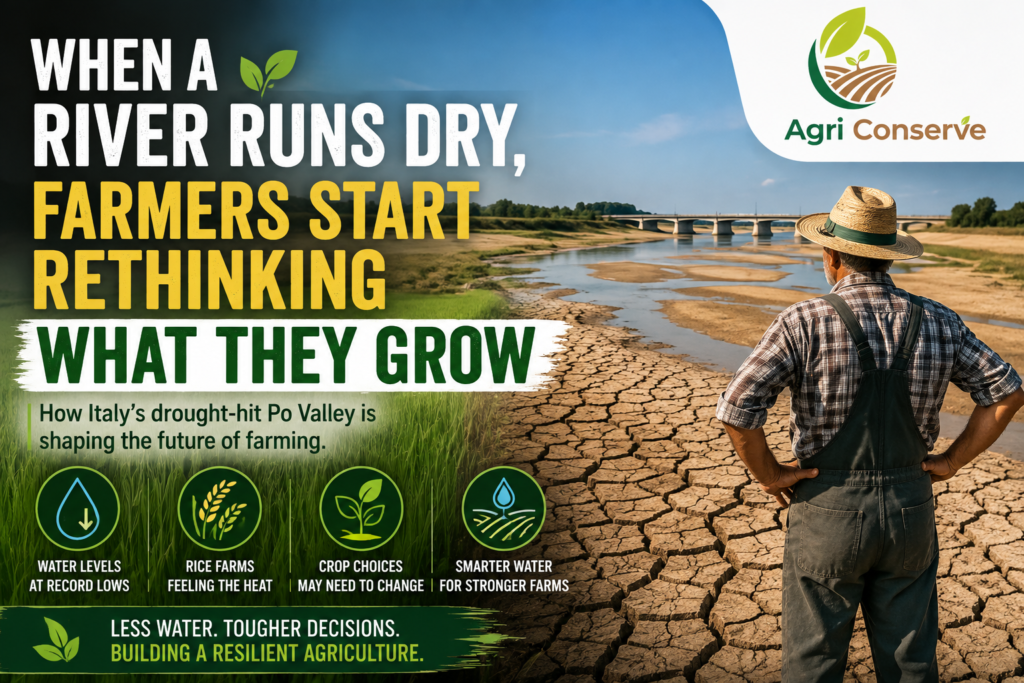

In Italy’s Po Valley, farmers are facing an uncomfortable question: what should they plant when there may not be enough water to grow it?
The Po River is at exceptionally low levels after a severe drought, putting pressure on one of Europe’s most important agricultural regions. The valley supports rice, maize, vegetables, fruit and livestock production, but farmers are increasingly having to think beyond simply finding enough water for the current crop.
For rice growers, the problem is particularly serious. Rice requires large amounts of water, and farmers in Italy’s traditional rice-growing areas have already had to reduce or abandon some cultivated land because supplies are becoming harder to secure. Italy is Europe’s largest rice producer, making the situation important beyond the farms directly affected.
The Crop May Have to Change
When water becomes unreliable, farmers cannot simply keep farming in exactly the same way.
Some growers are considering crops that require less water, while irrigation organisations are introducing rotation systems so available supplies can be shared between farms. Other ideas include storing more water during wetter periods and improving the ability of soils to retain moisture.
That represents a much bigger shift in agriculture.
For decades, farmers have often selected crops based on soil, climate, market demand and tradition. Increasingly, water availability is becoming another deciding factor.
This Is Not Just an Italian Problem
The Po Valley is a particularly clear example of a challenge that is appearing in agricultural regions around the world.
When rivers, reservoirs and groundwater supplies become less predictable, farmers may have to reconsider which crops make economic and environmental sense. A crop that was profitable for generations may become increasingly difficult to grow if its water requirements no longer match local conditions.
This is where agricultural research becomes important. Drought-tolerant varieties, precision irrigation, soil-water management and better seasonal forecasting can give farmers more options.
But technology alone cannot solve a water shortage.
Agriculture May Need to Become More Flexible
The future of farming may involve more than finding ways to grow the same crops with less water. In some regions, it could mean changing the crops themselves.
That could reshape local food systems, agricultural markets and even traditional farming identities.
The lesson from Italy’s Po Valley is simple but important: when water availability changes, farmers may eventually have to change with it.