
For farmers, rain is usually welcome. This year, in parts of Canada, there has been too much of it.
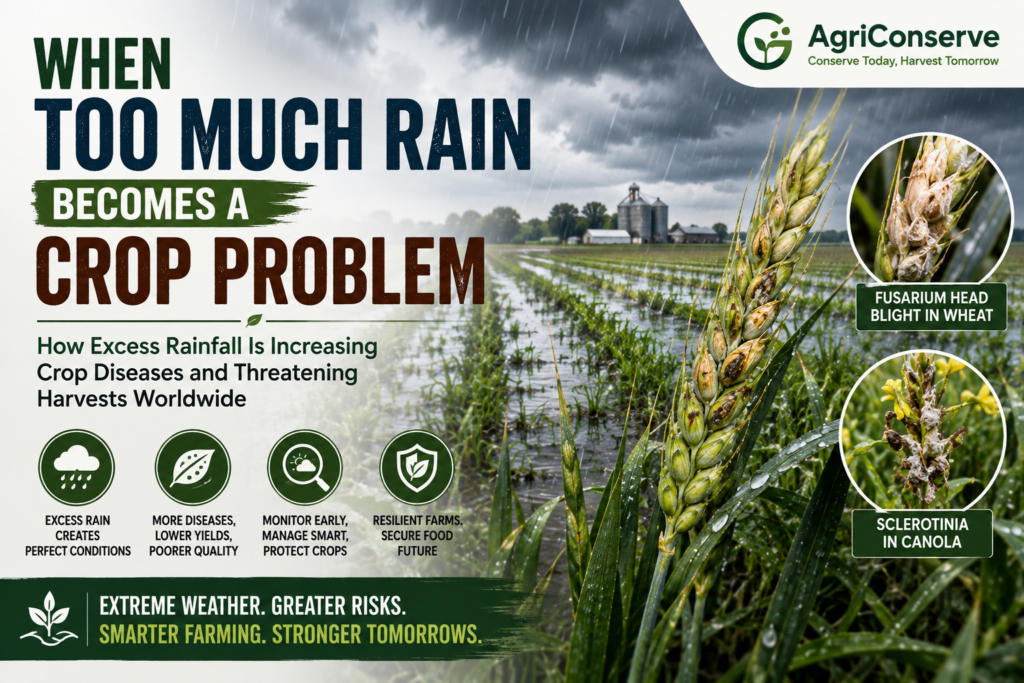
A wet spring and early summer across parts of Western Canada have created conditions that are now raising concerns about crop diseases just as the harvest season approaches. Farmers are watching wheat, canola and pulse crops closely, with fungal diseases threatening both yields and grain quality.
Among the major concerns is Fusarium head blight in wheat, along with diseases such as sclerotinia in canola.
The problem is a reminder that agriculture is not simply about having enough water. Timing matters just as much.
When Weather Creates the Perfect Conditions for Disease
Excess moisture can create an ideal environment for fungal diseases to develop and spread. For farmers, that can mean another difficult decision: whether the potential damage justifies spending more money on crop protection.
In Saskatchewan, some farmers have already invested heavily in fungicides in an attempt to protect crops before harvest. But with fertilizer, fuel and other input costs already putting pressure on farm margins, disease management can become an expensive gamble.
And the outcome is not always clear until the crop is harvested.
A Problem That Goes Beyond Canada
What is happening in Canada reflects a wider challenge for agriculture.
Farmers in different parts of the world are facing very different weather extremes. Some are dealing with drought and heat, while others are dealing with excessive rainfall and flooding. Both can create conditions that damage crops and encourage pests or diseases.
That makes crop protection increasingly dependent on more than simply applying a treatment after a problem appears.
Early disease detection, weather monitoring, resistant crop varieties and better forecasting can help farmers act before losses become severe. Agricultural researchers are also exploring biological control and other lower-risk approaches to crop protection.
Agriculture and Agri-Food Canada, for example, has been researching forecasting systems for Fusarium head blight and biological approaches to managing the disease.
The Bigger Lesson for Farmers
A changing climate does not necessarily mean there will be less water everywhere. In some regions, the challenge may be the opposite: rainfall arriving at the wrong time, in the wrong amount, or followed by conditions that allow disease to spread rapidly.
For farmers, resilience therefore means being prepared for both extremes.
The future of crop protection will increasingly depend on combining traditional farming knowledge with better weather information, crop science and timely disease management.
Because sometimes the biggest threat to a harvest isn’t the absence of rain.
It’s when the rain doesn’t stop.