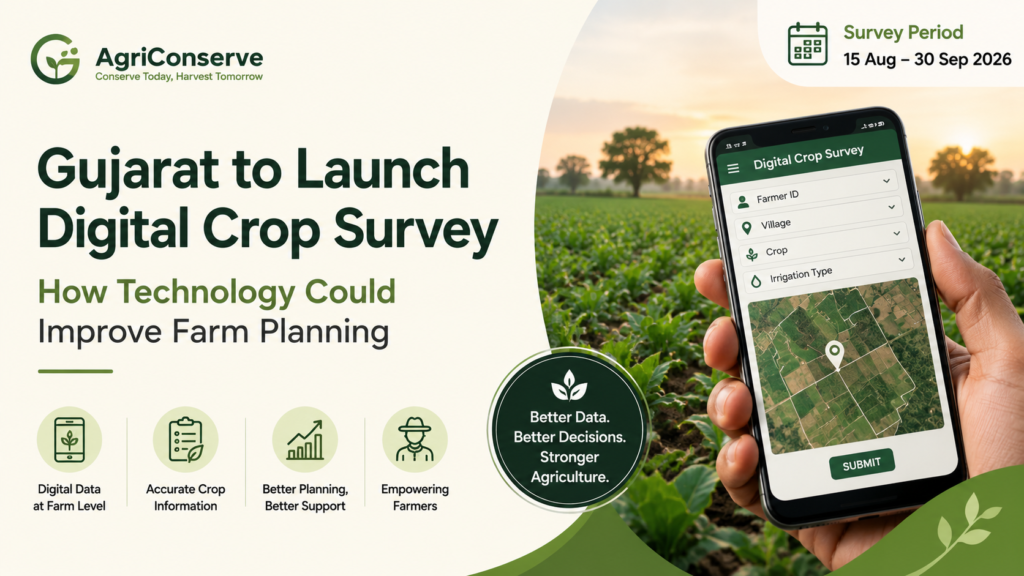

Agriculture is becoming increasingly data-driven, and Gujarat is taking another step in that direction. The state will conduct a digital crop survey from August 15 to September 30, 2026, using digital tools to collect more accurate information about crops and agricultural land.
What Is a Digital Crop Survey?
A digital crop survey records information about crops actually grown on individual agricultural plots. Gujarat’s Digital Crop Survey system uses field-level information to build a clearer picture of what crops are being cultivated and what irrigation methods farmers are using.
Instead of relying only on conventional reporting, digital surveys can provide more detailed and location-specific agricultural data.
Why Accurate Crop Data Matters
Knowing what farmers are growing—and where—is important for agricultural planning.
Reliable crop data can help authorities improve:
- Crop production estimates
- Procurement planning
- Input supply
- Irrigation planning
- Agricultural policy
- Disaster response
- Government support programmes
The Union government has reported that Digital Crop Surveys are already providing plot-level visibility of crops and supporting evidence-based planning for procurement, input supply and logistics.
Technology Meets the Farm
The Gujarat system builds on India’s broader AgriStack initiative. Digital agricultural records can connect information about farmers, land and crops, creating a more integrated foundation for delivering agricultural services.
The government has also reported that Farmer IDs and digital crop surveys are being used in different states to improve access to schemes, disaster relief, crop verification and procurement.
This represents an important shift: agricultural decisions can increasingly rely on real-time and location-specific information rather than delayed estimates.
What Could It Mean for Farmers?
Better agricultural data does not automatically improve farm incomes, but it can help governments and institutions respond more accurately to farmers’ needs.
For example, better crop information could support more targeted responses when a region faces crop damage, changing cropping patterns, or unusual weather conditions.
It can also improve transparency by creating a more reliable record of what is actually being cultivated.
The Bigger Picture
Digital agriculture is moving beyond tractors, drones and sensors. Data itself is becoming an important agricultural resource.
As more states adopt digital crop surveys, Farmer IDs and other digital agriculture systems, the next challenge will be ensuring that the information collected is accurate, secure and actually useful to farmers.
The goal should not simply be to digitize agriculture. It should be to use better information to make agricultural planning, farmer support and resource allocation more effective.