
India is moving steadily toward smarter and more sustainable agriculture. A recent workshop organized by the Council of Scientific and Industrial Research highlighted several innovative farming technologies designed to improve soil health, boost crop productivity, and help farmers make better decisions using real time data.
The two day event focused on practical solutions that can support farmers across different regions of India. From artificial intelligence based crop monitoring to low cost soil testing tools, the technologies presented at the workshop aim to make farming more efficient and environmentally sustainable.
Workshop Focused on Data Driven Farming
The workshop took place on March 5 and 6, 2026 at the Regional Agricultural Research Station of Kerala Agricultural University located in Kumarakom.
Titled Farm Data to Decisions, the event was conducted under the Region Specific Smart Agriculture (RSSA) mission. This initiative focuses on creating advanced tools and technologies that address local agricultural challenges and improve farming outcomes.
Scientists from the Indian Council of Agricultural Research, researchers from universities, and farmers from Kerala, Tamil Nadu, and Karnataka participated in the workshop.
The event included interactive sessions where farmers discussed real field problems directly with agricultural experts. On the second day, students also had the opportunity to interact with scientists and learn about modern farming technologies.
Innovative Technologies Demonstrated at the Event
Several advanced farming tools were demonstrated during the workshop. These technologies focus on precision agriculture, which allows farmers to apply resources only where they are needed.
Variable Rate Fertilizer Application
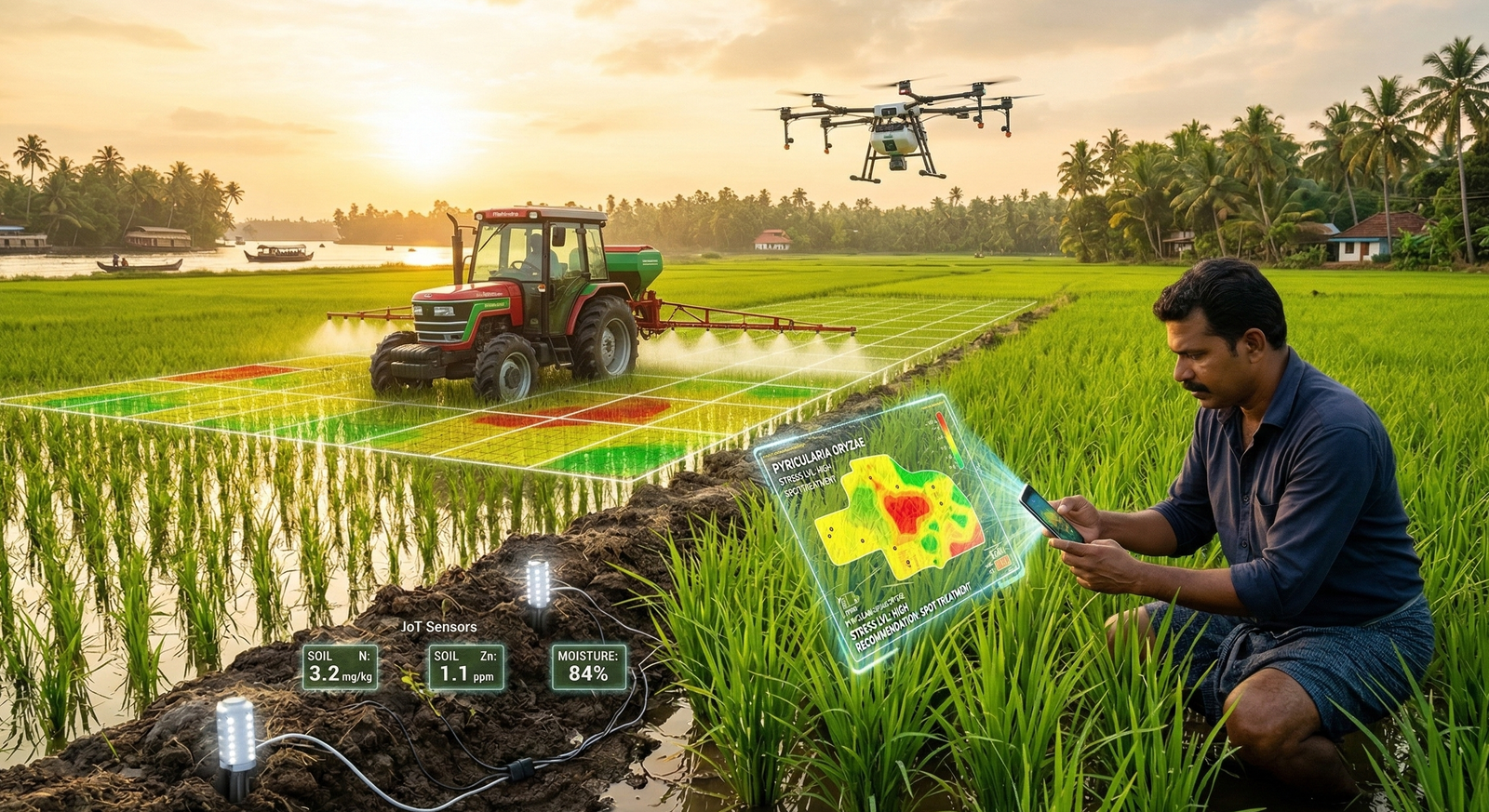
One of the highlights of the event was the demonstration of variable rate fertilizer applicators that can be attached to tractors and drones. These tools can apply fertilizers precisely to specific crop zones as small as 3.5 square meters.
This targeted approach reduces unnecessary fertilizer use, lowers input costs, and improves soil health compared to traditional uniform application methods.
AI Based Paddy Disease Detection
Researchers also introduced an artificial intelligence powered mobile application that helps farmers detect diseases in paddy crops.
Farmers can simply upload photos of crops taken in the field. The app analyzes the image, identifies possible diseases, and generates stress maps. These maps help farmers apply pesticides only in affected areas instead of spraying the entire field.
IoT Based Field Monitoring
Another important innovation showcased at the workshop was an Internet of Things based monitoring system. Sensors placed in farmer fields across Kerala, Tamil Nadu, and Karnataka collect microclimate data in real time.
This information helps predict weather related risks and allows farmers to prepare for possible crop damage caused by changing climatic conditions.
Low Cost Optical Soil Testing Probes
Scientists also presented low cost optical soil probes developed in India. These devices can instantly measure important nutrients in soil, including nitrogen and zinc.
Unlike many traditional testing tools, these probes do not require refills and can last for more than ten years. This makes them a practical and affordable solution for farmers who want quick and reliable soil analysis.
Insights from Agricultural Leaders
During the workshop, several leaders in agricultural research emphasized the importance of technology driven farming.
G. K. Patra, Director of CSIR Fourth Paradigm Institute, explained that the RSSA mission integrates technologies such as artificial intelligence, IoT, remote sensing, and precision farming tools to support data driven agriculture.
N. Kalaiselvi, Director General of the Council of Scientific and Industrial Research, highlighted the need to ensure that such innovations remain accessible to small and marginal farmers. According to her, sustainable technologies can play a key role in strengthening India’s agricultural sector.
B. Ashok, Vice Chancellor of Kerala Agricultural University, also stressed the importance of collaboration between research institutions and government agencies. Such partnerships can accelerate the adoption of modern farming tools and empower farmers with practical solutions.
A Step Toward Sustainable and Precision Agriculture
The technologies presented at the workshop demonstrate how data and digital tools can transform agriculture. By using smart sensors, AI based analysis, and precision equipment, farmers can reduce costs, improve crop health, and increase productivity.
These innovations also support India’s broader goal of promoting precision agriculture and building a climate resilient farming system. With access to accurate field data and modern technology, farmers can respond more effectively to changing environmental conditions and market demands.
As initiatives like the RSSA mission continue to grow, smart farming solutions are expected to play a vital role in shaping the future of agriculture in India.
