

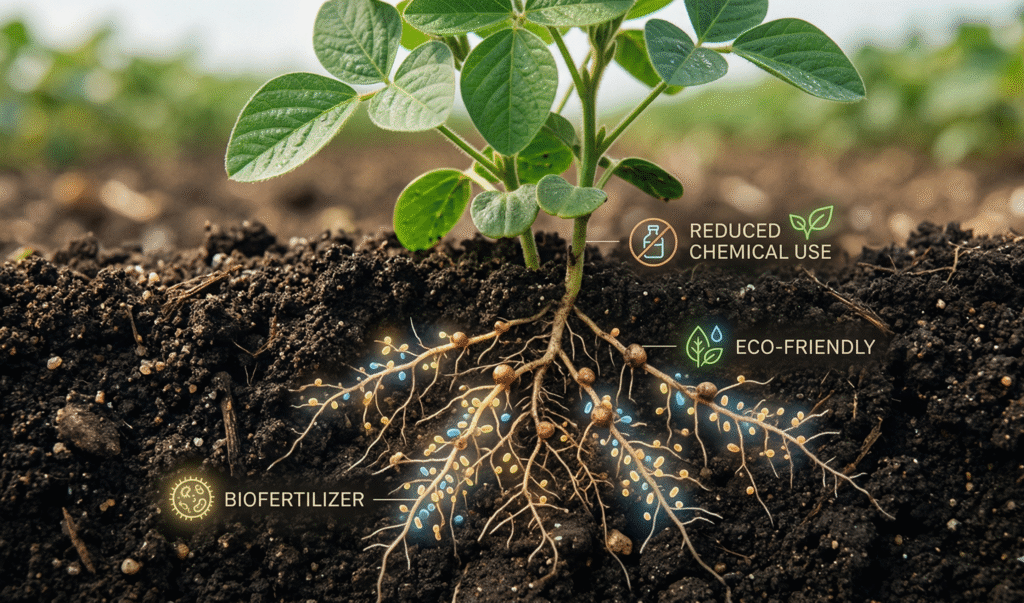
For decades, modern agriculture has depended heavily on synthetic nitrogen fertilizers to boost crop production. While these fertilizers have helped feed a growing global population, they come with serious environmental and economic costs. Today, a quieter and more natural alternative is gaining attention. Tiny soil bacteria are helping farmers nourish crops more sustainably while reducing reliance on chemical inputs.
The Hidden Cost of Synthetic Nitrogen Fertilizers
Synthetic nitrogen fertilizers are produced through a highly energy-intensive process that converts atmospheric nitrogen into ammonia. This method consumes a significant portion of global energy and contributes notably to greenhouse gas emissions.
The impact does not stop there. When farmers apply more fertilizer than crops can absorb, the excess nitrogen often runs off into nearby water bodies. This leads to algal blooms, water pollution, and damage to aquatic ecosystems.
In addition, the rising cost of synthetic fertilizers creates financial pressure, especially for small-scale farmers. Supply chain disruptions and fluctuating prices make it harder for growers to plan and maintain consistent yields.
How Nature Has Always Solved This Problem
Long before industrial farming, plants relied on natural systems to access nutrients. Certain soil bacteria have the unique ability to convert nitrogen from the air into a form that plants can use. These bacteria form close relationships with plant roots and act as natural nutrient providers.
Legumes such as soybeans are a well-known example of this partnership. The bacteria living in their root systems effectively function as living fertilizer units, delivering nitrogen directly where it is needed.
The Rise of Biological Fertilizers
Scientists have been studying these beneficial microbes for years. One breakthrough came from Mariangela Hungria, whose research demonstrated that treating soybean seeds with nitrogen-fixing bacteria could significantly reduce the need for synthetic fertilizers.
Her work played a key role in large-scale adoption, particularly in Brazil, where most soybean farms now use microbial solutions as part of their cultivation process.
Turning Science into Practical Farming Solutions
Although the concept is promising, bringing biological fertilizers from research labs to farms has not been simple. These microbes are sensitive to environmental conditions such as heat and humidity, which makes storage and transportation challenging.
Researchers at institutions like Massachusetts Institute of Technology and University of Minnesota are working to improve the stability and effectiveness of these bacteria.
Some innovations include protective coatings that help microbes survive harsh conditions and advanced techniques to enhance their nitrogen-producing ability. The aim is to create products that farmers can use just as easily as traditional fertilizers.
Why Farmers Are Adopting This Approach
The growing interest in biological fertilizers is not driven by environmental concerns alone. Farmers are also seeing clear economic benefits. In regions where these solutions are widely used, growers have reported reduced input costs without compromising crop yields.
This approach also aligns with the increasing demand for sustainable farming practices. Governments and global food companies are encouraging low-carbon agriculture, and microbial fertilizers fit well within these goals.
In some cases, farmers can even earn incentives or meet sustainability certifications by reducing their reliance on chemical fertilizers.
Challenges That Still Need Attention
Despite the progress, biological fertilizers are not a complete replacement for synthetic options in every situation. Their performance can vary depending on soil conditions, climate, and farming methods.
There are also practical challenges such as maintaining product consistency and extending shelf life. For many farmers, the most realistic approach may be a combination of both systems.
This hybrid model uses microbes as the primary source of nitrogen while supplementing with small amounts of synthetic fertilizer when necessary.
What This Means for the Future of Agriculture
Biological fertilizers are not a one-size-fits-all solution, but they represent a major step toward more sustainable farming. By working with natural processes instead of against them, agriculture can become more efficient and environmentally friendly.
As research continues and technology improves, these microbial solutions are expected to become more accessible and widely adopted. This could benefit both large-scale farms and smallholders by reducing costs and environmental impact.
The future of farming may not rely solely on industrial inputs. Instead, it could depend on harnessing the power of nature itself, starting with the microscopic organisms already living in the soil.
