
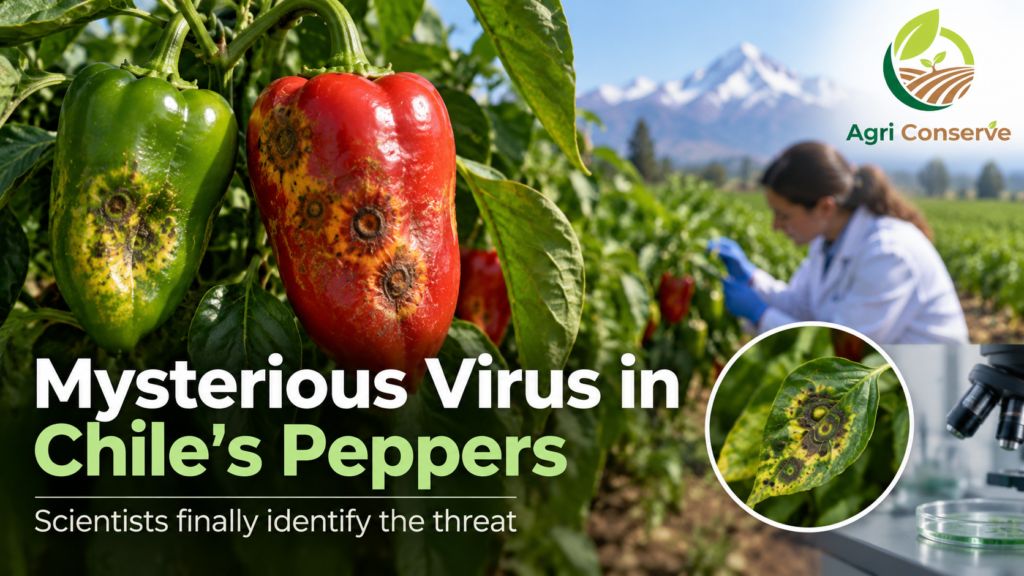

A strange pattern began appearing on peppers and tomatoes in Chile. Some fruits developed unusual rings, dark patches and discoloured surfaces. Others showed signs of tissue damage that made them difficult to sell.
At first, the cause was unclear.
Now, an international team of researchers has identified the culprit: pepper necrotic spot virus, a plant pathogen previously discovered in Peru but not known to occur in neighbouring Chile.
The finding, announced by Washington State University in October 2026, highlights how quickly agricultural diseases can move between regions and why early detection matters for farmers.
The Clues Began at Local Markets
The investigation started when Marlene Rosales, a plant virologist at the Pontifical Catholic University of Chile, noticed unusual symptoms on tomatoes and peppers sold in Santiago.
The fruits displayed circular patches of dying tissue, bronze-coloured discolouration and other visible abnormalities.
Rosales traced the affected produce back to northern Chile, particularly the Arica region near the Peruvian border.
The region is important to Chile’s food supply because its Azapa and Lluta valleys produce tomatoes and peppers during the winter months, when production in central Chile slows down.
When researchers inspected fields in Arica, they found similar symptoms, particularly in pepper crops.
But identifying the responsible pathogen required more than visual inspection.
DNA’s Cousin Helped Solve the Mystery
The Chilean researchers collaborated with scientists at Washington State University, including plant virologist Hanu Pappu, who has spent decades studying insect-transmitted plant viruses.
The team analysed the pathogen’s genetic material using RNA sequencing and laboratory tests.
Their findings confirmed the presence of pepper necrotic spot virus, establishing that the pathogen had reached Chile.
The virus belongs to a group called orthotospoviruses, which includes serious agricultural pathogens affecting tomatoes, peppers, peanuts and several other crops.
This discovery was particularly important because the symptoms could resemble those caused by other viruses. Identifying the exact pathogen gives agricultural researchers a clearer starting point for monitoring and disease management.
Tiny Insects Can Carry a Serious Threat
One of the most concerning findings involves how the virus spreads.
Researchers confirmed that thrips, tiny insects commonly found around agricultural crops, can transmit the pathogen.
Thrips feed on plants and can carry certain viruses between infected and healthy crops.
Their small size makes them easy to overlook, but their ability to move between plants can make disease management difficult.
The study does not establish precisely how the virus first entered Chile. Infected planting material and insect movement are possible pathways for plant-virus spread, but confirming the route requires further investigation.
For growers, the discovery reinforces the importance of monitoring both crop symptoms and insect populations.
Why Early Detection Matters
Unlike some fungal or bacterial diseases, plant viruses generally cannot be cured once they establish an infection.
Farmers therefore depend heavily on prevention, early diagnosis, vector management and resistant varieties where available.
That makes accurate identification essential.
A farmer who mistakes a viral infection for a fungal problem could spend money on treatments that do not address the cause.
Researchers now want to improve awareness of the virus among agricultural professionals and strengthen the ability of field inspectors to recognise suspicious symptoms.
Better monitoring could help authorities identify affected growing areas and limit further spread.
A Warning That Goes Beyond Chile
The discovery offers a useful lesson for agricultural regions worldwide.
Plant diseases do not follow national boundaries, and modern agricultural supply chains connect production areas over considerable distances.
A pathogen known in one country may eventually appear in another, particularly when suitable host plants and insect carriers are present.
International scientific cooperation helped identify this virus in Chile. That same cooperation will remain important as researchers investigate its distribution and potential impact.
For farmers, the lesson is straightforward.
Unusual spots, discolouration or changes in crop appearance should not be dismissed without investigation.
Sometimes, protecting an entire growing region begins with recognising that something unusual is happening to a single plant.