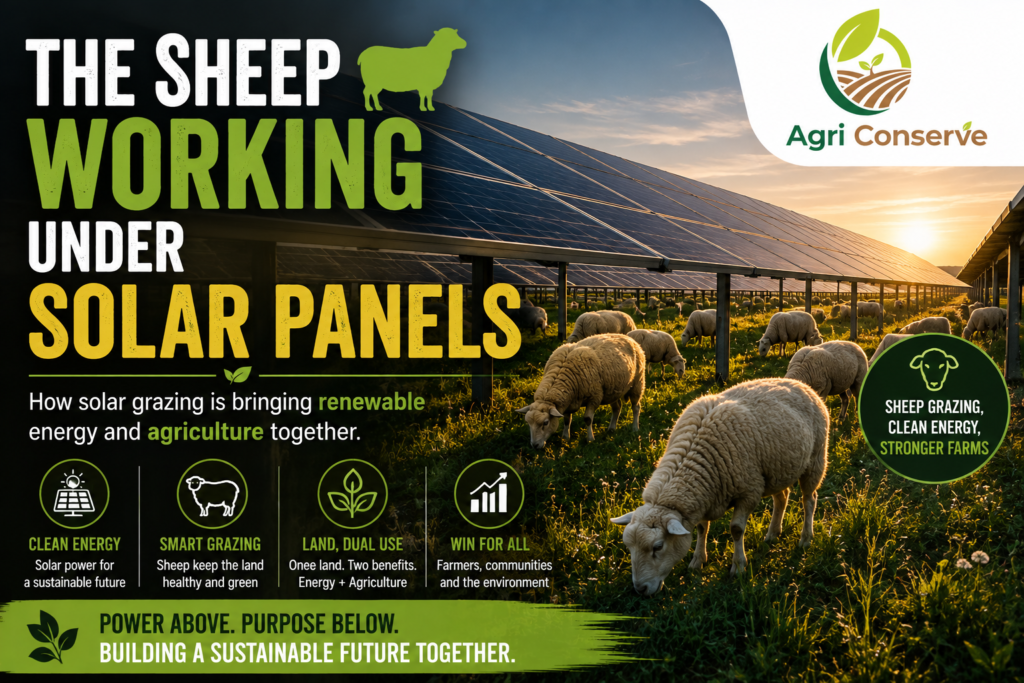

Solar farms usually bring to mind rows of panels stretching across open land. In parts of Texas, there is another sight beneath them: thousands of sheep.
The practice is known as solar grazing, or agrivoltaic grazing. Instead of relying entirely on tractors and mowing equipment to control vegetation around solar panels, farmers bring sheep onto the site to graze the grass.
And the idea is growing quickly.
The American Solar Grazing Association’s 2024 census recorded more than 129,000 acres of solar sites being grazed across the United States, with Texas accounting for more than 68,000 acres.
Why Sheep?
Solar panels need relatively clear ground around them. If vegetation grows too tall, it can interfere with panels and create additional fire-management concerns.
Sheep happen to be well suited to the job.
They can move between the rows, graze vegetation without climbing onto the panels, and require far less machinery than conventional mowing. Goats can be problematic because they may climb structures and chew equipment, while cattle are generally too large for many standard solar installations.
For solar operators, that can mean another way to manage vegetation. For livestock farmers, it creates access to grazing land and another potential source of income.
When Energy and Agriculture Share the Same Land
That is what makes solar grazing particularly interesting.
Instead of treating renewable-energy development and agriculture as competing uses of land, agrivoltaics attempts to make them work together.
The panels generate electricity above the ground while sheep produce agricultural value underneath them.
American Farmland Trust has highlighted solar grazing as an opportunity for farmers and ranchers to access land, generate additional income and continue agricultural activity alongside expanding solar development.
But it isn’t as simple as putting sheep inside a solar farm.
Farmers still need to manage water, fencing, animal health, predators and forage. Solar operators also need vegetation maintained to appropriate heights. Research from Texas A&M notes that grazing can help with vegetation management, while also pointing out that animal selection and maintaining suitable vegetation can be challenging.
A Different Future for Agricultural Land?
The growth of solar power is changing rural landscapes around the world. The question is increasingly becoming how those landscapes can continue producing something useful beyond electricity.
Solar grazing offers one possible answer.
It doesn’t make every solar project suitable for livestock, and it won’t replace conventional farming. But where conditions are right, one piece of land can produce both clean energy and agricultural value.
Perhaps that is the most interesting part of the story.
The future farm may not always look like a traditional field. Sometimes, it could be a flock of sheep moving quietly beneath hundreds of solar panels.