
What if the next frontier of farming isn’t another field—but a mine?
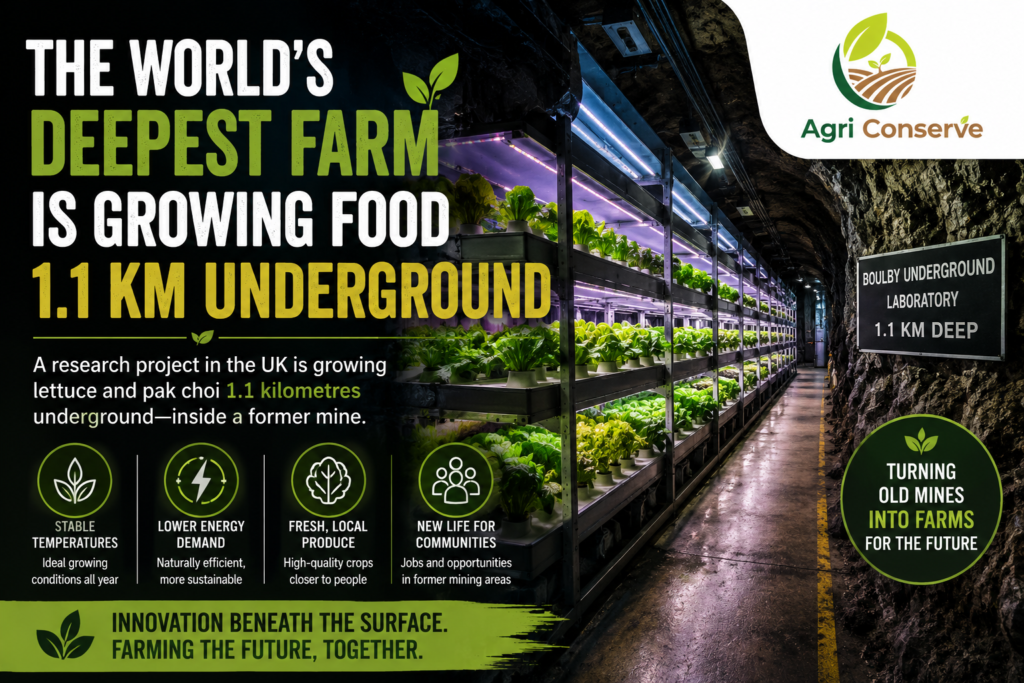
Researchers in North Yorkshire, England, are growing crops 1.1 kilometres underground inside the Boulby Underground Laboratory. The project, led by the University of Sheffield and Farm Urban, is testing whether old mine infrastructure could be repurposed to grow food in controlled conditions.
The idea sounds futuristic, but the reason behind it is surprisingly practical.
Traditional vertical farms can require large amounts of energy for heating, cooling and maintaining the right growing environment. Deep underground, temperatures are naturally more stable. Researchers believe this could reduce some of the energy demands associated with controlled-environment farming.
From Mine Shafts to Salad
The Boulby project is currently testing crops including lettuce and pak choi. Researchers are monitoring how well plants grow in the unusual environment while collecting real-world information about yields, energy use and operating costs.
The goal isn’t to replace conventional farming.
Instead, researchers want to understand whether underground spaces could provide another option for producing fresh food—particularly in places where land is limited or weather conditions are becoming harder to predict.
That could make abandoned mines surprisingly valuable.
Across the UK, thousands of former mine sites exist, and researchers believe some could potentially be transformed into food-production hubs if the economics and safety requirements work out. Such projects could also create new employment opportunities in communities that have historically depended on mining.
Could Underground Farming Become Mainstream?
Not yet.
The Boulby experiment is still a research project, and there are plenty of questions to answer. Energy costs, food safety, crop performance, logistics and commercial viability will determine whether underground farming can move beyond experimentation. Researchers themselves stress that they need practical evidence before deciding whether the model can work commercially.
But that’s what makes the project interesting.
Agriculture has traditionally depended on sunlight, soil, rainfall and open land. Controlled-environment farming is beginning to challenge some of those assumptions.
The future of food production may not be about choosing between farms above ground and farms underground. It may be about finding the right place and technology for each crop.
And somewhere beneath the North Yorkshire countryside, researchers are already testing what that future could look like.