
Developing a new crop variety has traditionally been a long process. Breeders cross plants, grow them in different conditions, test their performance and repeat the process over several generations.
But a new international research project is trying to speed that process up with artificial intelligence.
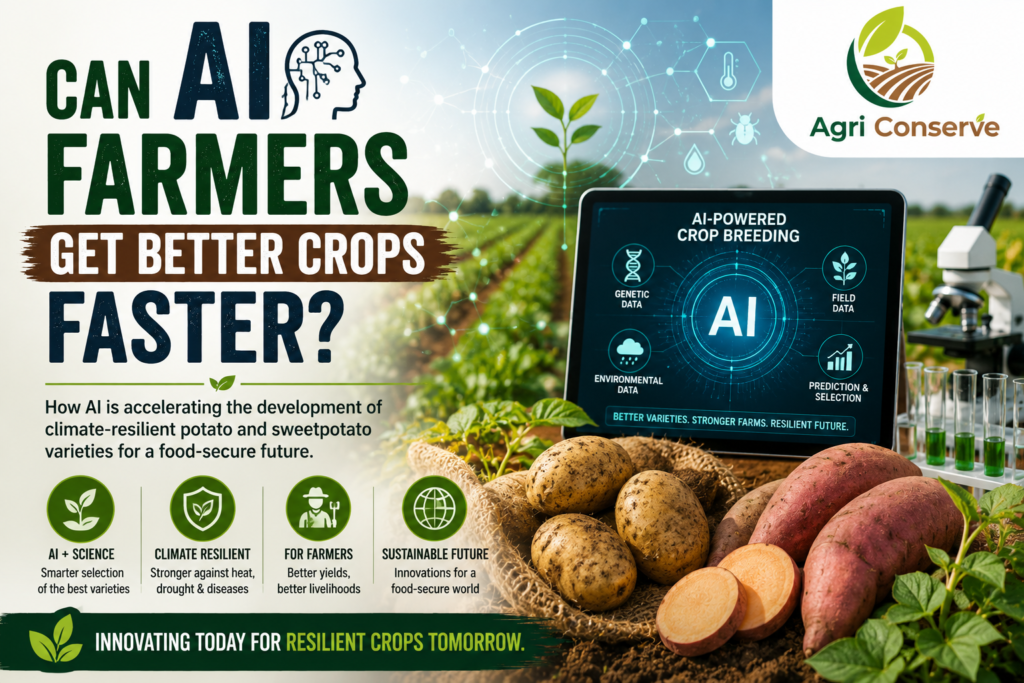
The International Potato Center (CIP), the James Hutton Institute in the UK, Kenya Agricultural and Livestock Research Organization (KALRO), and Egerton University have launched GAIN-RT, a project that will use AI to accelerate the development of climate-resilient potato and sweetpotato varieties.
The idea is fairly simple: instead of relying only on years of conventional testing, researchers can use AI to analyse huge amounts of genetic, environmental and field data and identify promising varieties earlier.
From the Laboratory to the Farm
The researchers want AI to help predict which potato varieties are most likely to perform well under difficult conditions, including climate stress, pests and diseases.
That could be particularly valuable for smallholder farmers, who often have fewer options when a crop fails. A variety that can maintain reasonable yields under heat, drought or disease pressure could make a significant difference to farm resilience.
But the project is not about replacing agricultural scientists with machines.
Field testing remains essential. The partnership brings together AI specialists, crop breeders and researchers with local knowledge so that promising results can actually be tested under real farming conditions.
Why Potato Matters
Potato is one of the world’s most important food crops, and it is grown across a wide range of climates. Sweetpotato is also an important food and nutrition crop, particularly in parts of Africa.
If researchers can shorten the time needed to develop stronger varieties, farmers could gain access to improved planting material sooner—something that becomes increasingly important as climate conditions and pest pressures change.
The project also plans to train scientists, including women and early-career researchers, in AI-driven crop breeding. That means the goal is not simply to develop new varieties, but also to build local scientific capacity.
The Bigger Change in Agriculture
AI is beginning to move deeper into agriculture. It is no longer limited to drones, farm monitoring or automated machinery.
It is now entering one of the most fundamental parts of farming: deciding which crops should be grown in the first place.
If projects like GAIN-RT succeed, the future of crop breeding could become considerably faster and more data-driven.
For farmers, however, the real measure of success will be simple: Will better varieties reach their fields sooner, and will those varieties actually perform when conditions become difficult?
That is where agricultural innovation ultimately has to prove itself—not in the algorithm, but in the field.