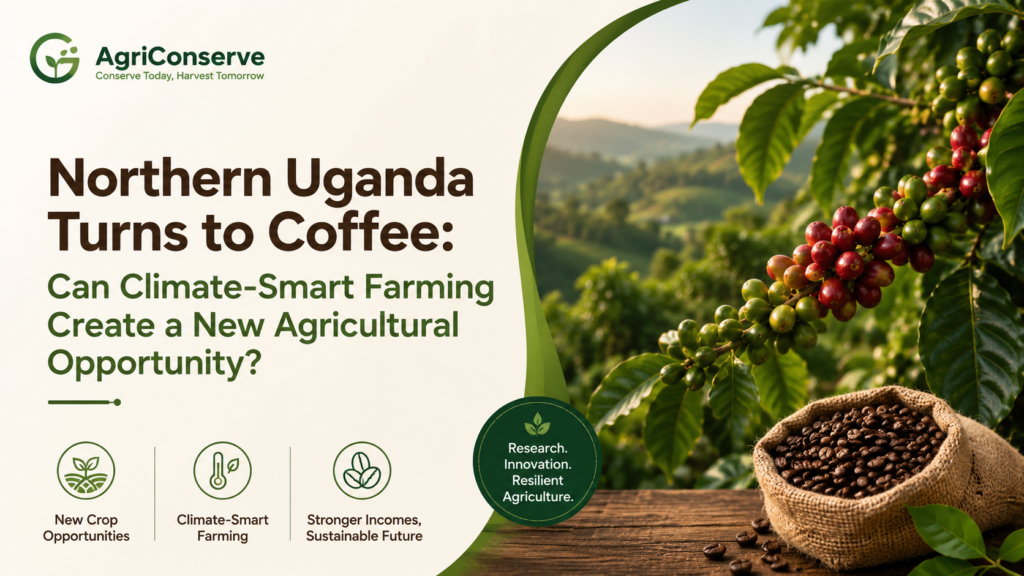

Northern Uganda has traditionally been associated with crops such as cotton, sunflower, soybean, simsim and tobacco. But researchers are now exploring whether coffee could become an important new commercial crop for the region.
At the Ngetta Zonal Agricultural Research and Development Institute (Ngetta ZARDI) in Lira, researchers are studying coffee varieties and demonstrating their potential under Northern Uganda’s conditions. The initiative is particularly focused on combining improved varieties with climate-smart farming practices.
Why Coffee?
Coffee is already an important agricultural commodity for Uganda, but production has historically been concentrated in particular regions.
Expanding coffee cultivation into suitable areas of Northern Uganda could give farmers another commercial crop and potentially diversify agricultural incomes. Uganda’s Coffee Development Authority has also previously highlighted efforts to promote coffee production in non-traditional coffee-growing areas such as the Lango sub-region.
The Role of Climate-Smart Farming
Simply introducing a new crop does not guarantee success. Farmers need varieties and production systems that can cope with local weather conditions, soil characteristics, water availability and changing climate patterns.
Researchers are therefore looking at improved coffee varieties and climate-smart approaches that could make production more resilient. This is particularly important as farmers increasingly face unpredictable rainfall and periods of heat and drought.
Uganda has recently experienced prolonged dry conditions in several regions, with farmers reporting crop losses and concerns about the next planting season.
What This Could Mean for Farmers
If coffee performs well in Northern Uganda, the crop could provide farmers with:
- A potential additional source of farm income
- Greater crop diversification
- Access to commercial and export markets
- Opportunities for value addition and processing
- A pathway toward more resilient agricultural systems
However, successful expansion will depend on appropriate varieties, farmer training, good agronomic practices, post-harvest handling and reliable market access.
Research Before Expansion
The development of new agricultural opportunities should be supported by research rather than simply market demand.
Demonstration farms and agricultural research institutes can help determine which varieties perform best, how they respond to local conditions and which management practices farmers should adopt.
This approach is important because agricultural innovation works best when scientific research, farmer knowledge and market opportunities come together.
The Bigger Picture
Northern Uganda’s coffee experiment highlights an important lesson for agriculture: crop diversification can be more than simply planting a different crop.
When supported by crop research, climate-smart practices, farmer education and appropriate market systems, diversification can become a tool for improving agricultural resilience.
As climate conditions continue to change, regions around the world may increasingly need to reconsider which crops are best suited to their future growing conditions.