
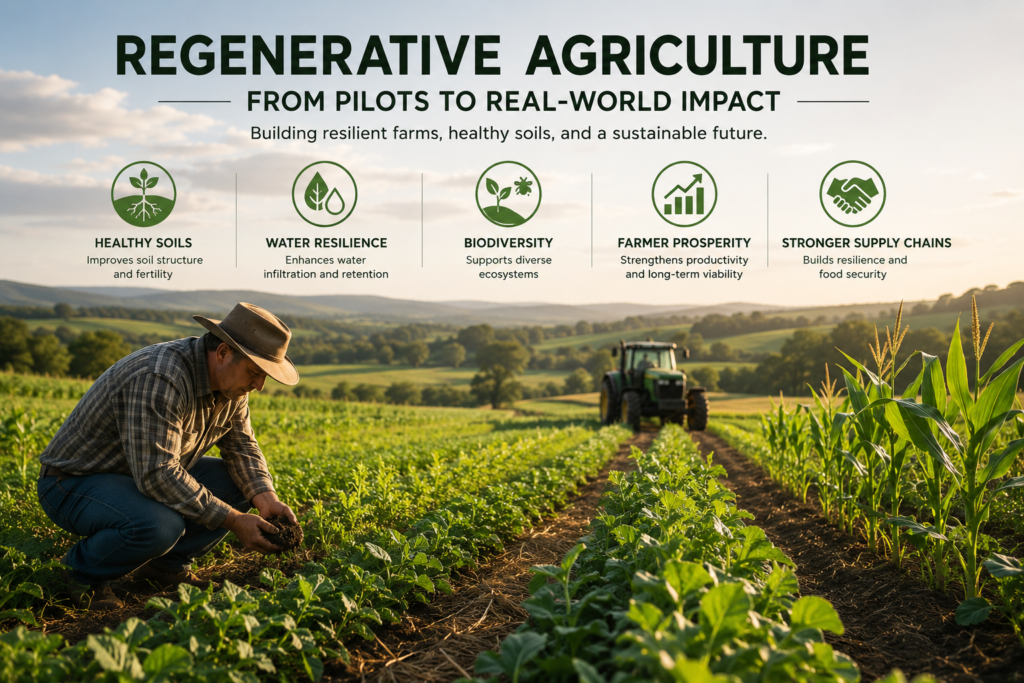
For years, regenerative agriculture has been discussed as one of the most promising approaches for building a more resilient and environmentally responsible food system. Much of that conversation focused on experiments, small scale projects, and early adoption programs. Today, the conversation is changing.
Across the agriculture industry, attention is shifting from testing regenerative farming practices to finding ways to implement them on a broader scale. Companies, investors, and agricultural networks are increasingly focused on turning concepts into long term systems that can work across real farming conditions.
Why Regenerative Agriculture Is Entering a New Stage
Regenerative agriculture has gained momentum through increased investment, corporate commitments, and growing awareness of environmental challenges affecting food production. Soil degradation, biodiversity loss, and pressure on natural resources have encouraged stakeholders to explore farming methods that support both productivity and ecological health.
However, interest alone is no longer enough.
The next stage requires building practical pathways that help farmers adopt regenerative methods without creating unnecessary financial or operational pressure. Scaling these practices means addressing how they function across different crops, climates, and local agricultural realities.
The Shift From Demonstration Projects to Large Scale Implementation
Many agricultural and food sector initiatives are now expanding beyond controlled trials and limited programs. The objective is becoming clearer: integrate regenerative principles into everyday farming operations and supply chains.
This transition reflects a broader understanding that sustainable agriculture cannot rely only on isolated success stories. Long term impact depends on whether these approaches can deliver consistent outcomes across regions and production systems.
As a result, organizations are investing more effort into creating support systems that make adoption easier and more measurable.
The Challenges That Still Need Solutions
Despite growing momentum, several barriers continue to influence adoption rates.
Transition costs remain one of the most discussed concerns among farmers. Changes in farming practices may require new processes, additional learning, and time before measurable results appear.
There is also ongoing debate around how regenerative agriculture should be defined and evaluated. Different organizations often use different criteria, creating confusion around expectations and outcomes.
Without greater alignment, comparing results and scaling successful practices becomes more difficult.
Building Common Standards Without Removing Flexibility
Industry leaders and agricultural groups are increasingly exploring shared frameworks that focus on measurable outcomes instead of rigid rules.
This approach recognizes that farming conditions vary widely between locations. What works effectively in one region may not deliver the same results elsewhere.
Rather than applying a single model everywhere, newer approaches encourage flexibility while maintaining clear goals related to soil health, biodiversity, water management, and productivity.
Farmers remain central to this process because local knowledge often plays a major role in long term success.
Why Measurement and Trust Will Shape the Future
As regenerative agriculture expands, investors and supply chain partners are placing greater emphasis on transparent reporting and evidence based outcomes.
Reliable measurement systems can help demonstrate both environmental improvements and economic performance. Clear reporting may also increase confidence among stakeholders and unlock future investment opportunities.
The future of regenerative agriculture may depend less on ambition alone and more on the ability to show practical, repeatable results.
Final Thoughts
Regenerative agriculture is moving into a more mature phase of development. The focus is no longer limited to testing ideas but increasingly centered on implementation at scale.
Success will likely depend on creating systems that support farmers, adapt to local conditions, and deliver measurable outcomes over time. If that balance can be achieved, regenerative agriculture could become an important part of building a more resilient agricultural future.
